
In his seminal book Development as Freedom, Amartya Sen (2000) distinguishes two definitions of women’s agency and equality: “intrinsic” (for the good of a woman’s position itself) and “instrumental” (for the benefit of the economy and society as a whole). Studying the instrumental as well as the intrinsic aspects of women’s economic activities in the past is highly important. Recent work on the economic history of Europe has emphasized women’s earning capacity and their economic remunerations as significant indicators for household welfare as well as for women’s freedom (e.g van Nederveen Meerkerk 2010; Ågren, 2017; Drelichman and Agudo, 2020; Gary and Olsson, 2020; de Pleijt and van Zanden, 2021). While earlier research on household living standards largely relied on men’s wages, focusing on urban unskilled wage laborers, and ignoring household life cycles (e.g. Allen, 2009a), recent studies have criticized such one-sided approaches by including the incomes of women and children and adding a life-cycle dimension (Humphries and Weisdorf, 2015; Boter, 2020; Horrell, Humphries, and Weisdorf, 2022). In this article, we want to extend this approach to the Chinese case, most notably the economically advanced region of the Yangtze Delta. Some excellent studies notwithstanding (e.g. Li, 2009; Kung and Lee, 2010), the scholarship on Chinese women as economic contributors as well as women’s agency in its own right, is comparatively underdeveloped. Especially the analysis of long-run developments, bridging preindustrial and industrialized societies, deserves further attention.1
In light of the instrumental value of women’s work, several scholars on European history have argued that its contributions to the household economy may have been vital for the transition from a preindustrial to an industrial society (e.g. De Vries, 1994; Allen 2015). Others are more critical of this optimistic story, suggesting that women’s income was crucial for the survival of households, and thus induced by poverty instead of economic efflorescence (e.g. van Nederveen Meerkerk, 2008; Humphries and Schneider, 2019). Whether to survive or thrive, women’s contributions mattered greatly for the household economy of industrializing European societies.
This brings us to the intrinsic opportunities that industrialization created for women, which varied according to their life cycle. For Britain, Humphries and Weisdorf (2015, 429) conclude that there was a clear distinction between, on the one hand, married women and children, whose labor market options declined with the waning of handspun textiles. On the other hand, for young adult unmarried women, they note rising wages and job opportunities. De Pleijt and van Zanden (2021, 634), who extend Humphries’ and Weisdorf’s long-term analysis of Britain to compare wage developments in different parts of Europe, also establish a clear relationship between marital status and the gender wage ratio – a proxy for women’s economic status. In Southern Europe, women received lower wages than in Northwestern Europe, relating to different patterns of family formation: later marriage and smaller families in the latter. They conclude from this that as women earned more, they had a greater say in whom they married and at which point in their lives.
How can we translate these insights to Chinese economic history? At present, scholars are divided on the instrumental effects of women’s work on economic development in China. Allen (2009b) has argued that, as opposed to what happened in Europe, the real earnings of female textile workers in the Yangtze Delta declined since the 1850s, leading to a stark household immiseration already before China industrialized. His argument was largely based on Li (2009) and aimed to contribute to the comparison of European-Chinese household living standards. In contrast, earlier regional studies found that in the period in which China opened to global trade and started to industrialize, women’s income from both rural and (proto)industrial economic activities were sizable: ranging from 14 to 20 per cent of total household income (Buck, 1937; Johnson, et al., 1987; Mann, 1992).
Apart from the importance for the Chinese (household) economy it is also highly relevant to assess women’s longer-term economic involvement in the context of one of the most prominent debates in global economic history: the Great Divergence between Asia (China) and Europe (Britain). Scholars such as Huang (1990), adhering to an “involution” view, insist that Yangtze farming households hovered around subsistence level for centuries, not least because of the small income of female household members. However, this argument was refuted by Pomeranz (2000, 320) and Li (2009, 388), who contended that female earnings from textile production were not below subsistence, at least in eighteenth-century China.
Regarding the intrinsic value of Chinese women’s economic contributions, historians have debated their status in the light of the male breadwinner model. Many scholars argue that in the agrarian society China was, men for centuries formed the primary agricultural labor force that predominantly provided for the household income. In addition, Confucian ethics and other social controls, symbolized by the old Chinese saying 男主外,女主内 (“men work outside and women manage domestic affairs”), supposedly confined Chinese women to domestic tasks and undermined their economic importance (Buck, 1937; Goldstone, 1996). In contrast, scholars like Benjamin and Brandt (1995) and Kung and Lee (2010) have found for different local communities that women’s contributions to total household income were similar to men’s, thus undermining the idea that China in practice was a male breadwinner society. Also, for industrializing areas, Mann (1992) found that foreign trade and industrialization enhanced women’s work opportunities, premised on their class, locality, household consumption and life cycle stage. Like in the European case, Chinese women’s contributions did not always enhance their position. For example, Bell (1994) argues that although women’s income was vital for household economic viability, their social status was likely to be depressed by local culture and norms. But overall, we expect that enhanced earning capacity worked in favor of Chinese women’s agency.
In order to contribute to these international as well as national discussions on the instrumental and intrinsic value of women’s economic contributions, this article has three objectives: first, it compiles new empirical wage data drawn from the archives and from secondary literature. Thus, it attempts to make a long-term reconstruction of women’s real incomes, that has so far been lacking due to fragmented case studies. We delineate trends in women’s income and wage as well as their household economic contributions in the Yangtze Delta over the period 1756-1930. Second, the article analyzes the instrumental value of women’s wages, by looking at three sources of textile income simultaneously, rather than separately, enabling a more accurate assessment of the economic effects of women’s wages on the household and the wider economy. Third, we assess the effects on women’s position and status through a life-cycle perspective, using age and marital status as explanatory factors. While we by no means suggest that our data and analysis are exhaustive, our approach will hopefully spur further debates on the role of women in China’s industrializing economy and society in the longer run.
We focus on female cotton textile laborers in the Yangtze Delta for several reasons. First, women had been predominant in cotton textile manufacturing in the household handicraft industry for centuries, and were – with a few exceptions – also prevalent in modern textile mills. Analyzing the textile sector not only enables long-term reconstructions of female economic remuneration, but also facilitates comparison of women’s earning capacity from different modes of production. Second, the typical household labor division of “men plough and women weave” had become prevalent in the weaving center of Yangtze Delta since the mid-Qing period (Li, 1996, 106).2 This means that even if women are not explicitly mentioned in the sources, their economic contributions can be assumed, because they generated the overwhelming share of income from cotton textile production.3 Third, cotton textile production experienced several major changes in the highly commercialized and industrialized Yangtze Delta from the late nineteenth century to the 1930s, which provides opportunities to comprehend and compare different mechanisms driving temporal changes. Last but not least, the prominent economic role of the Yangtze Delta in Chinese history makes this region a widely discussed case study for international comparison on various issues of economic history (Pomeranz, 2000; Allen et al., 2011). By gauging the long-term evolution of textile women’s income in the Yangtze Delta, we offer new Chinese evidence to the global comparison.
This article proceeds as follows. Section 2 starts with a brief description of the household economy and textile production in the Yangtze Delta. It describes the historical development of household labor allocation, the technology of textile production and productivity changes. This forms important context for measuring the different modes of textile production women engaged in, their daily output and corresponding income. Section 3 first explains the data sources and then provides long-term estimates of women’s earnings between 1750 and 1930. Section 4 relates women’s economic contributions to household subsistence. Section 5 concludes and puts our findings in a wider international perspective.
In imperial China, the Yangtze Delta geographically included eight prefectures: Suzhou, Songjiang, Changzhou, Zhenjiang, Yingtian (Jiangning), Hangzhou, Jiaxing and Huzhou (Li, 1998, 3, see Map 1). In the early seventeenth century, ecological crises such as floods, droughts and plant diseases (Li, 1998, 58), and difficulties surrounding irrigation forced Yangtze farming households to cultivate cotton instead of rice, particularly in the higher terrains of Songjiang prefecture and Taicang department. Cotton production increasingly prevailed in the Yangtze area, providing a major source of income-supplementing agriculture in the context of high population density and decreasing land resources.4 During the mid-eighteenth and nineteenth centuries, Songjiang had become the major internal export region for cotton cloth: to North China via the Grand Canal, to Jiangxi and Hubei-Hunan and thence to Guangdong and Guangxi in the south. Whereas until 1860 around 45% of all households throughout China engaged in cotton textile production, the proportion of textile households reached 65% in Jiangsu and a notable 90% in Songjiang (Xu, 1992, 211).5
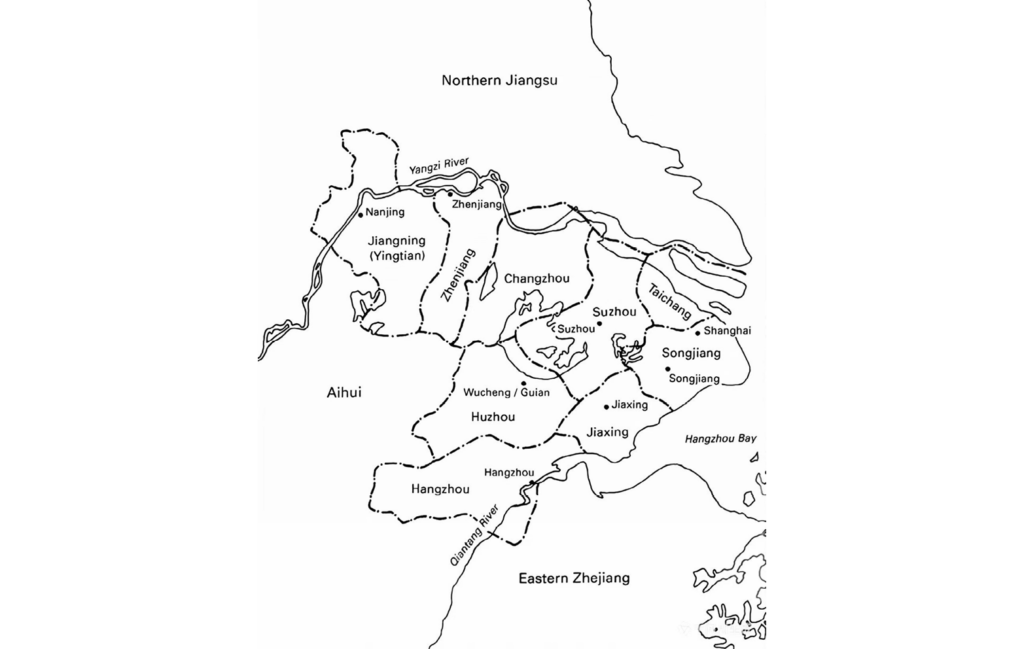
SOURCE: Administrative map of the Yangtze Delta during the Qing dynast y (Li, 1998, xviii).
The commercialization of cotton production, together with the introduction of the double cropping system and the subdivision of farms contributed to a pronounced gendered labor division between agricultural and cotton textile production since the mid-Qing dynasty. According to Bozhong Li (1997, 11), the average size of paddy land per Yangtze farming household had decreased to 10 mu (1.6 acres) since the early-Qing period.6 An adult male laborer could undertake all agricultural tasks on this arable land without the help of female household members.7 This largely excluded women from land farming and diverted their labor to cotton spinning and weaving. Even during agricultural peak season, women were rarely seen in the fields. Instead, households increasingly hired male seasonal farm hands, resolving labor scarcity peaks while women spun and wove at home. A family of five normally deployed one adult woman exclusively for cotton handweaving. The elderly and child female members assisted with hand-spinning. Although girls possessed less physical strength than adult women, these auxiliary workers produced much of the necessary yarn for the female handweaver (Bossen and Gates, 2017).
Since the late nineteenth century, hand-spinning’s competitiveness declined under the pressure of cheap foreign (and later domestic) machine-made yarn. In 1894, the consumption of mechanized yarn for handweaving was only 23.4% of all consumed yarn throughout rural China, but this rapidly rose to 72.3% in 1913 (Xu, 1992, 237). Several customs reports between 1868 and 1890 reflect that hand-spinning became unprofitable: the price of homespun yarn dropped 50% while the price of raw cotton remained the same. In addition, Indian machine-made yarn had a similar price as Chinese raw cotton.8 This displaced hand-spinning in many Chinese provinces, but many former spinners became handweavers. Ultimately, handweaving would also wither away, but its decline was slower (Myers, 1965, 621-622). Until the 1920s, many handweavers used cheaper foreign machine-made yarn to weave native cloth, both reducing input costs and producing more glossy and durable cloth, which enhanced the competitiveness of handweaving (Myers, 1965, 620-621, Yan, 1955, 80). The preference for machine-made yarn induced Chinese capitalists to invest in domestic spinning factories. In the early twentieth century, Chinese cotton spinning mills, with an increasing female labor force, expanded rapidly, while handweaving persisted in many villages.
Household labor division developed in various ways within the Yangtze Delta. In the handweaving center of Nantong南通, weavers were predominantly male, with women as subsidiary labor; in Songjiang 松江and Taicang 太仓areas, many textile men and women searched factory jobs in Shanghai especially in the early twentieth century (Ma and Wright, 2010). For small farm households with little arable land in the Shanghai outskirts, labor allocation also changed: married women were inclined to weave (sometimes next to field work) at home with their husbands working outside, whereas young unmarried girls were the first female group migrating to cotton mills (Xu, 1992; Yu and van Nederveen Meerkerk, 2025).
Technological change also influenced the gender division of family labor, their productivity and the corresponding nominal earnings. In Ming and early Qing China, textile technology had consisted of the spinning wheel and handloom. Most Yangtze textile households had replaced the hanging spindle with the simple spinning wheel during the Ming period.9 The Jiaxing Prefecture Annals recorded that the average daily production of cotton yarn for a female spinner was around four to five liang 两 (between 2.8 and 3.5 pounds).10 In the later Qing period, adult women increasingly used multiple-spindle wheels, roughly doubling their yarn production (Li, 2000, 48). However, historians doubt whether multiple-spindle wheels were widely used in rural Yangtze households. Xu (1992, 46) states that the three-spindle wheel was utilized in some Yangtze areas such as Shanghai上海, Puxi浦西, Baoshan宝山 and Jiading嘉定, but did not become widespread in the whole Yangtze region because of its high requirements of manual strength and spinning skills. Li (2000, 46) concludes that the multiple-spindle wheel was predominantly employed in the most commercialized regions in the Delta.
On the other hand, weaving technology developed only slowly. Shuttle looms were used for handweaving in both the Ming and Qing periods.11 Producing one bolt of native cloth commonly required 18-20 liang (12.6-14 pounds) of cotton yarn, which means that four spinners working on a single spindle wheel satisfied one weaver’s yarn demand (Li, 2000, 48). According to local gazetteers, three types of native cloth prevailed in the region, namely “大布 (large cloth)”,“小布 (small cloth)” and “阔布 (wide cloth)”. One bolt of native cloth used 10-14 count warp and weft yarns, the size ranged between 16-22 feet long and 1-1.2 feet wide.12 Xu (1992, 51, 246, 397-398) summarizes some key developments in household textile productivity.13 First, between the 1660s and 1720s when rural households both spun and wove, they normally required seven days to produce one bolt of cloth altogether. In later periods, working days were reduced to six, four of which were needed for spinning, another for preparation activities such as ginning, fluffing and sizing and one day for weaving. Second, between 1900 and 1910, some Yangtze handweavers introduced the hand-operated loom from Japan and productivity improved by around 50% (Xu, 1992). Almost simultaneously, the iron gear loom was adopted in the Yangtze Delta, which raised productivity by 50% to 100% compared to the hand-operated loom.14 Third, as foreign factory-made yarns poured into Yangtze market, household weavers that abandoned the use of hand-spun yarn for imported machine-made yarn doubled their output. The daily production of native cloth for a female weaver was between 1.5 and 2 bolts, and if the time saved by abandoning hand-spinning was devoted to handweaving, the output of handwoven cloth increased markedly.15 As we will now show, higher handweaving production drove up Yangtze women’s real earnings even in the face of competition from foreign textile products in the early twentieth century.
This section delineates Yangtze women’s textile incomes from the 1750s to the 1930s, comparing their earning capacity in household textile production in the eighteenth and early nineteenth centuries, and then examining the period of foreign competition later in the century. As many Yangtze women started to work in the modern urban cotton mills that emerged in the 1890s, we will also analyze wages in textile factories since then and compare these to women’s earnings from handicraft production. This allows us to gauge the impact of globalization, industrialization and household-level changes on women’s earning capacity.
To calculate women’s daily income from handicraft textile production, we subtract production costs from the market prices of textile products, assuming the productivity levels discussed in the previous section. Other historians have also applied this method to estimate Chinese women’s earning power for particular regions and periods (Shi, 1987; Xu, 1992; Li, 2009). For the early Qing period (1644-1735), Shi calculated the net profit of one bolt of native cloth by subtracting the price of ginned cotton (1.125 catty) from the price of cloth per bolt.16 She then converted the net income data into volumes of rice based on the price of rice per “shi 石”17 for different periods. According to Xu (1992, 88, 209-210), one bolt of standard native cloth in the Yangtze Delta weighed 1.09 catty.18 The gazetteer of Zidi village 紫堤村志 (1961, 68) recorded that one catty of ginned cotton was made from three catties of raw cotton, and yielded one catty of handmade yarn which in turn could be used to manufacture one catty of native cloth.19 Thus, one bolt or catty of native cloth entailed one catty of ginned cotton or cotton yarn. As previously discussed, in the Qing period, one bolt/catty of native cloth equaled 6 workdays by using the single spindle wheel. Therefore, the daily net income from textile production was the price of one bolt or catty of native cloth minus the price of one catty of ginned cotton divided by 6. When factory yarn was used since the late nineteenth century, the productivity of handweaving improved to 1.5 bolts of native cloth per day. The daily net profit of each textile woman was the price of 1.5 bolts of cloth minus the cost of 1.5 catty of mechanized yarn. In both cases, the labor cost of additional textile household members was not taken into account, as it was usually unpaid (Bossen and Gates, 2017).
Modern social surveys were not conducted on a large scale before the twentieth century, which makes data collection of textile women’s income in imperial China highly challenging. We thus estimated women’s daily income from varying modes of textile production more indirectly, by subtracting average regional input costs from sale prices on the (local) market, divided by the number of days needed to produce cloth. To then arrive at real wages, we used local rice prices to express the wages in the purchasing power of basic food. We collected price data of exported native cloth and imported yarn (for handweaving only), as well as the price of ginned cotton (if women still spun themselves).
The relevant information comes from many scattered sources: first, for women who both spun and wove (traditional mode), Shi (1987) mentions price data of ginned cotton, native cloth per bolt and the price of rice between 1756 and 1849. We revisited the primary sources in her work and extracted the data from local gazetteers like Chongming gazetteer 崇明县志 and Shatouli gazetteer 沙头里志, Fahua village gazetteer 法华乡志, Shanghai county gazetteer 上海县志, memorials to the emperor宫中档乾隆朝奏折, old collections of archives in Qing dynasty like 阅世编, 历年记 and 一斑录·杂述. For traditional production between 1875 and 1920, we took price data of ginned cotton, native cloth and rice from Xu (1992), Xu’s book is a collection of primary sources on the historical development of native cloth production in the Yangtze Delta. These price data primarily come from reports on customs trade, newspapers, local gazetteers and oral archives, to which other historians also often refer. Because Xu’s price data is limited, we extended them with additional sources, such as the customs records compiled by the Second Historical Archives. These provide price data of machine-made yarn and native cloth from 1914 to 1930, as well as the price of ginned cotton and native cloth between 1912 and 1930, which enabled us to construct women’s income for both traditional handspun cloth, and hand-woven cloth from machine-made yarn in this later period. Additionally, wage data of female textile workers in the early twentieth century comes from the Yearbook of Chinese Labor Statistics and social surveys.20 Finally, we use rice price data compiled by Wang (1992) to convert women’s income in terms of rice in different periods.
Obviously, this article benefits from earlier works by Shi (1987), Xu (1992) and Li (2000, 2009) that provide important data about prices and productivities. Nevertheless, apart from bringing together as well as adding new data, we believe we also contribute by offering a new focus. In contrast to the abovementioned studies, we center women’s economic role under different labor relations in textile production over a long time stretch, that includes both pre-industrial and industrial textile production. Moreover, we include the perspectives of the life cycle as well as human capital to explain women’s economic contributions to the household.
Table 1. The net income from handweaving between 1756 to 1849
| Year | Price of raw cotton (wen/catty) | Cost of native cloth per bolt (wen) | Price of native cloth (wen/bolt) | Net income of native cloth per bolt (wen) | Price of rice (wen/shi) | Net income of one bolt native cloth (rice: dou) |
|---|---|---|---|---|---|---|
| 1756-1776 | 33.00 | 85.50 | 250.00-270.00 | 227.00-252.00 | 1440.00 | 1.26-1.40 |
| 1776-1796 | 40.00 | 103.60 | 200.00-400.00 | 96.40-296.40 | 4000.00 | 0.24-0.74 |
| 1800-1820 | 200.00 | 4000.00 | 0.50 | |||
| 1840 | 50.00 | 129.50 | 300.00 | 170.50 | 2000.00 | 0.85 |
| 1849 | 121.60 | 210.00 | 250.002 | 40.00 | 6000.00 | 0.07 |
Source: Shi (1987), 79.
Note 1. The units of prices and volumes in the text were converted into their equivalents according to rates as follows: 1shi石=10 dou斗 (both the measure of volume for grain), 1 shi of milled rice weighed approximately 175–195 pounds, 1liang两 (tael)=1000-1300wen文, 1liang=10 qian钱=100 fen分. “liang (tael) 两”and “wen 文” (Chinese monetary units for uncoined silver money and copper cash in imperial and republic period). Variations in different regions and periods apply. Rawski and Li (1992), p. xv.
Note 2. For the data in 1849, the price of native cloth was for “XIAOBU”, another kind of native cloth with smaller size. 1 bolt of “XIAOBU” was around 1.2 catty.
Following the estimation method previously discussed, we first construct the daily income of hand-spinning and -weaving between 1756 and 1849. Shi (1987) calculated textile women’s real income in volumes of rice in this period (Table 1). We verified Shi’s primary sources and consequently used her income data to detect women’s daily income, by dividing the profits from one bolt of cotton by 6 (working days).
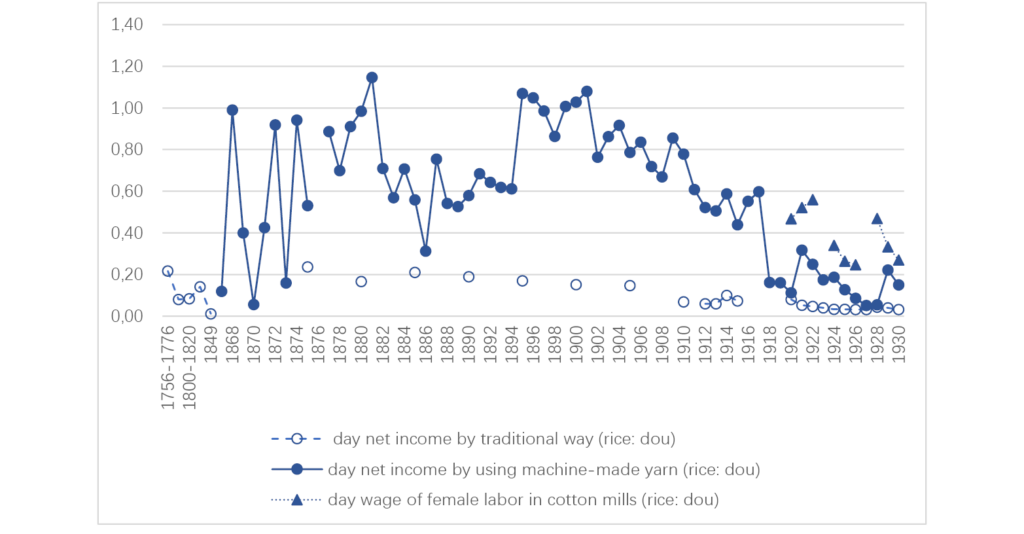
As a next step, we extended Shi’s dataset by adding women’s daily income estimates for hand-spinning and -weaving in the period between 1875 and 1920, based on additional sources mentioned above.21 Xu provides price data of exported native cloth and ginned cotton as well as the price of rice in Shanghai for several points in time between 1867 and 1920, allowing us to use the same method to calculate women’s daily income for this later period. We used price data on raw cotton and cotton products (cotton yarn and cloth) at five-year intervals. This extended series is represented by the dashed line in Figure 1. However, since the late 1870s, imported yarn also increasingly spread among Yangtze handweavers. Therefore, we also calculate these women’s daily earnings by using price data of factory cotton yarn for native cloth production, shown as the solid line in Figure 1.
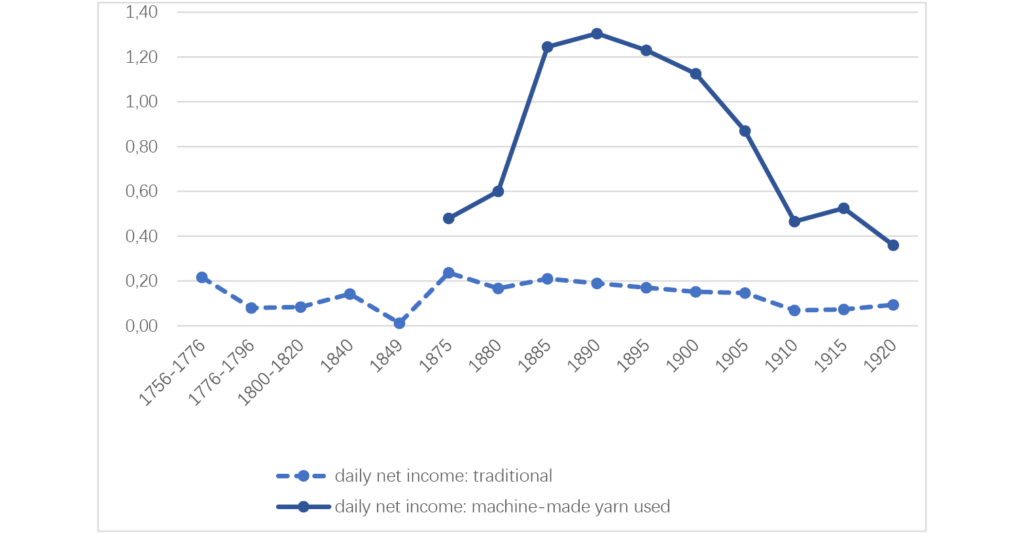
SOURCES: For the day net income by traditional way (women both hand-spinning and handweaving), Shi (1987), 79. Xu (1992), 176, tables 2-15. For the day income by using (Indian) factory yarn, Xu (1992), 177, tables 2-16.
Note 1. Figure 1 includes Shi’s estimations between 1756 and 1849, but for the data in 1849, the price of cloth was for the native cloth with smaller size, this explains why the daily net income in 1849 was much lower than the one in 1840.
Note 2. The traditional way of textile production here means that textile households still spun native yarn for handweaving by themselves, this is the same as follows when we refer to the “traditional way”.
Taken together, women’s daily rice income in “traditional” handicraft production (using hand-spun yarns) shows a downward trend from the mid-eighteenth century to the mid-nineteenth century with a brief rebound between 1840 and 1875. The rising prices of cotton and rice contributed to the declining profitability of textile production in this period, in combination with the presumably negative influence of The Taiping Rebellion (1851-1864) on the economic trend. From 1875 to 1910, women’s average daily income was around 0.15 dou of rice, and again gradually decreased. On the other hand, if handweavers used imported yarn, their daily remuneration was notably higher, reaching a peak in 1890 (1.31 dou of rice). Although it tapered off afterwards, the average income remained much higher than that from traditional production (hand-spinning and -weaving).
Figure 2 presents more detailed estimates of the daily net income of handweaving using factory yarn between 1867 and 1913, based on the prices of native cloth and imported yarn. From 1867 to 1894, producing one bolt of cloth entailed 1.3 workdays and this productivity improved to 1.5 bolts of cloth per day since 1895 (Xu, 1992, 216, 246).22 Likewise, Li asserts that textile labor productivity had doubled by the late nineteenth century (Li, 2009, 394). Furthermore, Figure 2 displays women’s daily remunerations from handicraft spinning and weaving between 1912 and 1930, enabling a comparison of net incomes in the two forms of production under emerging textile industrialization and global trade.
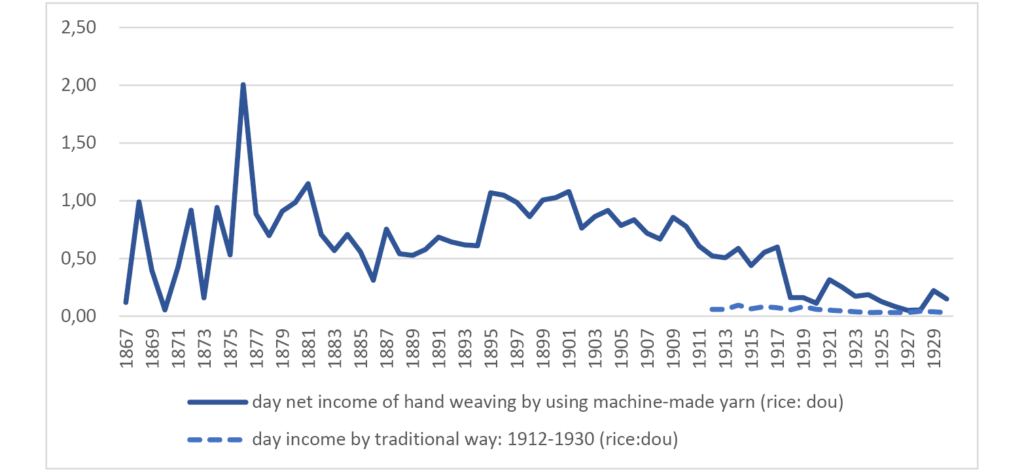
Note 1. The estimation method: according to the value and amount of machine-made yarn, native cloth and ginned cotton per year, we calculated the prices of one catty of cotton yarn, one bolt of native cloth and one catty of ginned cotton, then we used the estimation method discussed previously to estimate the day net income of women who only wove (based on sources 1, 2 and 3) and who both spun and wove (based on sources 1 and 4). As source 2 provides limited data from 1867 to 1913, we use data from source 3 to compensate for this lack of daily handweaving income data after 1913. Source 4 refers to ginned cotton, based on which we estimate the daily income of women who used ginned cotton to spin and then wove. Source 5 was used to convert women’s daily income into volumes of rice.
Note 2. Unit conversion: 1 tael = 0.99 Haikwan tael = 1.10 Shanghai taels = 1.39 yuan, and 1 shi = 1.4 piculs = 0.926 Shanghai shi (Wang, 1992, 48). 1 Haikwan picul=1.2096 piculs (Xu, 1992, p.174).
Note 3. The price data of imported yarn of 1869 was mistaken according to Xu, so we adjusted it by consulting Chinese customs data of 1869. See Second Historical Archives.
The real earnings of Yangtze female weavers using factory yarns show a volatile development between the 1860s and the 1910s, but the general trend was still downward. Handweaving with machine-made yarn experienced an obvious decline into the early twentieth century. This was largely due to the shrunken price gap between mechanized yarn and native cloth. Contemporary testimonies reveal that the price of one bolt of cloth increased from 0.6 yuan to 0.7 yuan between 1903 and 1915 in the Shanghai suburb Sanlintang, yet the imported yarn price rose from less than 0.30 yuan per catty to 0.32-0.33 yuan per catty. Around 1920, the price of imported yarn went up to around 0.6 yuan per catty, while the selling price of cloth remained between 0.7-0.8 yuan per bolt, barely covering its production cost (Xu, 1992, 294).
Textile households using imported yarn for handweaving had an average daily income of around 0.75 dou of rice between 1867 and 1913, far exceeding that of traditional production in this period. For instance, the real income per day in “traditional” textile production between 1875 and 1915 was merely 0.16 dou of rice (see Figure 1). Rational households in this case would abandon hand-spinning and exclusively focus on handweaving to maximize their textile income. As previously discussed, since total Chinese consumption of machine-made yarn for handweaving had increased to over 70% by 1913, this share must have been much higher in the front-running weaving districts of the Yangtze Delta. One result of the introduction of machine-made yarn into household textile production was the enhancement of women’s earning power by producing hand-woven cloth. Conversely, women who both spun and wove in the later period, saw their real income drop even more sharply since 1920, decreasing from the equivalent of 0.06 dou of rice in 1920 to 0.03 dou by 1930. Assuming that the basic consumption of rice for one adult was 3 dou per month, or 0.1 dou per day, we must conclude that the income from traditional textile production could no longer support one person’s subsistence.23
Source: The wage data between 1920 and 1925 is from Wang et al. (1928), 59-65. The 1930 data is from “National Survey of Workers’ Living and Industrial Production” in National Library (2013), 43. The 1929 data is from Xing (1932), 43. Gu (1929), 4-10. The data for 1928 refers to: Shanghai Local Association (1933), 2. The data for 1926 is from: Liu (1985), 401. The price data of rice is collected from Shanghai Economic Institute (1958), 120.
Note: The wages were spinning wages in general without distinguishing more specific tasks.
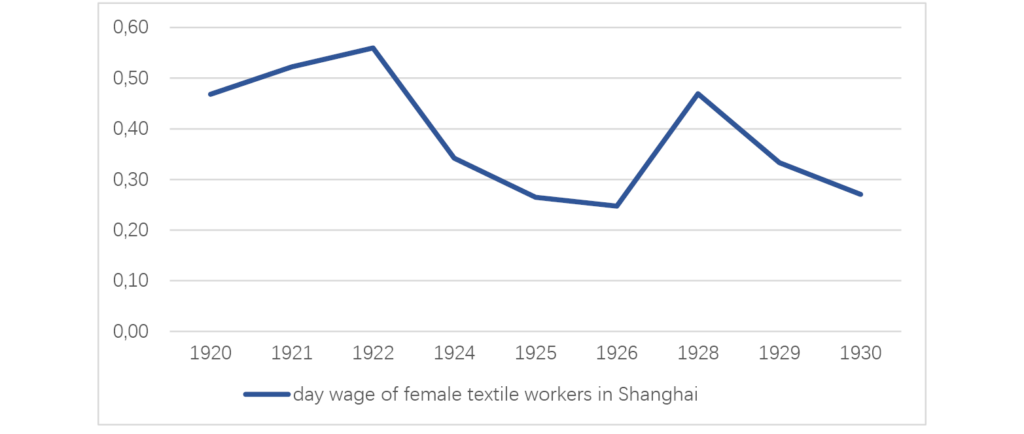
The wage data of industrial female textile workers in Shanghai between 1920 and 1930 are depicted in Figure 3, in order to analyze the impact of industrialization on women’s earning power. The data are collected from statistical books and secondary literature (Yu and van Nederveen Meerkerk, 2025).
Figure 3 shows that the average daily wage of female factory workers was 0.39 dou of rice – sufficient to support the rice consumption of three family members. Women’s daily remuneration was very high in the early 1920s, but dropped quickly between 1922 and 1926, pointing to their vulnerable position. After the May Thirtieth Movement24 in 1925, a series of strikes resulted in higher textile wages, translating into rice wages of 0.47 dou in 1928. From 1928 to 1930 women’s rice income suffered a decline under the impact of the global economic crisis, but even in the low-remunerated year 1930, their wage could still support two people’s daily rice consumption. Urban textile jobs thus became an attractive option for (part of the) rural textile households when the returns from hand-spinning and -weaving increasingly diminished.
Source: see Figures 1, 2 and 3.
Note: Excluding one outlier value (2.01) for women weavers using machine-made yarn in 1876.
Based on women’s real income by type of textile production in various periods, we now reconstruct their earnings over the long run by synthesizing the income data presented in this section. Traditional handicraft textile production (both hand-spinning and -weaving) may have coexisted with handweaving with machine-made yarn. Similarly, handweaving could persist simultaneously with some women, particularly young skilled women, working in the modern textile industry.25 Projecting all income series in a single graph (Figure 4) allows us to compare women’s earning capacity in the different modes of production, and to comprehend the changes of textile women’s work through time, also related to the life cycle. Figure 4 highlights that the traditional way of hand-spinning and -weaving yielded the lowest income in most observed years.
Particularly since the second half of the nineteenth century, traditional production constituted a large income gap compared to handweaving with machine-made yarn.26 It was also from this time on that elderly women (normally aged above fifty) became the main labor force of hand-spinning and weaving in the house, their income was indeed the lowest. Little girls below 13 years old probably also spun at home unremunerated.27 From 1894 to 1917, the real income of textile women by adopting machine-made yarn for handweaving, though experiencing a fluctuating decline, was still above 0.5 dou of rice per day, and enough to support the daily minimal grain consumption of a family of five. Adult women (married or single) were usually the handweavers as this production demanded manual strength and proficiency. Factory work became the most profitable between 1920 and 1930, the wage curve in Figure 4 primarily reflects the income of adult women normally up to 30 years old.
We found additional survey data, showing that in Japanese-owned spinning factories in Shanghai, workers aged between 16 and 25 accounted for about 56% of all workforce, and workers who were older than 31 comprised no more than 9% (Fong, 1932, 116). This proportion was similar in Chinese spinning factories, in general, the average age of female spinners was about 16 and 17 (Liu, 1985, 191-192).28 Nevertheless, life cycle effects also existed in factory textile production, as Table 2 shows.
Table 2. Day wages of spinners by age and gender in Hengfeng factory (1912)
| Age | Male | Female | ||
|---|---|---|---|---|
| wage (yuan) | Number | wage (yuan) | number | |
| 0-10 | 0.21 | 6 | 0.19 | 11 |
| 10-14 | 0.22 | 40 | 0.20 | 94 |
| 15-20 | 0.25 | 59 | ||
| 20+ | 0.30 | 105 | 0.22 | 573 |
Source: Wang (2016), 1230.
Table 2 shows that wages increased with age both for male and female workers. Although the wages of child laborers were not much lower than those of adults, they were much fewer in number, presumably because Shanghai mill owners found child labor less efficient (Honig, 1986, 51). In addition to age, marital status and fertility also influenced women’s employment. Many spinning mills dismissed pregnant women workers, female workers were not granted maternity leave before the 1930s, and childcare was almost non-existent in the early twentieth century (Song et al., 2011, 57-58, 164). This partly explains why older married women were highly underrepresented in the factories. However, as the age of marriage was low, this simultaneously means that many married Chinese girls and women worked in the factories before they had children. A 1930 survey confirms that of all factory girls in Shanghai aged 5-19, 12% were married, and this share was over 50% in the 20-24 age category (Liu, 1985, 559). Even if married women were underrepresented among textile workers compared to the entire Yangtze population, the working married women among them were at least accepted as breadwinning spouses until they had children, and they got to be outdoors and socialize with others. Conversely, the non-married among them probably managed to postpone marriage, suggesting they had more independence and life experience once they would get married.
In addition to life-cycle effects, proficiency was also important in the labor market. Perhaps unsurprisingly, the more skilled (and seemingly more literate) women of Songjiang and Taicang received higher payments in Shanghai cotton mills than women from other Yangtze districts. Meanwhile, the regional supply of women to the factories was highly determined by household labor allocation choices depending on local agricultural and industrial development, as the example of the farming households in the Shanghai outskirts discussed above demonstrates. From our available sources, we cannot know how much influence married and unmarried women themselves had on such choices, but it can be assumed that their economic opportunities (e.g. from the quite lucrative weaving with factory yarns), and thus their status in the household, gave them a say in such decisions.29
How many family members could a woman’s textile income support? In order to answer this question, we have applied Robert Allen’s method of calculating subsistence baskets for a family of five persons, as was the median family in the region under investigation. According to Allen et al. (2011, 21), a barebone subsistence basket in the Chinese context consisted mainly of rice, but also of beans, very little meat and other consumables such as oil and fuel.
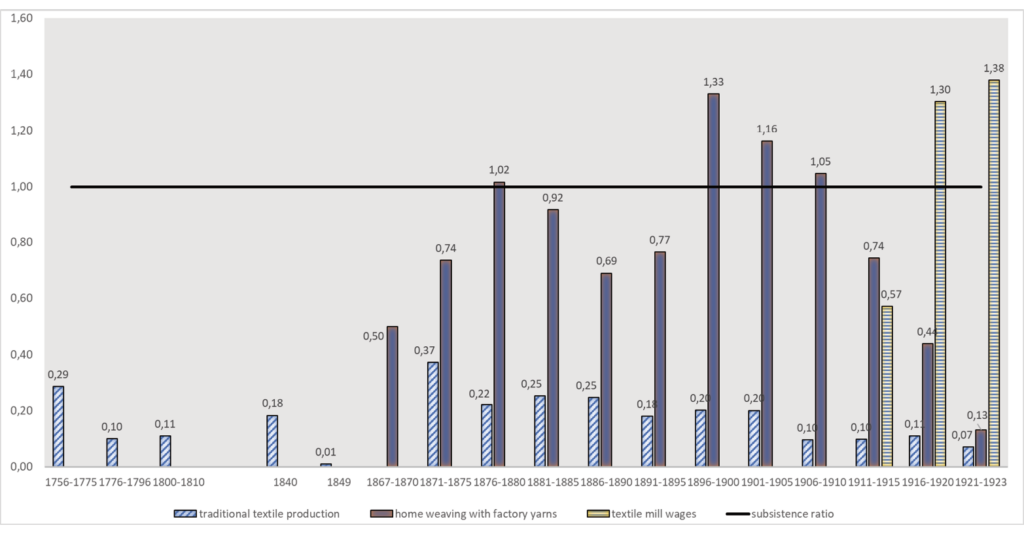
In Table 3, we indicate the subsistence units of all these goods, and transferred Allen’s annual per capita data into the average daily needs for a household of five, to make the average consumption more relatable.30 Using these standardized subsistence needs, we consequently calculated how many baskets for a household of five the daily wage of female textile workers could buy. We deflated the baskets with Allen et al.’s price data for the period 1737-1923.31 We used our nominal wage data and related these to the price of a basket in the years for which we were able to collect wages. Because for the early periods we have only decadal averages, we used the average of the price of the baskets for these periods. For the later periods where we have more serial data, we took five-year (unweighted) averages of both prices and wages to smooth out certain outliers in the data. Based on what we know from Li (1998, 149-150), we averaged the number of working days for women in textiles to be 200 per year.32 Figure 5 shows our findings, leading to some interesting observations.
Table 3 . Subsistence needs in China, per annum (individual) and per day (family of 5)
| per year | family of 5 per day | |
|---|---|---|
| Rice (kg) | 179 | 2.45 |
| Beans (kg) | 20 | 0.27 |
| meat/fish (kg) | 3 | 0.04 |
| oil (kg) | 3 | 0.04 |
| soap (kg) | 1.3 | 0.02 |
| cotton (m) | 3 | 0.04 |
| candles (kg) | 1.3 | 0.02 |
| lamp oil (kg) | 1.3 | 0.02 |
| fuel (M BTU) | 3 | 0.04 |
Source: Allen et al. (2011), 21.
Note: kg = kilograms; m = meters; M BTU = millions British thermal unit.
First of all, even if the “traditional” way of textile production (household members spinning and weaving at home) was much less rewarding than the other types of textile work, we nevertheless see that throughout the period, up until 1900, this type of work could in many periods sustain one household member’s subsistence needs. However, as noted above, we can assume that young girls were also helping with the spinning, so it would be a bit misleading to say that a female textile worker could maintain herself, as she needed the labor input from other family members.
With the rise of imported (and later China-produced) factory yarns, it is clear that a woman weaving could contribute substantially to the household income especially in the period of transition to modern industrialization. If she wove for 200 days, she could on average (almost) maintain a whole household, at least between the 1870s and 1910s. As prices of consumer goods determined both male and female wages, it is interesting to see that the developments of men’s and women’s wages largely coincided (Allen et al. 2011, 28). Together, an unskilled male laborer and his weaving wife could sustain over 2 hypothetical households of five, meaning that if they had 2 or 3 children, or a live-in parent, they could lead a fairly comfortable life at the end of the nineteenth and early twentieth century. It should be noted, though, that – as our wage data trends are smoothened out – the contributions from both forms of handicraft textile work were rather volatile, and could easily be distorted by political turmoil and/or market fluctuations (see also Figure 4). Trends seem to have fluctuated more for women than for men (Allen et al., 2011), which may have to do with the fact that women were more confined to specific sectors, most notably textiles, thus hampering their position both in terms of economic contributions to the household and perceived social status following from this. Historians have discerned similar mechanisms of indirect wage discrimination for other parts of the world (van Nederveen Meerkerk, 2010; de Pleijt and van Zanden, 2021, 635).
Sources: See Figures 1, 2 and 3. Price data: Allen et al. 2011 dataset.
Thirdly, it is evident that with the rise of modern industry, the income-generating opportunities in the traditional sector and especially handweaving with factory yarns rapidly declined at the beginning of the twentieth century. This was exactly the period when working in a Shanghai spinning factory started to become rewarding for women. Especially in the early 1920s, cotton mill workers could more than sustain their household’s subsistence from their wage. This was probably an extraordinary period, in which the demand for women laborers was high, translating into rapid wage increases. But even a fall in textile wages later in the decade still allowed women to contribute significantly to the household income: assuming they would work 300 days per year, female mill workers’ earnings hovered between 0.75 and 1 welfare ratio until 1930.33 A hypothetical family from a Shanghai suburb with a wife handweaving at home, the husband doing unskilled work in the city and a daughter spinning in one of the mills, would even be able to attain a welfare ratio between 2.5 and 3 in the 1910s and 1920s.
Finally, to say something about the potential bargaining position women had, it is relevant to compare their contributions to the household to those of men. To this end, we make a comparison of real earnings (in terms of welfare ratios) between the textile women in our dataset and male unskilled laborers, based on Allen et al. (2011).
Table 4. Percentage of real earnings by female textile workers compared to male unskilled workers, 1756-1923.
| Period | Male wage/traditional textile production | Male wage/home weaving with factory yarns | Male wage/ textile mill wages |
|---|---|---|---|
| 1756-1775 | 22.2 | ||
| 1776-1796 | 8.1 | ||
| 1800-1810 | 9.6 | ||
| 1840 | 18.6 | ||
| 1849 | 1.7 | ||
| 1867-1870 | 55.9 | ||
| 1871-1875 | 39.2 | 77.4 | |
| 1876-1880 | 18.8 | 86.4 | |
| 1881-1885 | 19.8 | 71.8 | |
| 1886-1890 | 15.7 | 43.9 | |
| 1891-1895 | 11.0 | 46.8 | |
| 1896-1900 | 12.0 | 79.5 | |
| 1901-1905 | 11.8 | 68.2 | |
| 1906-1910 | 6.9 | 75.3 | |
| 1911-1915 | 7.8 | 58.9 | 45.3 |
| 1916-1920 | 8.4 | 33.6 | 100.1 |
| 1921-1923 | 5.6 | 10.5 | 109.3 |
Sources: See Figure 5.
Table 4 shows that women’s earning capacity in textile production in the mid- to late Qing period was always below men’s, but compared to them they were no negligible players in the household economy. Especially in the late nineteenth century, both by traditional (home-spinning and -weaving), and more specifically by handweaving with factory-made yarns, women could earn a significant proportion of the real earnings men made, up to almost 87% in the period 1876-1880. This aligns with Li’s argument that women were able to earn 75% of a male agricultural laborer’s wage with handicraft weaving if they worked 200 days a year, and up to 100% if they worked 240 days per annum (Li, 1998, 149-150). For the short period we can compare women’s urban textile mill wages with the earnings of unskilled male construction workers, we can even conclude that these were roughly on par in the period directly after World War I. As said, this was an exceptional period for the development of female wages, and they were to decline over the 1920s, just as male construction workers’ wages in Beijing that Allen et al. used declined quite drastically in this period.
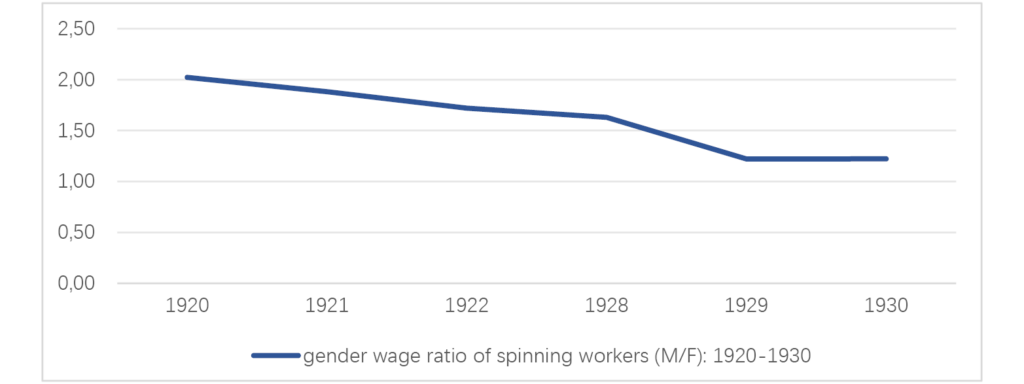
In order to come to a more balanced comparison for the later period, we therefore look at male and female factory spinning wages between 1920 and 1930 (Figure 6). This comparison confirms that the early 1920s were a period of exceptionally high wages for women and men in the recently established textile mills. However, it is also clear that male wages dropped more steeply than those of women. On the one hand, this could signify that women’s position and status relative to men in the mills increased. On the other hand, there are also indications that a feminization of textile factory work occurred (Yu and van Nederveen Meerkerk 2025), suggesting that most men sought opportunities in other, perhaps more rewarding sectors.
Source: the data for 1920-1922 are from Wang (1928), 47. The data of 1928 and 1929 are from Xing (1932), 39, 43. The 1930 data is from The National Library (2013), 43.
Note: The gender wage data are collected from various sources that probably used different survey methods and standards, but the male and female wage data in the same year is from the same source, to reflect a reliable indication of gender wage inequality.
We have very little information on how these more equal gender ratios, as well as the relatively high earning capacity of women in the emerging factories, impacted their social position. However, a qualitative survey taken in the 1920s among Wuxi migrant women working in the Shanghai mills provides some evidence. About half of the interviewed women (23 out of 47) reported having more decision-making power than their husbands within the household, while another eight stated that they had an equal say. Furthermore, quite a few women stated that they would not obey to their mother-in-law, thus defying customary norms regarding hierarchical family relations. Although these women may not have been fully representative, as they were not afraid to give their opinion, about 16 respondents said that they lived within a traditional patriarchal family situation, so these were also interviewed and presumably answering honestly (Liu, 1985, 559). Therefore, we can assume that at least for many women working in textile mills, their economic input correlated with an enhanced social status and agency within the household.
Our analysis shows that women in the Yangtze Delta contributed significantly to the household income by textile production in any form during most of the late Qing and early Republican eras. With traditional spinning and weaving, women could generally earn the barebones subsistence needs of at least one person in the household, although they were probably assisted by children in the work. Handweaving with factory-made yarns, which entered the scene in the Delta by the mid-nineteenth century, was even more lucrative. In the later decades of the nineteenth century, earnings from this type of textile production in theory allowed for the sustenance of an entire household of five, though this fluctuated somewhat. If a female handweaver was widowed, this implied that she could maintain her children and/or an elderly parent if necessary. In the more likely case that she was married, even when she was not the single breadwinner, her extra income formed a welcome addition to her husband’s, allowing such households to rise significantly above subsistence level, and perhaps even obtain a “respectability basket” with more luxurious consumption goods (Allen, 2009a). Likewise, in the early 1920s, the wage of female spinners in modern mills could more than sustain their households’ subsistence. This attests to what Amartya Sen would call the instrumental value of women’s income-generating activities for the household economy and beyond, as consumption levels in the region most probably increased. In a broader sense, women’s labor supply also contributed to the early development of China’s textile industrialization.
Simultaneously, women’s intrinsic value was enhanced by engaging in handweaving or factory spinning. Female textile workers could bargain higher bride prices and gained more respect at home when their textile income made a major contribution to household welfare since the later nineteenth century. This value was most obvious for female mill spinners in the early twentieth century: female laborers could escape from patriarchal control by working at the factory, and their importance as wage earners may have allowed them to postpone marriage and childbearing. Reportedly, they also saw themselves as the main decision-maker within the household. All these quantitative and qualitative findings imply a relatively higher social status for female textile workers, at least within their own households.
Women’s instrumental and intrinsic values were nevertheless affected by exogenous factors (foreign trade and industrialization), as well as by endogenous factors (age, skill and gender). We showed that imports of cotton yarns diminished profits for hand-spinners, while sustaining a respectable income for female handweavers since the late nineteenth century. However, in the first decades of the twentieth century, when modern textile factories were established in Shanghai, handweavers’ real incomes rapidly fell. A similar pattern has been discerned in the European context on the eve of the Industrial Revolution. In Britain, for example, especially married women saw their economic position deteriorate with the transition from home-based to factory textile production (Humphries and Weisdorf, 2015). As the Yangtze Delta was the first in China to open up to globalization and industrialization, we can see that here too, these global processes both created opportunities – with the entry of imported yarns in the nineteenth century – and again caused restrictions for married women when handicraft textiles declined in the early twentieth century. Nonetheless, we also show that modern factories in the 1920s provided new earning opportunities for young women, both unmarried and married, who did not (yet) have children to care for. Exactly in a period when unskilled male wages were declining towards subsistence level (Allen et al. 2011, 28), daughters or wives could earn substantially in the factories. Gender wage ratios in the spinning mills became almost equal towards the end of the 1920s.
Internal factors including age, skill, marital status and gender, played a role in women’s earning capacity under such transitions caused by globalization and industrialization. That is why young adult women with higher literacy and skills, usually seized better-remunerated work and thus increased their capabilities. We should however be careful not to paint a too rosy picture. As other historians have indicated for Europe, preindustrial and industrializing labor markets were highly segmented according to gender, leading to indirect mechanisms of discrimination, as women were generally crowded into only a few sectors, most notably textiles (van Nederveen Meerkerk, 2006). As a consequence, “women profited disproportionally from a tight labor market, and their wages declined disproportionately when there was a surplus” (de Pleijt and van Zanden, 2021, 635), meaning that wages could suddenly rise in times of labor scarcity, but might just as abruptly fall again. We also see such volatility reflected in our Yangtze wage series (e.g. Figure 4), indicating that Chinese women too, suffered from fluctuations in textile demand, as well as from disruptions due to political or social turmoil. Nevertheless, our differentiated analysis of female textile workers’ contributions also shows that over most of the late eighteenth to early twentieth centuries, these were seldom negligible and sometimes even raised the living standards of Yangtze households to levels well above subsistence. In this respect, we extend Pomeranz’s and Li’s claim that including women’s earnings into broader debates on economic development and diversification, such as the Great Divergence, is a worthwhile enterprise that hopefully leads to more meaningful long-term and global comparisons in the future.
This research was funded by the European Research Council, Grant agreement No. ERC Consolidator Grant #771288; Acronym TextileLab. The authors would like thank the editors and anonymous referees of Investigaciones de Historia Económica – Economic History Research for their valuable comments.
ÅGREN, Maria. 2017. Making a living, making a difference: Gender and work in early modern European society. Oxford: Oxford University Press.
ALLEN, Robert. 2009a. The British Industrial Revolution in global perspective. Cambridge: Cambridge University Pres.
ALLEN, Robert. 2009b. Agricultural productivity and rural incomes in England and the Yangtze Delta, c.1620–c.1820. The Economic History Review 62 (3): 525-550. DOI: https://doi.org/10.1111/j.1468-0289.2008.00443.x
ALLEN, Robert. 2015. The high wage economy and the Industrial Revolution: A restatement. The Economic History Review 68 (1): 1-22. DOI: https://doi.org/10.1111/ehr.12079
ALLEN, Robert; BASSINO, Jean-Pascal; MA, Debin; MOLL-MURATA, Christine; VAN ZANDEN, Jan Luiten. 2011. Wages, prices, and living standards in China, 1738–1925: in comparison with Europe, Japan, and India. The Economic History Review 64 (S1): 8-38. DOI: https://doi.org/10.1111/j.1468-0289.2010.00515.x
BOSSEN, Laurel; GATES, Hill. 2017. Bound feet, young hands: Tracking the demise of footbinding in village China. Stanford: Stanford University Press.
BOTER, Corinne. 2020. Living standards and the life-cycle: reconstructing household income and consumption in the early twentieth century Netherlands. Economic History Review 73 (4): 1050–1073. DOI: https://doi.org/10.1111/ehr.12997
BELL, Lynda S. 1994. For better, for worse: Women and the world market in rural China. Modern China 20 (2): 180-210. DOI: https://doi.org/10.1177/009770049402000203
BUCK, John Lossing. 1937. Land utilization in China. Nanking: University of Nanking.
BENJAMIN, Dwayne; BRANDT, Loren. 1995. Markets, discrimination, and the economic contribution of women in China: Historical evidence. Economic Development and Cultural Change 44 (1): 63-104. DOI: https://doi.org/10.1086/452201
CHEN, Jiru (ed). 1630. The gazetteer of Songjiang prefecture. 松江府志.
CHEN, Qiyu; FAN, Zhongxiang; LU, Chuande (eds). 2010. 中国地方志集成 (The collection of Chinese local gazetteers). Shanghai: Shanghai Bookstore Publisher.
DE VRIES, Jan. 1994. The Industrial and the Industrious Revolution. The Journal of Economic History 54 (2): 249-270. DOI: https://doi.org/10.1017/S0022050700014467
DRELICHMAN, Mauricio; GONZÁLEZ AGUDO, David. 2020. The gender wage gap in early modern Toledo, 1550–1650. The Journal of Economic History 80 (2): 351-385. DOI: https://doi.org/10.1017/S0022050720000145
FANG, Xing. 1996. 清代江南农民的消费 (The consumption of Jiangnan peasants in Qing China). 中国经济史研究 (3): 91-98.
FONG, H.D. 1932. Cotton industry and trade in China. Tianjin: The Chihli Press.
GAO, Qi (ed.). 1932. The gazetteer of Shanghai prefecture. 上海县志.
GARY, Kathryn E.; OLSSON, Mats. 2020. Men at work. Wages and industriousness in southern Sweden 1500–1850. Scandinavian Economic History Review 68 (2): 112-128. DOI: https://doi.org/10.1080/03585522.2019.1704859
GOLDSTONE, Jack. A. 1996. Gender, work, and culture: Why the Industrial Revolution came early to England but late to China. Sociological Perspectives 39 (1): 1-21. DOI: https://doi.org/10.2307/1389340
GROVE, Linda. 1993. Mechanization and women’s work in early twentieth century China. In the Compilation committee of the collection of essays in honor of Mr. Yanagida Setsuko (ed), 中国传统 社会与家族: 柳田節子先生古稀纪念 (Traditional Chinese society and the family: Essays in honor of Yanagida Setsuko). Tokyo: 汲古书院, 95-120.
GU, Binyuan. 1929. 上海的女工问题 (The problems of Shanghai women workers). 女青年月刊8 (5): 4-10.
GU, Yanwu. 1901. The Jiading gazetteer. 嘉定县志.
HONIG, Emily. 1986. SISTERS AND STRANGERS: WOMEN IN THE SHANGHAI COTTON MILLS, 1919- 1949. Stanford: Stanford University Press.
HORRELL, Sarah; HUMPHRIES, Jane; WEISDORF, Jacob. 2022. Beyond the male breadwinner: Life-cycle living standards of intact and disrupted English working families, 1260- 1850. The Economic History Review 75 (2): 530-560. DOI: https://doi.org/10.1111/ehr.13105
HU, Renfeng. (ed.). 1922. The gazetteer of Fahua village. 法华乡志.
HUANG, Philip C. 1990. The peasant family and rural development in the Yangtze Delta, 1350-1988. Stanford: Stanford University Press.
HUMPHRIES, Jane; WEISDORF, Jacob. 2015. The wages of women in England, 1260-1850. The Journal of Economic History 75 (2): 405-447. DOI: https://doi.org/10.1017/S0022050715000662
HUMPHRIES, Jane; SCHNEIDER, Benjamin. 2019. Spinning the Industrial Revolution. The Economic History Review 72 (1): 126-155. DOI: https://doi.org/10.1111/ehr.12693
HUNTER, Janet. 2004. Women and the labour market in Japan’s industrializing economy: the textile industry before the Pacific War. London etc., Routledge.
JOHNSON, Marshall; PARISH, William L.; LIN, Elizabeth. 1987. Chinese women, rural society, and external markets. Economic Development and Cultural Change 35 (2): 257-277. DOI: https://doi.org/10.1086/451585
KUNG, James Kai-Sing; LEE, Daniel Yiu-Fai. 2010. Women’s contributions to the household economy in pre-1949 China: Evidence from the Lower Yangzi Region. Modern China 36 (2): 210-238. DOI: https://doi.org/10.1177/0097700409355798
LI, Bozhong. 1996. 从 ‘夫妇并作’到 ‘男耕女织’: 明清江南农家妇女劳动问题探讨之一 (From ‘Husband and wife working together’ to ‘Man ploughed and woman wove’: A discussion on the labor problems of female farmers in Ming and Qing Jiangnan). 中国经济史研究3: 99-107.
LI, Bozhong. 1997.‘男耕女织’与‘妇女半边天’角色的形成: 明清江南农家妇女劳动问题探讨之二 (The formation of the role of ‘Man ploughed and women wove’ and ‘women’s economic power’: A discussion on the labor problems of rural women in Ming and Qing Jiangnan). 中国经济史研究 3: 10- 22.
LI, Bozhong. 1998. Agricultural development in Jiangnan, 1620-1850. New York: St. Martin’s Press Inc.
LI, Bozhong. 2000. 江南的早期工业化:1550-1850 (Early industrialization in Jiangnan: 1550-1850). Beijing: 社会科学文献出版社.
LI, Bozhong. 2009. Involution and Chinese cotton textile production: Songjiang in the late eighteenth and early nineteenth centuries. In Giorgio RIELLO; Prasannan PARTHASARATHI (eds), The spinning world: A global history of cotton textiles, 1200-1850. Oxford: Oxford University Press, 387-395.
LIANG, Fangzhong. 2008. 中国历代户口,田地,田赋统计 (Statistics of household registration, land and land tax in China’s dynasties), Beijing: 中华书局.
LIU, Mingkui. 1985. 中国工人阶级历史状况: 1840-1949 (The historical situation of the working class in China). Beijing: 中共中央党校出版社.
LU, Songlin. (ed.). 1740. Shatouli gazetteer. 沙头里志.
MA, Junya; WRIGHT, Tim. 2010. Industrialization and handicraft cloth: The Jiangsu peasant economy in the late nineteenth and early twentieth centuries. Modern Asian Studies 44 (6): 1337-1372. DOI: https://doi.org/10.1017/S0026749X09990333
MYERS, Roman H. 1965 Cotton textile handicraft and the development of the cotton textile industry in modern China. The Economic History Review 18 (3): 614-632. DOI: https://doi.org/10.1111/j.1468-0289.1965.tb01760.x
MANN, Susan. 1992. Women’s work in the Ningbo area, 1900-1936. In Thomas RAWSKI; Lilian LI (eds), Chinese history in economic perspective. Berkeley: University of California Press, 243-270.
MU, Xuan; YAN, Xuexi. 1994. 大生纱厂工人生活的调查: 1899-1949 (The investigation on workers of Dasheng Spinning Factory:1899–1949). Nanjing: Jiangsu renmin chubanshe.
NATIONAL LIBRARY (ED.). 2013. 民国时期社会调查资料汇编 Compilation of social survey data during the Republic of China, vol 21. Beijing: The Publisher of Chinese National Library.
NEDERVEEN MEERKERK, Elise van. 2006. Segmentation in the pre-industrial labour market: Women’s work in the Dutch textile industry, 1581-1810. International Review of Social History 51 (2): 189-216. DOI: https://doi.org/10.1017/S0020859006002422
NEDERVEEN MEERKERK, Elise van. 2008. Couples cooperating? Dutch textile workers, family labour and the ‘Industrious Revolution’, c. 1600-1800. Continuity and Change 23 (2): 237-266. DOI: https://doi.org/10.1017/S026841600800684X
NEDERVEEN MEERKERK, Elise van. 2010. Market wage or discrimination? The remuneration of male and female wool spinners in the seventeenth-century Dutch Republic. Economic History Review 63 (1): 165-186. DOI: https://doi.org/10.1111/j.1468-0289.2009.00500.x
NEDERVEEN MEERKERK, Elise van. 2019. Women, Work and Colonialism in the Netherlands and Java. Comparisons, Contrasts, and Connections 1830-1940. London etc: Palgrave Macmillan.
PLEIJT, Alexandra de; ZANDEN, Jan Luiten van. 2021. Two worlds of female labor: Gender wage inequality in Western Europe, 1300-1800. Economic History Review 74 (3): 611-638. DOI: https://doi.org/10.1111/ehr.13045
POMERANZ, Kenneth. 2000. The Great Divergence: China, Europe, and the making of the modern world economy. Princeton: Princeton University Press.
RAWSKI, Thomas; LI, Lillian (eds). 1992. Chinese history in economic perspective. Berkeley: University of California Press.
SEN, Amartya. 2000. Development as freedom. Cambridge: Cambridge University Press.
SHANGHAI ECONOMICS INSTITUTE OF THE CHINESE ACADEMY OF SCIENCE. 1958. 上海物价资料汇编: 1921-1957 (The compilation of Shanghai price data). Shanghai: Shanghai People’s Publisher.
SHI, Jianyun. 1987. 从棉纺织业看清前期江南小农经济的变化 (The cotton textile industry and changes of the peasant economy in Yangtze Delta in Early Qing). 中国经济史研究. 3: 67-83.
SHANGHAI LOCAL ASSOCIATION (EDS). (1933). 上海市统计 (Shanghai Statistics), Shanghai: 上海商务印书馆.
SONG, Zuanyou; ZHANG, Xiuli; ZHANG, Sheng.2011. 上海工人生活研究:1843-1949 (A study on the living conditions of Shanghai workers: 1843-1949). Shanghai: 上海辞书出版社.
TAIPEI PALACE MUSEUM (eds). 1982. 宫中档乾隆朝奏折. Taipei: Taipei Palace Museum Press.
TOPLEY, M. 1975. Marriage Resistance in Rural Kwangtung. In Margery WOLF; Roxane WITKE (eds). Women in Chinese society. Stanford: Stanford University Press, 67-88.
THE NANJING LIBRARY AND THE JIANGSU PROVINCIAL SOCIAL SCIENCE ACADEMY’S ECONOMIC RESEARCH GROUP (eds). 1987. 江苏省工业调查统计资料: 1927-1937 (Industrial investigation and statistics of Jiangsu province: 1927-1937). Nanjing: Nanjing gongxueyuan chubanshe.
The Second Historical Archives of China. 2001. 中国旧海关史料: 1859-1948 (Historical materials of China’s old customs: 1859-1948). Beijing: 京华出版社.
WALKER, Kathyle Mons. 1993. Economic growth, peasant marginalization, and the sexual division of labor in early twentieth-century China. Modern China. 19 (3): 354-365. DOI: https://doi.org/10.1177/009770049301900304.
WANG, Jingyu (ed). 2016. 中国近代工业史资料 1895-1914 (Historical materials of Chinese modern industry: 1895-1914, vol.2). Beijing: Kexue chubanshe,
WANG, Qingbin (ed). 1928. 第一次中国劳动年鉴 (The first yearbook of China labor statistics). Beijing: Beiping shehui diaochabu.
WANG, Qingmu; CAO, Binlin (eds). 1930. The gazetteer of Chongming county. 崇明县志.
WANG, Yeh-Chien. 1992. Secular trends of rice prices in the Yangzi Delta, 1638-1935. In Thomas RAWSKI; Lillian LI (eds), Chinese history in economic perspective. California: University of California Press, 35-68.
WANG, Yongan. 1961. 上海史料丛编:紫堤村志(Shanghai historical materials collection: The gazetteer of Zidi village). Shanghai: The Press of Shanghai Cultural Relics Preservation Committee.
WU, Xin; HONG, Xifan; YAO, Wennan (eds). 1918. Shanghai gazetteer expanded.上海县续志.
XING, Bixin; WU, Duo; LIN, Songhe; ZHANG, Tiezheng (eds). 1932. 第二次中国劳动年鉴 (The second yearbook of China labour statistics). Beijing: Beiping shehui diaochabu.
XU, Xinwu. 1992. 江南土布史(The history of homespun cloth in Jiangnan). Shanghai: Shanghai shehui kexueyuan chubanshe.
YAN, Zhongping. 1955. 中国棉纺织史稿 (The Chinese cotton textile industry). Beijing: Kexue chubanshe.
YAO, Tinglin.1982. 历年记, In Shanghai People’s Publisher (ed), 清代日记汇抄. Shanghai: Shanghai People’s Publisher, 39-172.
YE, Mengzhu. 1981. 阅世编. Shanghai: Shanghai Chinese Classics Publishing House.
YU, Xinjuan. 2010. 长江三角洲棉业外贸研究: 1912-1936 (Study on the foreign trade of the cotton industry in Yangtze Delta: 1912- 1936). Shanghai: Shanghai People’s Publisher.
YU, Wenjun; NEDERVEEN MEERKERK, Elise van. 2025. From home production to modern mills: Labor allocation, gender and living strategies of Chinese peasant households, ca. 1910s-1930s. Modern Asian Studies 59 (1): 95-121. DOI: https://doi.org/10.1017/S0026749X2400043X.
ZHANG, Youyi (ed.). 2016 中国近代农业史资料: 1912-1927 (Historical archives of modern Chinese agriculture: 1912-1927), Beijing: Kexue chubanshe.
ZHENG, Guangzu. 1852. 一斑录. Beijing: China Bookstore Publisher.
1. . There is also scope for comparison within Asia, e.g. Hunter (2004) or van Nederveen Meerkerk (2019).
2. . According to Li (1998, xvi), the mid-Qing period refers to 1736-1850, in this paper we take 1756 as the starting year for our analysis.
3. . According to Li (1996), women both engaged in agriculture and cotton textile production before mid-Qing dynasty (1736-1850), which makes it difficult to calculate women’s overall income by agriculture and home production as there was no reliable data specifying women’s exact labor input in farming. In our focus on the period between the 1750s to the 1930s, the majority of household cotton textile production was performed by women. Nevertheless, women definitely devoted much time to non-measurable household work or auxiliary farm jobs, which we unfortunately cannot reconstruct due to data scarcity.
4. . In 1820, the size of arable land per capita was 1.2 mu (0.19 acre) in Suzhou and Songjiang prefectures, barely sufficient to support a farming household with five members. Liang (2008), table 77, 556.
5. . Songjiang was an advanced cotton textile center in Jiangsu during the Qing and Republican periods.
6. . Qing period: 1644-1911. Early Qing: 1644-1735, Mid Qing: 1736-1850 and Late Qing: 1851-1911.
7. . Li (1997, 13) assumed the average size of arable land per household in Songjiang prefecture in late-Ming period had been 25 mu (4 acres), and it reduced to 10 mu in Qing period in the Yangtze Delta.
8. . Customs reports in Xiamen 厦门 in 1868, in Yichang 宜昌 in 1890, in Hainan 海南 between 1882 and 1891, see Yan (1955,79-83). Yan found evidence in customs reports that household textile production had two fates under the competition of foreign machine-made yarn, one was to give up spinning and weaving, the other was to stop hand spinning and continued to weave.
9. . Ming period: 1368-1644.
10. . Jiaxing Prefecture Annals 嘉兴府志 (1840), vol 34, p. 6. “liang 两 ” and “ jin 斤 ” were the measure of weight in China. 1 jin (catty) = 16 liang (tael) = 0.5 kilograms = 1.1 pounds (Li, 1998, p. xvii). The day production here was also largely used by many historians such as Xu (1992), Li (2000).
11. . In addition to shuttle loom, iron gear loom was also used in Yangtze Delta but not widespread due to its high price.
12. . See the gazetteer of Songjiang prefecture 松 江府志 , vol 6, p. 10-11; gazetteer of Shanghai county 上海县志 , vol.1, p.13; gazetteer of Chongming county 崇明县志 , vol.9, p.13.
13. . We believe Xu’s estimation on productivity is highly reliable because it is based on many records in gazetteers of different Yangtze prefectures/counties, such as Songjiang 松江 , Shanghai 上海 , Jiading 嘉定 , Chongming 崇明 , and is widely referred by other scholars such as Li (1998, 149), Allen (2009, 546), Pomeranz (2000, 317-333).
14. . However, the iron gear loom was not widely used by Yangtze weaving households because of its high price. Shuttle loom was still the primary tool of hand weaving in rural areas ( Xu , 1992, 399).
15. . We assume the total days for textile production in a year did not change and the price of homespun yarn was close to that of machine-made yarn. As many sources ( Xu , 1992; Yan , 1955) suggest, textile household adopted machine-made yarn instead of homespun yarn because the former was cheaper.
16. . According to Shi (1987, 79), producing one bolt of native cloth required around 1.125 catty of ginned cotton, and the price of ginned cotton per catty was 2.303 times as much as that of raw cotton, so the production cost of one bolt (catty) of native cloth was the price of raw cotton per catty ×2.303×1.125. although the price ratios of raw cotton and ginned cotton fluctuated in Qing times, they were normally maintained around 2.30 to 2.76.
17. . “ shi 石 ” and “ dou 斗 ” were measures of grain volume in China. 1 shi =10 dou . shi was also used to denote a weight of approximately 156 jin .
18. . Native cloth in the Yangtze Delta normally referred to the standard of “Dongxi 东稀布 ”, one bolt of standard native cloth was 1.31 feet wide, 21.87 feet long and 3.63 square yards ( Xu , 1992, 209).
19. . This ratio was also mentioned by scholars such as Huang (1990, 84), Pomeranz (2000, 317-318), and Allen (2009, 546).
20. . For more details on our wage data sources, see Yu and van Nederveen Meerkerk , 2025.
21. . The primary data comes from the Chinese customs records and the journal 学术月刊 , published in Xu (1992, 176)
22. . According to Xu, textile households in Guangdong province required 1.3 days to produce one bolt of cloth around 1860, but the productivity in Yangtze Delta was not mentioned, we think Yangtze textile households as living in the most advanced weaving district at least had a similar productivity as their Guangdong counterparts. furthermore, it is not clear when exactly textile productivity was improved to 1.5 bolts per day, but according to Xu’s archives, it should be around the Sino- Japanese War of 1894, so we take 1895 as the starting year for the improved productivity. The improvement of hand weaving productivity was, according to Xu (1992, 216, 246), due to the innovation of weaving looms as well as the fact that machine-made yarn used to hand weaving was not easily broken.
23. . The consumption amount of rice was from a folk proverb which was adopted by many scholars, see Fang Xing (1996, 92).
24. . The May Thirtieth Movement originated in the protest of Shanghai textile workers against the Japanese cotton mill-owners who fired Chinese workers and undercut their wages. This triggered a series of labor strikes, evolving into an anti-imperialism mass movement in China.
25. . As we show elsewhere, women engaged in different forms of cotton textile production based on their age, marital status and skills. Furthermore, regional economic development affected women’s labor decision. For instance, young unmarried women with higher textile skills in Song-Tai district were most popular in Shanghai cotton mills, and many elderly women conducted hand-weaving within the household ( Yu and van Nederveen Meerkerk, 2025).
26. . The archive data showed that in 1894 about 77% homespun yarn were used for producing native cloth throughout China and in 1913 this proportion dropped to 28%, homespun yarn were primarily consumed for home use ( Xu , 1992, 237). In Yangtze Delta, the adoption of foreign yarn for hand weaving might be earlier, according to Xu, Yangtze weaving household had used foreign yarn to produce homespun cloth for commercial purpose since 1895( Xu , 1992, 239).
27. . Women aged 50 beyond were rarely seen in Shanghai spinning mills and little girls aged 13 or older could weave by themselves ( Liu , 1985, 192; Li , 2000, 69), therefore, we infer that women aged 50 and above, or 13 and below were limited to hand spinning in the house.
28. . In most cotton mills, the number of spinners was much more than weaving workers, so we generally discuss women wages as spinning workers.
29. . For the gendered labor allocation in textile households and its impact on women’s work, see Walker (1993), Grove (1993), Yu and van Nederveen Meerkerk (2025).
30. . After all, the reader will probably better be able to relate to what a person (or a family) consumes per day than per year. According to Fang (1996) one agricultural wage laborer consumed on average 0.15 dou of rice per day, women and old parents might need less (around 0.1 dou /day), and children ate even less. The average day rice consumption of a family of five was around 0.5 dou , namely 0.1 dou per person on average. This would be considerably more than Allen et al. (2011) assume (as 0.1 dou equals about 800 grams, and Allen e.a. estimate 490 grams per day). Nevertheless, we decide to use Allen’s estimates, first of all because he also gauges the daily intake of other consumable into the equation, which seems realistic, second of all because his data are more recent and finally, because this would allow for international comparisons, as Allen et al. compare welfare ratios in multiple locations and throughout time.
31. . The actual data used for Allen et al. (2011) can be downloaded here: https://datasets.iisg.amsterdam/dataset.xhtml?persistentId=hdl:10622/VY7UY3#china.
32. . The annual working days of textile women varied by time and place. We can only make a rough estimation on an average number by reliable sources. Li (1998, 149-150, 220-221) pointed out some figures of working days per year for handicraft women: 177 workdays in Songjiang 松江 around 1860 and 200 days in Shanghai in the early twentieth century. Li’s figures were actually from Xu (1992). Xu made such estimations of workdays based on the interviews of textile women who were born in the late nineteenth century (1992, 242), the estimation on earlier period (1750-1860) was based on local gazetteers in Songjiang, Shanghai and other counties (1992, 216). Furthermore, an investigation on Dasheng spinning mills in Nantong 南通 reflected that women workers normally had 250 working days per year ( Mu and Yan , 1994, 180-184). Based on these figures, we take a medium number for the annual working days.
33. . Own calculations based on rice consumption only, as Allen’s price data only go up to 1923. Wages are based on: Wang et al. (1928), 59-65; National Library (2013), 43. Xing (1932), 43. Gu (1929), 4-10. Shanghai Local Association (1933), 2. Liu (1985), 401. The price data of rice are collected from Shanghai Economic Institute (1958), 120.