Since the 1970s and 1980s, profound structural transformations forced industrial regions to rethink their productive models (Borja and Castells, 1997). The energy crises revealed the vulnerability of these economies and stimulated industrial policies oriented toward a restructuring based on innovation (Rubio Varas and Muñoz Delgado, 2021). Many governments adopted a more market-oriented approach to management, promoting liberalization and deregulation policies (Colli and Nevalainen, 2019). In this context, cities and regions began to be conceived as strategic actors within a global economy that rewarded territories capable of attracting capital and talent (Harvey, 1989).
Capitals such as London and Paris initiated the transformation of obsolete industrial areas into innovation districts (Catalan, Miranda and Ramon-Muñoz, 2011; Engel, 2023). In these processes, public-private partnerships (PPPs) emerged as a decisive tool to facilitate economic and territorial transformation, enabling cross-sectoral cooperation through mechanisms for sharing costs, risks, and benefits (Koppenjan et al, 2022). Although these forms of collaboration have existed for centuries, their role in contemporary urban reconfiguration has been little explored from the perspective of Economic History. Analyzing these forms of cooperation is essential to understand how contemporary industrial policies articulate territorial and productive transformations.
In the last four decades, hybrid collaboration has become a key mechanism for designing innovative districts. Cases such as London Docklands, Boston Seaport, and Bercy in Paris illustrate how this model can stimulate urban development and attract technology sectors (Nelson, 2001; Brownill and O’Hara, 2015). In Spain, initiatives such as 22@ (Barcelona) or the technological parks in Andalusia, Galicia, and the Basque Country reflect their adaptation to the national context (Pareja-Eastaway and Piqué, 2011; Aranguren, Magro and Valdaliso, 2012; Valdaliso and Catalán, 2021; Varela-Vázquez et al, 2022).
Following the academic tradition on the effects of economic agglomeration, the concept of “entrepreneurial ecosystems” has emerged over the past decades (Spigel and Harrison, 2018; Stam and Van de Ven, 2021). According to Spigel (2017, p. 1), an entrepreneurial ecosystem is “the combination of localized cultural outlooks, social networks, investment capital, universities, and active economic policies that create supportive environments for innovation-based firms.” This approach emphasizes that business creation cannot be understood without considering the various types of ties within a territory (Stam, 2015; Brown and Mason, 2017). Unlike districts, ecosystems adopt multisectoral configurations with structures that are more dependent on institutional evolution (Colombelli et al, 2019; Vujovic and Baloutsos, 2025). Both approaches have been incorporated into the repertoire of contemporary industrial policies, which seek to adapt global models to local realities.
From this theoretical foundation, cases such as the Digital District of the Valencian Community (in Spanish, Distrito Digital de la Comunitat Valenciana; DDCV) occupy a hybrid position: they display features characteristic of urban innovation districts and entrepreneurial ecosystems, given their regional reach and the diversity of actors involved. For this reason, it is particularly relevant to revisit trajectories such as that of Alicante, which, although less studied, have sought to develop an innovative ecosystem since the 1980s (Vidal Olivares, 2020).
The Valencian Community has an academic tradition in the study of districts, especially since the 1990s (Salom-Carrasco, 1997; González et al, 2001). These studies have addressed the formation of productive networks, territorial resilience, and the effects of globalization on sectors such as textiles and toys (Ybarra, 2008; Miranda, 2011; Beneyto et al, 2020). The province of Alicante has been interpreted as a territory with a dual structure: an industrial interior and a coastal strip focused on services, tourism, and construction (Miranda, 2006; Ramón-Dangla, 2012; Fuster and Martínez, 2017; Taltavull, 2017; Gil et al, 2020; Escudero, 2021). Since the late twentieth century, innovative policies have been promoted to rebalance this duality, although historical-economic evaluation of these initiatives remains limited.
Unlike other cases, the DDCV has a limited bibliography, although interest in its impact on the Valencian productive structure has grown in recent years (Pedreño and Moreno, 2017; Beneyto et al, 2020). Its precursor, the audiovisual complex Ciudad de la Luz (CdL), has a more consolidated research trajectory, with various academic studies and reports on its history and socioeconomic impacts (IVIE, 2009; Claici et al, 2016; López, 2016; Malpica et al, 2018; Devesa, 2023). Existing literature reveals a strong presence of official discourse and a lack of long-term analyses assessing the actual effectiveness of the investments made, a gap this article seeks to address.
This article proposes to analyze the DDCV as a representative case of regional path development driven by innovation policies and inter-industry synergies. The study begins in 1982, coinciding with the consolidation of the regional government (Generalitat Valenciana), which assumed competencies in industrial and innovation policy. Particular attention is given to the period between 2018 and 2024, when the Generalitat Valenciana supported the DDCV as a mechanism to repurpose the underutilized infrastructures of CdL to attract technology companies and renew the productive fabric.
The choice of Alicante as a case study is based on several factors. First, it allows the examination of a relatively unexplored case of territorial innovation with strong comparative potential with other regions in southern Europe. The Alicante case provides an opportunity to analyze how public-private policies are designed and implemented across different institutional frameworks and historical contexts. This article aims to explore the interactions between policy design, institutional arrangements, and local governance in shaping regional innovation processes.
Since the late twentieth century, innovative activity in Spain has been concentrated in specific hubs, particularly along the Mediterranean corridor (Holl et al, 2024). Within this context, Alicante has demonstrated notable dynamism in implementing technological initiatives, making it a relevant case for studying the mechanisms of regional transformation (Valdaliso and Catalán, 2021; Varela-Vázquez et al, 2022; Charnock, Mansilla and Ribera-Fumaz, 2023). At the same time, its trajectory reveals tensions between the aspiration to replicate successful experiences and the limitations of the local context.
This background sets the stage for analyzing how public administrations, companies, and universities interact in a territory undergoing productive restructuring, characterized by the coexistence of traditional and emerging sectors. Projects such as the DDCV or Ciudad de la Luz (CdL) exemplify reconversion processes linked to policy initiatives and allow reflection on their capacity to promote sustainable territorial transformation.
Consequently, this article poses the following research question: How do public-private policies in Alicante shape innovation and territorial transformation, and what are the limits of replicating international models in this regional context? The two main hypotheses are as follows: 1) the DDCV can be understood as the cumulative result of public-private policies shaped by local institutional and political trajectories; and 2) reproducing global innovation models produces heterogeneous outcomes, influenced by structural constraints and governance capacities specific to the region. The article argues that the institutional specificity of Alicante helps explain why replicating these models does not always guarantee homogeneous outcomes.
To address this question, the article has three objectives: 1) to reconstruct the historical trajectory of some of the main policy models regarding spaces for innovation in Alicante since 1982, identifying actors, milestones, and public-private collaboration mechanisms; 2) to analyze the impact of political cycles on the continuity and orientation of these initiatives; and 3) to evaluate the impact of infrastructure reconversion as a mechanism to consolidate a regional digital ecosystem.
The methodology combines the analysis of institutional documentation – including reports, meeting minutes, strategic plans, and financial statements of the managing body of the DDCV, the Valencian Community Thematic Projects Society (in Spanish, Sociedad Proyectos Temáticos de la Comunitat Valenciana; SPTCV, later SPTD) – with the review of secondary sources such as business databases, the Valencian Parliament’s session records, specialized press, and an interview with the current DDCV manager. This approach allows the reconstruction of the evolution of the different projects, identification of their key actors and milestones, and assessment of the extent to which stable governance structures were consolidated and their intended objectives achieved.
The article is structured as follows: first, the theoretical and methodological framework is presented. Next, the historical evolution is analyzed, from the first initiatives in the 1980s to the current state of the DDCV, including an in-depth exploration of its business fabric. Finally, the main challenges of the Alicante case and its contributions to the study of productive and regional transformation in intermediate economies are discussed.
This theoretical framework examines the transformation of the State’s role in innovation industrial policies, focusing on how public-private collaboration has reconfigured territorial governance. Throughout the twentieth century – and particularly since the postwar period – the State played a central role in territorial articulation and the shaping of strategic sectors (Comín and Díaz Fuentes, 2001; Musacchio, Lazzarini and Aguilera, 2015). This capacity for action was exercised not only at the central level but also through regional and local structures, as seen in the case of Alicante.
State-owned enterprises (SOEs) played a prominent role in the European economic reconstruction, acting not only as service providers but also as instruments of territorial cohesion, industrial modernization, and internal market integration (Toninelli, 2000; Millward, 2011). However, from the 1970s onwards, the rise of neoliberal discourse, liberalization policies promoted by the IMF and OECD, and pressures stemming from crises forced the public sector to redefine its functions. The State did not disappear from the economic scene but rather reconfigured its role toward more decentralized, flexible, and instrumental structures (Clifton et al, 2011; Colli, 2015; Musacchio, Lazzarini and Aguilera, 2015). Since then, the State shifted from being a direct manager to a facilitator, regulator, and strategic partner, operating through hybrid entities such as consortia or public-private partnerships (Nevalainen and Yliaska, 2021).
This process unfolded within the paradigm of New Public Management (NPM), which promoted a managerial culture oriented toward efficiency, competitiveness, and results, directly influencing the design and management of industrial policies (Hood, 1991; Pollitt, 2009). Under NPM, the State focused on providing instruments capable of facilitating cooperation among actors. This did not weaken state power but rather reconfigured it, emphasizing its ability to intervene through public-private agencies or specific support programs.
In Spain, this reconfiguration must be linked to Hall and Soskice (2001) approach to state-influenced market economies. Even amid the expansion of NPM, the Spanish State – particularly through the newly established Autonomous Communities – maintained its strategic capacity, actively intervening in innovation industrial policies and coordinating key sectors (Comín, 1999). The difference from the previous stage lay in the distribution of power: from regional agencies to SOEs, including hybrid entities, allowing greater flexibility and adaptation to local contexts but also introducing new risks associated with political discontinuity and the complexity of multilevel governance (Mackenzie et al, 2021).
A concrete manifestation of this multilevel governance was the emergence of regional development agencies (RDAs). Since the 1980s, European governments created RDAs to promote industrial and business support policies, rapidly expanding their functions to include innovation promotion (Halkier, 2001; Urueña, 2006). Operating within multilevel frameworks, RDAs have proven to be agile and flexible instruments capable of overcoming the traditional limitations of the public sector. Their capacity to foster long-term policies, facilitated by continuity in management teams and collaboration with regional governments, reinforces the vision of an actively territorial State (Valdaliso et al, 2014; Alabort and Valdaliso, 2025). In the case of Alicante, the absence of an RDA with sufficient autonomy implied greater power for certain SOEs, which acted as direct instruments of the regional government and were more vulnerable to political changes.
Since the early twenty-first century, the idea of the “entrepreneurial state” has gained traction, presenting the State as a strategic actor in innovation by assuming greater risks and mobilizing more resources (Mazzucato, 2014). In this line, authors such as Mariotti and Marzano (2019) or Belloc (2014) have shown how certain public entities, through flexible corporate forms, have been able to operate under efficiency criteria without abandoning their social and territorial objectives. SPTCV/SPTD exemplify this logic, as public companies assuming functions typically reserved for private actors but with a public interest goal, such as promoting business digitalization in Alicante.
This institutional transformation also entailed a renewal of public-private models. The new modalities have facilitated the alignment of public and private interests, enabling strategic projects in capital and knowledge-intensive sectors. As Gerrard (2001) noted, these arrangements represented “public services that were neither nationalized nor privatized,” operating in an intermediate space that maximized complementarities between public resources and private initiative. This logic proved particularly useful in emerging sectors, where uncertainty and capital intensity required patient investors and coordinated strategies. However, these formulas also revealed vulnerabilities arising from their dependence on political continuity (Varela-Vázquez et al, 2022).
In this context, NPM and the Triple Helix model are analytically connected: while NPM provides the logic of indirect coordination, the Triple Helix offers concrete mechanisms to operationalize intersectoral coordination among government, industry, and universities through agreements, joint R&D projects, and participation in sectoral clusters (Etzkowitz and Leydesdorff, 2000; Amaral and Cai, 2022). NPM and the Triple Helix thus function as complementary layers in innovation governance. In the Alicante case, the Triple Helix materialized in alliances with the province’s universities and technological institutes, as well as certain regional agencies, though with a limited degree of coordination.
Concurrently, the literature has developed new conceptual frameworks for analyzing innovation spaces. On the one hand, innovation districts are defined as urban concentrations of firms, research centers, and knowledge-intensive activities (Katz and Wagner, 2014). On the other hand, entrepreneurial ecosystems emphasize the interaction among multiple actors as an essential condition for innovative entrepreneurship (Stam, 2015; Theodoraki and Messeghem, 2017). This approach reflects a shift initiated in the late twentieth century, moving away from an individualistic perspective toward one that incorporates the role of institutional, sociocultural, and economic forces in the entrepreneurial process (Roundy et al, 2018; Stam and van de Ven, 2021).
These two perspectives, sometimes presented as mutually exclusive, are in fact complementary: the former emphasizes the spatial and urban dimension, while the latter highlights functional linkages, evolutionary capacity, and institutional resilience (Isenberg, 2010; Theodoraki and Messeghem, 2017; Colombelli et al, 2019). Nonetheless, authors such as Flanagan and Uyarra (2016) have warned against assuming overly linear narratives regarding the effectiveness of innovation policies, highlighting the tensions of combining political objectives with private interests. These warnings are particularly relevant to the Alicante case, which combines elements of both approaches.
The DDCV represents a unique case of recent transformations in the State’s economic action, combining the principles of the “entrepreneurial state” with new organizational forms in the public sector. This model revolves around a regional public company (SPTCV/SPTD) that has channelled funding to design and manage available spaces and to establish partnerships with various actors. In this sense, the DDCV allows for a revaluation of public companies as active instruments of industrial policy. SPTCV has assumed functions typically reserved for the private sector – such as space commercialization and cluster creation – acting as a full economic actor, especially in complex contexts like the pandemic. At the same time, the DDCV experience also reflects the boundaries between the logics of urban districts and entrepreneurial ecosystems. During the analyzed period, the project extended in response to certain institutional needs – such as generating greater political legitimacy and territorial cohesion – and strategic opportunities, including increased sectoral diversification, investment attraction, and talent acquisition.
From a theoretical perspective, this case provides key insights into debates on innovation industrial policies: it shows that models successful in certain cities or regions are not always replicable uniformly in other territories. The DDCV demonstrates that the effectiveness of these initiatives depends on contextual factors, such as multilevel governance, coordination between public and private actors, institutional adaptability, and sensitivity to political cycles. The case thus highlights the limits of a “one size fits all” approach to implementing innovation industrial policies. In sum, this theoretical framework offers a coherent reading of the Alicante case: innovation cannot be explained solely as the result of specific policies, but rather as the product of an institutional network characterized by well-coordinated multilevel governance among its various levels and actors.
This article employs an inductive and qualitative methodology, characteristic of Economic and Business History, focusing on the case study of the DDCV to explore how public-private collaboration and political cycles shape the development of regional innovation policies. An inductive approach was chosen because it allows for an in-depth analysis of a specific case, capturing its historical and organizational complexity, rather than testing predefined hypotheses. The selection of the DDCV is justified by its pioneering nature as a model of reconversion, its structure organized around a regional public company (SPTCV/SPTD), and its relevance as a case illustrating the limits of innovation policy transfer. The long-term perspective (1982-2024) enables the connection of institutional evolution with political changes and the assessment of the sustainability of the transformations undertaken.
To address the stated objectives, the research draws on five complementary types of sources: 1) primary documentation from the managing company of the DDCV (2000-2024); 2) official statistical sources and business databases, such as SABI (Iberian Balance Sheet Analysis System); 3) the session records of the Valencian Parliament (2000-2024); 4) specialized literature and local press (1982-2024); and 5) a semi-structured interview with the DDCV director, Mr. Fermín Crespo (20th November 2024)1. This methodological design seeks to ensure the reliability of the results and minimize bias, addressing the strategic, organizational, and territorial dimensions of the project.
Primary sources come from the documentary archive of the Digital Transformation Projects Corporation (“Societat de Projectes per a la Transformació Digital S.A”; SPTD, formerly SPTCV), accessible through its digital platform. This archive includes the company’s statutes, the legal framework for its incentive policies, agreements with private actors, and organizational and financial reports of the district since its creation. Additionally, the annual accounts preserved in the archive of the Regional Ministry of Finance of the Valencian Government, along with audit and oversight reports from the “Sindicatura de Comptes” (the regional external control body), were consulted. This documentation was cross-referenced with political debates published in the official parliamentary records of the Valencian Parliament, allowing a multiscale analysis of the governance of the DDCV.
To contextualize the evolution of the region’s innovative dynamics and assess the impact of the DDCV, national and international statistics were consulted. Data on GDP per capita, R&D expenditure, and the number of companies engaged in innovative activities were obtained from the Spanish National Statistics Institute (INE). The Spanish Patent and Trademark Office (OEPM) provided information on patent applications and other indicators of innovative activity. Finally, Eurostat and OECD data were used to situate Alicante’s indicators in a comparative perspective with other Spanish and European regions, facilitating comparisons with territories hosting similar projects.
The SABI business database was used to assess the district’s capacity to attract companies. From the directory of member firms, a proprietary database was constructed, incorporating variables such as type of business, sector, number of employees, registered office, and share capital (SPTD, 2024a). This procedure addressed the challenges posed by incomplete information on the district’s companies, necessitating the combination of multiple sources to provide an accurate picture of the business fabric. Another challenge was the absence of disaggregated sectoral data, as previously noted by Casellas and Pallares regarding Barcelona’s 22@ (2009, p. 1148). This limitation constrains the scope of quantitative conclusions, although the use of multiple complementary sources has mitigated its impact.
The analysis also includes a study of the media perception of the DDCV, essential for contrasting institutional narratives and providing a critical view of its impact. The newspapers El País and AlicantePlaza were selected for the breadth and continuity of their coverage of the district’s evolution, allowing an analysis of how the project was publicly presented across different contexts. Finally, the interview conducted with the DDCV director, Mr. Fermín Crespo, helped clarify previously undocumented aspects, such as internal dynamics, challenges, and growth strategies. This source is particularly valuable for understanding the mechanisms of adaptation to the political discontinuities identified.
In sum, this methodology allows for a comprehensive and critically informed understanding of the evolution of the various policies implemented, integrating a long-term institutional analysis that directly addresses the research objectives. However, before analyzing the specific innovation policies, it is essential to understand the economic and productive reality in which they were implemented. This context is characterized by a structural duality that has conditioned the effectiveness of public intervention.
Since the second half of the twentieth century, Alicante has established itself as one of the most populous and economically significant provinces in Spain and southern Europe. As the fifth most populous Spanish province, its demographic dynamism has historically coexisted with a dual productive structure, combining a coastline specialized in services and construction with an industrialized interior. This duality is reflected in the economic paradox that characterizes the province: while Alicante’s provincial GDP ranks it as the leading non-capital province in Spain, its GDP per capita (€21,622 in 2022) places it 44th out of 52, well below the national average (€28,748) (Llopis Vañó et al, 2020). This contrast reveals a high economic volume sustained by a broad productive base, yet accompanied by a structural lag in terms of productivity, indicating a lower value-added economy.
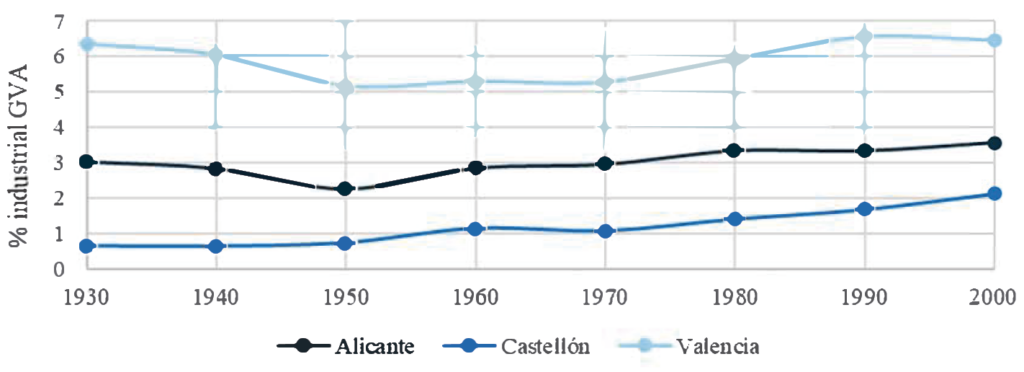
Historically, the province has played a key role in the Valencian industrial axis. According to the series on Gross Value Added (GVA) in industry by autonomous communities (1850–2000), the Valencian Community maintained a consistent contribution – between 8% and 10% of the national total – establishing itself as one of Spain’s most industrialized regions (Carreras, 2005, pp. 370-371). As shown in Figure 1, this strength persisted throughout the twentieth century, with Alicante exerting a decisive weight within the Valencian regional structure.
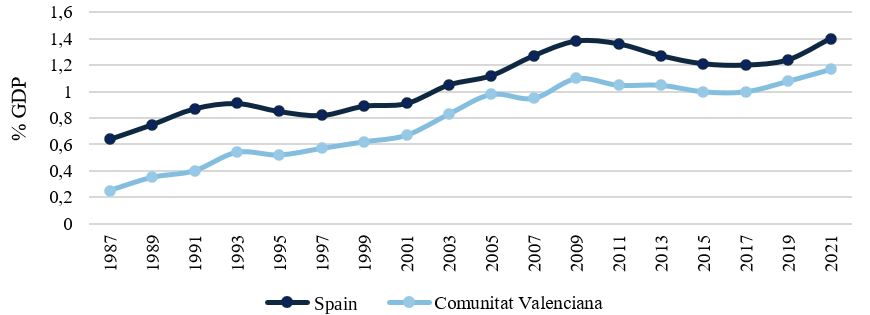
However, despite this strong industrial heritage, the province has faced difficulties in translating its industrial base into a consolidated knowledge economy. The answer lies in the persistence of a productive model that, while resilient, has not fully transitioned toward higher-technology activities. This paradox is paradigmatically reflected in R&D investment. As shown in Figure 2, R&D expenditure relative to GDP in the Valencian Community has increased since the late 1980s, yet it has always remained below the national average. This gap has been particularly significant in recent years: between 2019 and 2023, Valencian internal R&D investment grew by 35.5%, seven points below the national rate (43.7%), with a per capita evolution of 31.5% (42% at the national level)..
Source: INE (2022).
Note: Barcelona (1st position) and Madrid (2nd position) were excluded from the sample due to their leading positions (over 60% of the total), which distorted comparisons with the other top 8 provinces.
Source: Own elaboration based on regional patent data from the OECD (2024).
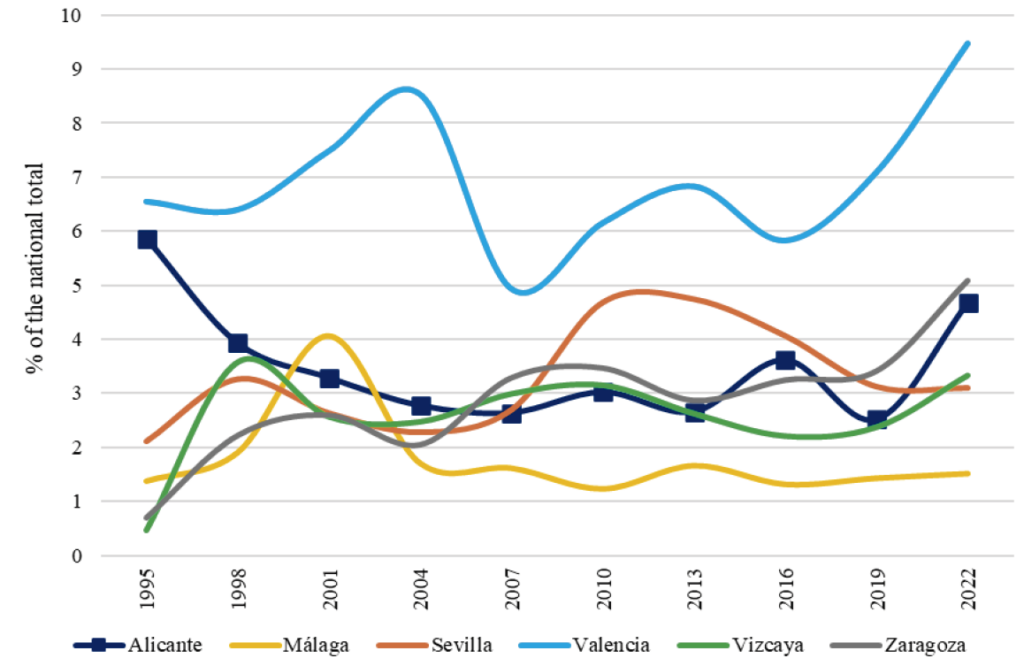
This limitation is also reflected in other innovation indicators. Figure 3 shows the evolution of patent applications submitted to the European Patent Office between 1995 and 2021, with Alicante occupying an intermediate level, fluctuating between 2% and 6% of the national total. This performance demonstrates its capacity to participate in innovation dynamics, although without consolidating sufficient growth to compete with Barcelona and Madrid. Business innovation indicators corroborate this pattern: according to INE business surveys, the Valencian Community has maintained a stable share of around 11–12% of the national total of companies engaged in innovative activities over recent decades.
Nevertheless, other indicators suggest resilience that nuances this assessment. According to BBVA Foundation and IVIE data, the provincial net capital stock rose from 2.41% of the national total in 1964 to 3.46% in 2021, demonstrating sustained accumulation of productive assets. In terms of industrial property, Alicante ranks prominently in the 2010–2025 period: third in industrial designs, fourth in utility models, and sixth in patent, trade name, and trademark applications nationally, according to the OEPM.
At the sectoral level, Alicante has been characterized by a diverse but specialized productive structure, with heterogeneous distribution between the interior and the coast (González et al, 2001; Miranda, 2011). Notable clusters include textiles in Alcoy, footwear in Elda (women’s) and Elche (sports and general), toys in Ibi, Castalla, Onil, and Dénia, agri-food industries in Jijona, as well as the rubber and plastics sectors (Miranda, 2006; 2011; Ybarra, 2008; Fuster and Martínez, 2017; Beneyto et al, 2020; Gil et al, 2020). This specialization has translated into an industrial employment structure that has maintained its relevance despite economic crises: between 2008 and 2024, Alicante ranked as the fourth Spanish province with the highest share of industrial employment. These industrial activities have been linked to medium-sized municipalities (20-50,000 inhabitants), generating SME networks with a strong export orientation2.
This industrial network has complemented the coastal model, focused on tourism and construction since the late Franco era. With over 14 million annual visitors, Alicante has established itself as a key node in the Mediterranean circuit due to its climate, location, and transport infrastructure. Construction has also been a fundamental pillar, driven by high tourism demand and second-home markets. Before the Great Recession, the sector expanded thanks to a combination of strong demand, a dense network of SMEs, a flexible regulatory framework, and support from the local financial system, led by the savings bank Caja de Ahorros del Mediterráneo (Taltavull, 2017).
The 2008 crisis, however, revealed the fragility of this dual model: while the construction sector collapsed, the industrial base demonstrated greater resilience but lacked the capacity to fully offset the economic contraction. This situation highlighted the need to diversify Alicante’s model toward higher value-added sectors. In this context, innovation policies were seen as a means to improve the competitiveness of Alicante’s productive structure. However, these initiatives did not start from scratch. In the final decades of the twentieth century, embryonic measures had already been implemented, though their results were conditioned by political and institutional dynamics, as will be analyzed in the following section regarding the specific models of innovation spaces.
TABLE 1. Policy models regarding the organization of space for innovative activities in Alicante
(1982-2024)
| Period | Political and Economic Context | Projects and Plans | Policy Models and Rationales |
|---|---|---|---|
| 1982 – 1995 | Economic crisis of the 70s – 80s Entry into the EEC Regional hegemony of the Socialist Party (PSPV-PSOE) | Innovation Triangle (Alicante-Elche- Santa Pola): Focus on transport infrastructure and technological institutes | Endogenous modernization: Focus on restructuring traditional industries Bottom-up approach led by civil society and public support |
| 1996 – 2014 | Economic boom followed by the Great Recession and EU sanctions Regional hegemony of the People’s Party (PP) | Ciudad de la Luz (CdL): Creation of large theme parks and leisure infrastructures and abandonment of the Triangle Model | Exogenous attraction and “build first”: Creating new sectors from scratch Top-down approach led by the Regional Government. State- driven entrepreneurship via public companies |
| 2015 – 2023 | Post-crisis recovery, digitalization demands, COVID-19 pandemic Left-wing coalition government | DDCV: Reconversion of CdL assets and creation of territorial clusters | Digital ecosystem and asset repurposing Hybrid model: Innovation district + regional ecosystem. Policy driven by the need to manage inherited liabilities |
| 2023 – Present | Lifting of the UE sanctions on CdL New digitalization challenges Return of the People’s Party (PP) to the Regional Government | DDCV and CdL coexistence: Reactivation of CdL as an audiovisual hub. Integration of DDCV into a broader regional strategy | Rationalization and specialization Separation of management from strategy. Return to sectoral specialization |
SOURCE: Own elaboration based in the various primary sources cited throughout the text.
The analysis of specific innovation spaces in Alicante must be understood within the broader framework of the regional innovation system. According to the EU Regional Competitiveness Index, the Valencian Community has improved its position in technological indicators, rising from rank 172 in 2013 to 137 in 2022 (Dijkstra et al, 2023). However, these regional advances contrast with the difficulties encountered in consolidating spatially concentrated innovation hubs in Alicante. Within this context, the province has deployed specific policy models to organize innovation activities, articulated through three main phases defined by their institutional approach.
Table 1 summarizes the main milestones of these models, considering the political, economic, and strategic dynamics that have shaped their trajectory. As detailed, the effectiveness of these policies is strongly influenced by their capacity to adapt to institutional changes and political cycles.
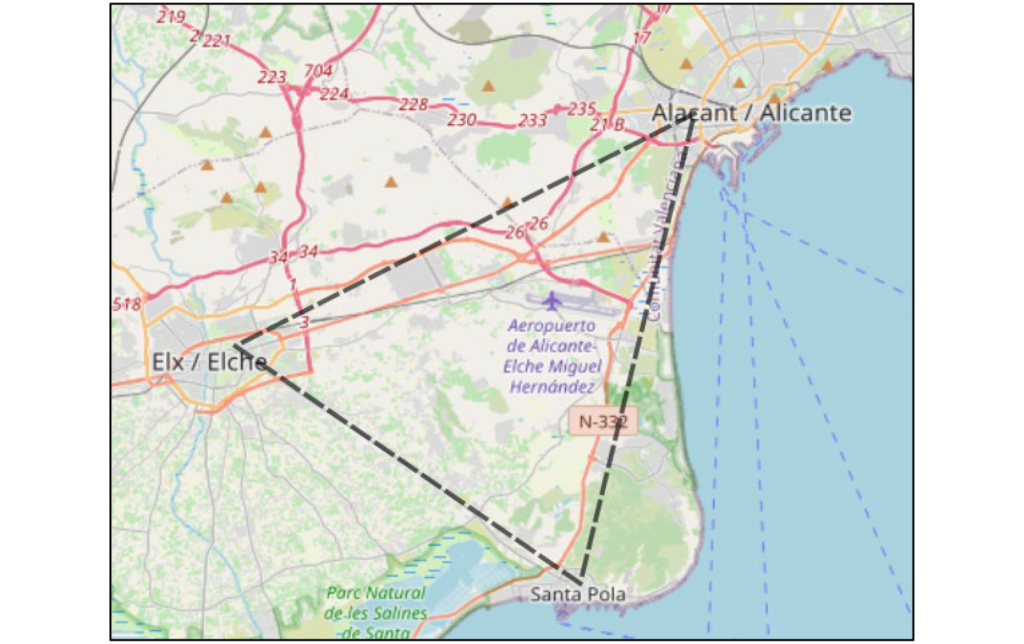
During the 1980s, Alicante began a process of productive restructuring to adapt its traditional industries to new market demands (Miranda, 2011). The energy crises severely affected a business fabric composed mainly of SMEs, which were highly interconnected and dependent on energy consumption (Ramón-Dangla, 2012). In this context, a new generation of young entrepreneurs, mostly from family businesses, promoted a modernizing vision for the region, aligned with democratic processes and European integration (Vidal Olivares, 2020). Organized in entities such as the Alicante Investors Club (1989) and in collaboration with urban planners and architects, they promoted the development of an area dedicated to emerging resilient industries (Conesa, 2005)3.
The selected space was the Alicante-Elche-Santa Pola triangle, with the airport as its central axis. This area was conceived as an emerging innovation ecosystem, the result of a hybrid public-private governance model. Unlike subsequent projects, the narrative behind this initiative was not imposed top-down by the regional administration but emerged from civil society. The rationale was based on the belief that strengthening infrastructure connectivity would naturally trigger the modernization of the endogenous industry fabric, without the need to create new public bodies to manage it.
Consequently, business groups sought institutional support from the nascent regional government, although financial leadership was primarily private. The public sector supported the initiative through certain infrastructure projects, such as the proposed – but never completed – rail connection linking the airport with Alicante and Elche, and the expansion of the high-speed rail network along the Mediterranean corridor. Other initiatives were also promoted, such as the arrival of CSIC spin-offs, the proposal to unify the Alicante and Elche university campuses – although the latter would ultimately develop independently – and the modernization of technological institutes such as the Footwear Institute in Elda and the Textile Institute in Alcoi (Vidal Olivares, 2020)4.
The selection of Alicante as the headquarters of the European Union Intellectual Property Office (EUIPO), located near the triangle, was one of the project’s main achievements. The arrival of the EUIPO – currently the second-largest EU agency – and the implementation of other initiatives demonstrated cooperation between public administrations and business and academic sectors to strengthen Alicante’s innovation capacities.
However, with Eduardo Zaplana’s victory (representing the right-wing party, PP) in the 1995 regional elections, the project was halted as it was considered an initiative inherited from the previous government. In 2000, fulfilling the wishes of Valencian filmmaker Luis García Berlanga, the construction of a large audiovisual complex in Alicante was launched: the Ciudad de la Luz (CdL) studios (Claici et al, 2016). This project, designed to compete with studios such as Pinewood (UK) or Cinecittà (Italy), represented a deliberate reorientation of the new government’s industrial policy, moving away from the model previously promoted by the Socialist Party (PSOE) – known regionally as the PSPV. The narrative changed drastically: the rationale shifted from supporting the modernization of existing endogenous industries to creating a new high-value sector from scratch though massive public investment in iconic infrastructures.
The location of CdL at the center of the triangle sought to leverage its connectivity to attract international film productions and foster local content industries. CdL was integrated into the new regional government’s logic, which viewed the audiovisual sector as an opportunity to diversify the economy and generate synergies with tourism, construction, and hospitality. Alongside CdL, projects such as Terra Mítica (Benidorm) were part of this strategy. This intervention highlighted the entrepreneurial role of the state, capable of intervening in the economy to energize emerging sectors and attract foreign investment.
At the end of 2000, Ciudad de la Luz S.A.U was established, a joint-stock company responsible for the construction and management of the facilities, attracting film productions, and supervising Producciones Aguamarga S.L, responsible for relations with producers (Malpica et al, 2018). With an initial share capital of over half a million euros, its main shareholders were the public company SPTCV (75%) and Producciones Aguamarga S.L (25%). The latter included Berlanga and Jaime de Polanco, a prominent communications entrepreneur, among its partners. Through two operations (2001, 2004), Aguamarga sold its shares to SPTCV, which became the sole owner, although Aguamarga continued managing the complex.
SPTCV was part of a broader strategy of the Generalitat Valenciana. Created in 1996 as a public company, it operated as the regional government’s investment arm in major infrastructure projects in the Valencian Community (SPTCV, 2020b, p. 6). Its main areas of action included managing large cultural and leisure infrastructures (Terra Mítica, Torrevieja auditorium, Benidorm cultural center) and transport (Castellón airport). The SPTCV model was characterized by a “build first” strategy, expecting physical assets to generate economic activity and attract investment on their own. This model failed on numerous occasions due to the lack of rigorous feasibility studies and the practical underutilization of these assets.
The public sector, through SPTCV, played a central role in CdL, driven by President Zaplana’s interest. Choosing Alicante as the headquarters demonstrated his influence in a territory where he had consolidated political power as mayor of Benidorm (1991-1995). This prominence highlights one of the risks of public intervention: excessive politicization and personalization of power in the absence of autonomous management structures.
CdL’s objectives included promoting the film sector to enhance Alicante’s international positioning (IVIE, 2009, p. 29). The complex was presented as the largest in Europe, covering more than 320 hectares. In August 2005, it began operations, hosting more than 60 productions over the following seven years (López, 2016). However, in 2007, Pinewood Studios filed a complaint with the European Commission, claiming that public investments in CdL constituted unfair competition and distorted the market. In addition, the economic crisis severely affected SPTCV’s partner, Producciones Aguamarga, which filed for bankruptcy in 2011. That same year, a legal dispute arose between the two partners over contractual breaches, resolved in 2013 with a fine of over one million euros imposed on Aguamarga (El País, 2012).
In May 2012, the European Commission ruled that the more than 265 million euros granted as public aid to CdL were incompatible with the Treaty on the Functioning of the European Union (Claici et al, 2016). According to the ruling, no private investor would have assumed such a high risk, representing a distortion of free competition. Consequently, the facilities were ordered to close for film production, and the full amount received had to be returned. Appeals were dismissed, and the liquidation of Ciudad de la Luz S.A.U. and the auction of its facilities, valued at 93 million euros, began (SPTCV 2018a, p. 7).
The first auction, however, went unsold. In September 2015, after a change in the regional government, a new board of directors was appointed at CdL, in a context marked by accusations of mismanagement against previous managers (Tarín, 2015). In May 2017, after a second failed auction, the European Commission’s Directorate-General for Competition accepted the Generalitat’s proposal to transfer all assets and liabilities to SPTCV (SPTCV, 2018a, p. 6). This transfer, formalized in 2018, included a fifteen-year ban on conducting economic activities on the premises (SPTCV, 2018a, p. 8).
This outcome initiated a process of reflection on the future of the complex. Among the proposals was the creation of an innovation district, aimed at integrating technological research with new market demands. Under a mixed collaboration model, the goal was to reverse the effects of the Great Recession and implement technologies such as big data, which were scarcely adopted in the local business fabric. In this context, the left-wing coalition government established in June 2015, promoted the creation of the Digital District of the Valencian Community (DDCV) in the CdL facilities. The new administration’s commitment was reflected in President Puig’s speech before the Valencian Parliament: “Our territory, and especially Alicante, has depended for many years on tourism and construction, and must have a differential strategy in the digital economy to guarantee its future. That is where the DDCV fits and is positioning itself” (Corts Valencianes, 2018a). The change of government thus reopened, more than two decades later, the debate initiated with the Alicante-Elche-Santa Pola Triangle regarding the province’s productive transformation, this time aiming not to repeat past mistakes.
The DDCV was integrated into the strategy of the new regional government as a tool to digitalize the business fabric and advance toward a new productive model (SPTCV, 2020a, pp. 9-10). The project aimed to become a competitive innovation ecosystem, with the goal of reducing the technological gap compared to other national and international territories. Its institutional design was structured around a hybrid governance model, managed by the regional public company SPTCV (Corts Valencianes, 2020).
From the outset, political rhetoric constructed a narrative based on a dichotomy between modernization and stagnation. As President Puig stated: “(…) the dilemma is inertia or future. And the Valencian Community has already decided – it has chosen the future” (Corts Valencianes, 2018b). This discourse framed the DDCV as a decisive tool, arguing that “(…) in just a few years, this type of technology will distinguish competitive regions in the world from those that have ceased to be. A context in which the DDCV will be decisive as a cluster of the new economy. Alicante is one of the territories with the greatest future potential in southern Europe” (Corts Valencianes, 2018b). This narrative sought to legitimize institutional action, guide SPTCV’s orientation, and mobilize resources toward the project. In this regard, SPTCV presented itself as a technical platform to implement the DDCV within the CdL facilities, being responsible for its promotion and offering strategic consulting and business support services.
This scheme reflected the logic of new public entities acting as intermediaries between the public and private sectors. However, the choice of SPTCV – a company originally designed for theme parks – over established regional development agencies like IVACE reveals the weight of path dependence. Rather than dissolving SPTCV to transfer its competencies to a specialized agency, the administration opted for its continuity. Analysis of corporate and parliamentary records suggests this decision responded less to innovation policy efficiency than to a strategy of corporate survival. Although liquidation would have highlighted the previous management’s failure, it would have forced the regional government to immediately crystallize the multimillion-euro losses inherited from CdL (see Table 2), severely impacting the current administration’s budget deficit. Consequently, the DDCV served as a mechanism to justify the public entity’s operational survival. This maneuver of institutional engineering prioritized the entity’s financial stability over the manager’s technical suitability, turning the project into an organizational solution to manage the toxic legacy of past assets.
In sum, the configuration of the DDCV was conditioned by a triple legacy resulting from this path dependency. First, a physical legacy: the obligation to occupy the specific facilities of CdL, originally designed for film production and not for a digital technology park, which imposed rigidities on space management. Second, a financial legacy: the project had to generate immediate revenue to sustain the structure of a public company weighed down by previous debts, prioritizing short-term solvency over long-term ecosystem maturation. And third, an institutional legacy: the assignment of management to SPTCV/SPTD instead of a specialized agency perpetuated a governance model more focused on infrastructure exploitation than on innovation promotion.
Operating within these structural constraints, from its early stages, the DDCV emphasized as a differentiating factor the creation of an environment fostering synergies between large companies – such as Accenture and Indra – and start-ups. However, as with CdL, doubts arose about the existence of a sufficient local business base. Supporters argued that a specialized digital services fabric with strong international projection was present (Corts Valencianes, 2019a). Nevertheless, in 2018, a stimulus plan of over 2.5 million euros was launched, offering direct grants of up to 40,000 euros for new technology companies (SPTCV, 2018a, pp. 63-64)5. Most of the attracted companies were foreign, with a notable presence of U.S, U.K, and Finnish firms, following agreements with institutions such as the University of Helsinki and the Business Incubation Centre Finland (Beneyto et al, 2020).
However, this direct intervention by the regional government led to conflicts already seen in CdL. The General Intervention Office of the Generalitat Valenciana detected irregularities in granting certain subsidies, which required a minimum stay and the development of technological activities within the district. Although SPTCV claimed to have acted within the European regulatory framework, the Intervention Office indicated that it lacked the authority to award them (SPTCV, 2018b, p. 7; 2019b, p. 9). Despite the regional government’s defense, opposition criticism forced SPTCV to acknowledge errors and strengthen the program’s internal controls (Corts Valencianes, 2019c; 2021a). This episode illustrated one of the inherent tensions in public companies: balancing operational autonomy with institutional oversight.
In response, the Consell relaunched the project with a campaign focused on increasing the number of companies and territorial expansion. New facilities were established at the Alicante port pier, aiming to consolidate an identity distinct from CdL (SPTCV, 2019a, p. 63). In 2020, the Department of Innovation moved its headquarters to the DDCV complex, reinforcing its centrality as a hub for regional innovation policies (SPTCV, 2020a, p. 61).
At the same time, a debate emerged on the territorial projection of the DDCV throughout the Valencian Community (Corts Valencianes, 2019b). In July 2021, President Puig announced the creation of six clusters – under the DDCV brand – located in different areas and sectors: 1) Benidorm and tourism; 2) Vega Baja del Segura and climate change; 3) Gandía and health; 4) Valencia and smart cities; 5) Castellón and energy transition; and 6) the interior of Castellón and depopulation (Corts Valencianes, 2021b). This sectoral territorialization responded to a functional decentralization of the DDCV to strengthen its regional legitimacy and hybridize it with other ongoing policies. Additionally, new investments were announced in Valencia, Elche, and Alicante – such as the 42Alicante programming campus alongside the Telefónica Foundation – to strengthen the role of the academic sector in the DDCV.
Within this plan, President Puig proposed establishing a DDCV office in every city with more than 50,000 inhabitants. The objective was to territorially integrate the project and digitalize more than one hundred thousand companies, fostering collaboration between SMEs and large firms (Corts Valencianes, 2021b). This decentralization process – required by his government partner, Compromís – became one of the main goals, with the DDCV as the instrument for its deployment (Corts Valencianes, 2021c).
However, the projects gradually faded. The tourism and climate clusters were never realized. The smart cities cluster remained stalled, and the health cluster, despite a promising start, lost momentum after the accelerator Innsomnia withdrew. Only the energy cluster advanced, thanks to an agreement with the oil company BP to develop green hydrogen in Castellón’s ceramic sector (El País, 2023).
According to the SPTD director, these clusters did not prosper due to the high costs of maintaining such structures. In his view, there was a risk of overlap that could compromise the efficiency of already established entities, such as technological institutes. This aligns with the principles of New Public Management, which prioritized efficiency and rationalization of public spending. However, the plan could have been articulated in collaboration with these existing entities, such as INESCOP, which had been working at the sectoral level for decades (Miranda, 2011). The lack of coordination thus weakened the potential to generate new synergies and complement the needs of these already formalized structures.
In an effort to promote the district, SPTCV sought new initiatives. Finding a private partner to create a company in the gaming and eSports sector was considered strategic, as it would allow anticipation of cities like Barcelona that were already exploring this possibility (SCCV, 2019, p. 114). After two years of searching, Do Dit Entertainment was established in partnership with the multinational GGTech Entertainment. With capital exceeding one million euros and SPTCV holding a 45% stake, this company exemplified how the state, through SPTCV, could be directly involved in promoting new emerging sectors (SPTCV, 2020b, p. 31)6.
Simultaneously, initiatives such as the Europe Office were launched to facilitate access to European funds; the CV Innova program, in collaboration with IVACE and the Department of Innovation, aimed to promote business cooperation; and the Talent District program sought to provide technical training to more than 15,000 people. All these efforts reinforced SPTCV’s role as a multifunctional public company, capable of facilitating intersectoral interactions and creating conditions to consolidate the DDCV as an innovation ecosystem. The new functional demands required redefining SPTCV’s institutional structure, adopting a new corporate name – Sociedad de Proyectos para la Transformación Digital S.A (SPTD) – and expanding its corporate purpose to include these new territorial objectives (SPTD, 2022, p. 5).
Historically, the Valencian Community had articulated its policies in favour of entrepreneurship and innovation through IVACE (formerly IMPIVA) and the Valencian Innovation Agency (AVI). IVACE was responsible for managing regional industrial policy, promoting innovation, internationalization, and investment attraction (Caixabank Research, 2016). In this context, the DDCV positioned itself alongside IVACE and AVI as a support instrument for the business fabric. This configuration followed a logic of complementarity: while these agencies-maintained competencies in industrial and innovation policy, the DDCV acted as a specialized instrument for digital transformation.
During this period, the DDCV entered a consolidation phase, as many of its companies were ready to meet new digital demands, increasing the demand for their services. In addition, these companies helped struggling sectors adapt technologically, generating greater dynamism and attracting new investments.
Taking advantage of this situation, efforts were made to incorporate the academic sector more strongly into the project. This process materialized through agreements with the province’s two main institutions: the University of Alicante (UA) and Miguel Hernández University of Elche (UMH). These collaborations took the form of applied R&D projects, human capital training programs, and networking and knowledge transfer activities, putting the Triple Helix model into practice. This academic integration was framed within the “Mediterranean innovation corridor” strategy, which sought to connect Alicante and Valencian projects (AlicantePlaza, 2023). Technological institutes, universities such as the Polytechnic University of Valencia, and the scientific and technological parks of UA and UMH were also included. The Department of Innovation supported these collaborations through funding for industrial PhD programs, linking young doctoral candidates with DDCV companies, promoting applied research, and preventing the “brain drain” that had severely affected the province during the crisis.
In this multilevel ecosystem, provincial councils and city councils also assumed greater relevance. The provincial council, with competencies in economic development, carried out complementary initiatives, such as public procurement of innovation in collaboration with AVI (Diputación de Alicante, 2021). Meanwhile, the Alicante city council promoted initiatives such as Impulsa Alicante – a local agency fostering economic and business development – and Alicante Futura, promoting sectors such as artificial intelligence and the blue economy. This architecture created a multilevel governance system in which the DDCV (through SPTD), IVACE, AVI, the universities, the provincial council, and the Alicante city council, under the coordination of the Directorate-General of Innovation, seemed to maintain specific but interrelated competencies.
However, the legacy of CdL continued to impact SPTD and, by extension, the DDCV. In September 2020, a court ruling formalized compensation of over 24 million euros to the former owners of the CdL land (SPTCV, 2018a, p. 26). Additionally, deficits accumulated from other projects affected the district’s development. Between 2021 and 2022, doubts grew over SPTD’s viability. As shown in Table 2, the company consistently posted negative results. These figures reflect a dual burden: while the DDCV generated an operational deficit typical of a project in its initial investment phase, the bulk of the losses stemmed from the financial costs and amortization of assets inherited from previous administrations. Consequently, these deficits were used by Puig’s government to criticize the previous regional administration, which had accumulated losses exceeding 987 million euros in projects such as CdL and Terra Mítica (Corts Valencianes, 2019a).
TABLE 2 . Income statement by SPTD projects (2018-2021; in euros)
| Project | 2018 | 2020 | 2021 |
|---|---|---|---|
| General – SPTD | -4.644.648 | -1.004.238 | -1.788.700 |
| Benidorm Theme Park Pedui | -876.266 | -2.570.809 | -794.798 |
| CdL PEDUI | -2.624.900 | -3.905.890 | -13.375.842 |
| Torrevieja Auditorium | -6.395.708 | -6.744.621 | -5.781.647 |
| Benidorm Cultural Center | -2.947.861 | -4.934.960 | -5.227.959 |
| Volvo Ocean Race | -2.644.193 | -245.468 | -392.067 |
| DDCV | -2.097.163 | -450.193 | -883.458 |
| Total | -22.230.739 | -19.856.179 | -28.244.471 |
Note 1: PEDUI (in Spanish, acronym for special master plan for uses and infrastructures).
Note 2: Figures represent the net annual result for each financial year, not the accumulated debt.
Source: Own elaboration based on SCCV, 2019, 2021, 2022.
The simultaneous management of multiple projects by SPTD generated internal tensions within the Valencian government, with calls even to separate the DDCV from other initiatives (Corts Valencianes, 2019c). Moreover, the project became involved in interinstitutional conflicts arising from institutional misalignment. While the Regional Government was led by the left-wing coalition, both the Provincial Council and the Alicante City Council were controlled by the conservative People’s Party (PP). This political divergence hindered cooperation, as highlighted by the Socialist parliamentary group during a parliamentary debate: “The PP of Alicante and the president of the Provincial Council should join efforts and not compete with what is already a reality in motion. This is not about political showmanship or irresponsible announcements of creating a Mediterranean Silicon Valley. The sensible and responsible approach is to collaborate from the municipal government” (Corts Valencianes, 2019a). These tensions reveal the challenges of multilevel coordination faced by projects that are highly dependent on political power, a recurring problem in the absence of autonomous intermediary structures.
The consequences of the pandemic on Alicante’s economy forced the regional government to implement new measures. One of these was requesting the European Commission to reactivate Ciudad de la Luz (CdL), arguing that the aid being granted to other audiovisual complexes was comparable to the subsidies that had led to its closure. In March 2022, the sanction was lifted, and SPTD regained full control of the facilities (SPTCV, 2021).
After a decade under sanction, the facilities returned to their original purpose: the audiovisual sector. This process coincided with the return of the PP to the regional government, bringing new changes. CdL, a project that had emerged during the PP’s mandate, became the exclusive focus. The agreement signed with the multinational MBS Group aimed to reposition the complex internationally after years of stagnation (La Vanguardia, 2024). This shift, resulting from a reorientation in the political sphere, required changing SPTD’s roadmap. The DDCV, strongly linked to the previous government, lost public momentum, and the institutional offices established in previous years were gradually relocated.
This process exposed the vulnerability of such initiatives, which require long maturation periods, to political and electoral instability. The recent history of the Valencian Community shows other recognized cases of this dynamic, as evidenced by the trajectory of the Valencia Technology Park7. The absence of independent intermediary bodies outside the political cycle has limited the effectiveness of these initiatives. Unlike other regions, such as the Basque Country, Valencian governments have opted for mechanisms closer to public direction but, at the same time, more exposed to potential partisan capture, a situation also observed in other parts of Spain (Valdaliso et al, 2014; Varela-Vázquez et al, 2022; Charnock, Mansilla and Ribera-Fumaz, 2023; Alabort and Valdaliso, 2025).
In recent months, the integration of the DDCV with the technology hubs in Castellón and Valencia has been promoted once again. This initiative, led by the Directorate-General of Innovation, would leave SPTD exclusively in charge of CdL. According to the SPTD director, the plan aims to strengthen the attraction of innovative companies and better coordinate the programs implemented regionally. This integration of the DDCV into a larger-scale regional plan appears to be a measure to curb the gradual withdrawal of public support and, consequently, also of private sector involvement in the district.
The future strategy of the DDCV must begin with an analysis of its current situation. To this end, this section presents a set of indicators based on the collected data, allowing for an assessment of the district’s health. However, to properly understand the current situation, it is essential to review its trajectory since 2018. Although official DDCV data are sometimes limited, it has been possible to reconstruct the evolution of the number of companies and employees since its launch using reports from SPTCV/SPTD, institutional statements, and specialized press. These figures should be interpreted with caution, as they present methodological challenges due to the heterogeneity of classification criteria. The coexistence of diverse contractual categories – installed companies, partners (national and international), and collaborating entities – with varying levels of engagement generates uncertainty regarding the project’s actual figures.
The district began with sustained growth, counting more than 30 companies and approximately 200 employees in March 2019, with a goal of reaching 120 start-ups and 500 employees that year (AquíMedios, 2019). By August 2020, there were around 500 employees distributed across 60-70 companies, with notable presences of Indra and Accenture (SPTCV, 2020a). Official data at that time recorded about 250 linked entities (80 installed companies, 100 partners, and 65–70 collaborating entities), with a significant foreign presence, as four out of ten companies were international (SPTCV, 2020a).
By March 2021, the DDCV included 176 installed companies and partners, in addition to international collaborators, with a clear commitment, according to the organization itself, to become a “boutique of start-ups and technology companies providing high value-added services” (SPTCV, 2021). The main sectors were software, big data, digital marketing, artificial intelligence, and fintech. By the end of 2021, the total number of linked entities reached 400.
The year 2023 marked an expansion phase: from 471 companies and entities in January to 500 in March, distributed among 86 installed start-ups, 260 partners throughout the Valencian territory, 148 collaborating institutions, and 5 international partners (El Mundo, 2023). The sectoral structure showed increasing diversification: digital marketing (20%), software development (15%), digital services (13%), tourism (7%), and e-health (5%), among others. Among collaborating entities, service companies predominated (45%), followed by associations (29%), coworking spaces (12%), and municipalities (6%).
With this trajectory perspective as a reference, it is now possible to address the analysis of the DDCV’s current situation, applying homogeneous criteria that allow the evaluation of both its consolidation and future prospects. Understanding how many companies are part of the project and the type of relationship they maintain with it is a key starting point. The SPTD defines three categories that structure these relationships: partners, collaborators, and based-in companies.
The partner category includes technology companies with a physical presence in the Valencian Community and a consolidated track record in the digital sector (SPTD, 2023c)8. These companies can participate in DDCV events, interact with the business ecosystem, and benefit from SPTD promotional activities (SPTD, 2024b). The collaborator category encompasses public and private entities based in the Valencian Community that show interest in innovation and carry out activities deemed necessary for the DDCV. This group includes business associations, technology parks, coworking spaces, and municipalities such as Gandía, Novelda, or Alcoy, which provide spaces and promote certain initiatives (SPTD, 2024b). Both partners and collaborators must participate in or contribute to the district’s activities and promotional campaigns. In return, SPTD offers services and support, such as inclusion in the district’s communication strategy (SPTD, 2023a; 2023b). This collaboration between local administrations, companies, and universities represents a practical application of the Triple Helix model. However, the predominance of the public sector reflects a more vertical structure, characteristic of state-driven innovation ecosystems.
Regarding distribution, partners represent the largest group, with more than 201 members, followed by collaborators, with 134. The based-in category, which includes companies whose main activity is located within the district, barely reaches 59 companies. These companies play a fundamental role in the DDCV’s business consolidation. In total, the district has more than 394 members, albeit with varying levels of involvement. This figure differs from previous estimates that suggested over 500 entities, partly due to duplications. The reclassification of companies and entities – based on the DDCV online glossary and cross-checked with SABI – has allowed for a more accurate figure that better reflects the project’s reality.
Beyond contradicting previous estimates, the data highlight the limited weight of stronger contractual relationships, such as the based-in category, which accounts for less than 15% of the total. This asymmetry between categories suggests a potential structural weakness of the DDCV: functioning more as a promotional project than as a fully consolidated business space. This confirms the need for districts to undergo long maturation periods to transition from symbolic attraction to real consolidation.
In 2024, of the 60 based-in companies in the DDCV, only 21 (35%) have their registered office within the district, while the remaining 39 (65%) are located outside. This distribution indicates that the DDCV has not yet fully consolidated its ability to generate new companies or attract firms willing to establish themselves entirely within the district. This shortcoming may reflect insufficient incentives to encourage business anchoring and stable contractual relationships. Contributing factors include the lack of services aimed at attracting and retaining talent, as well as a perceived limited capacity of the district to generate synergies. In this context, the suspension of incentive programs for hosting new companies represents an additional challenge.
The analysis of share capital reveals that most based-in companies with their registered office in the DDCV have limited financial capacity. Twelve firms hold share capital below €3,500, four between €3,501 and €10,000, one between €10,001 and €50,000, two between €50,001 and €100,000, one between €100,001 and €1,000,000, and only one exceeds €1 million. This distribution reflects a business landscape dominated by small firms with modest patrimonial structures. Only two companies surpass €100,000 in share capital – Código10 Soluciones Informáticas and Do Dit Entertainment S.L, the latter with SPTD equity participation. This indicates both the capacity of public companies to undertake direct investment in emerging sectors – reinforcing their role as an entrepreneurial state – and the uncertainties of private capital in refraining from such investments.
Employee data reinforce this trend. Among the based-in companies in the DDCV with their registered office within the district, most are microenterprises: 12 firms (57%) have between 1 to 10 employees, 8 firms (38%) employ between 11 and 50 people, and only one company (5%) has between 51 and 249 employees. None exceed 250 workers. This predominance of microenterprises limits the district’s productive and investment growth while increasing business dispersion, making it difficult to achieve economies of scale.
Among the based-in companies that operate in the DDCV but maintain their registered office outside the district, a clear concentration is observed in Madrid and Alicante, with 15 companies each. Valencia hosts 3 such companies, while Barcelona, Zaragoza, Burgos, Granada, Murcia, and Bizkaia each host one. Madrid’s primacy can be explained by its administrative and economic centrality, reinforced by an excellent transport network connecting it to Alicante via high-speed rail. More striking is the case of Alicante: the province hosting the DDCV competes with itself. Many companies prefer to maintain their headquarters in other localities within the province. This pattern suggests a limited capacity of the DDCV to attract and anchor companies in its immediate area of influence, in contrast to the retention ability of other regions. The phenomenon is especially relevant because companies do not relocate to hubs like Barcelona or Valencia but remain in their historical locations within the province. This behaviour raises questions about the DDCV’s value proposition. Its apparent inability to offer effective incentives affects its image and raises doubts about its viability as a consolidated district.
A possible explanation is that many companies seek to associate their image with projects like innovation districts, as it provides visibility, institutional prestige, and networking opportunities without the need for physical relocation or changes to their supplier and client networks. Joining the district serves more of a positioning and marketing function than a business relocation function. From the perspective of the Triple Helix model, this situation highlights the difficulties the district faces in fostering effective collaboration among its three helices. The absence of an integrative ecosystem limits its attractiveness as a consolidated innovation environment. In conclusion, the geographic distribution of registered offices reveals structural weaknesses in terms of business attraction and retention, even within its immediate area of influence.
The distribution of based-in companies in the DDCV shows a clear concentration in ICT-related and digital services, reflecting the district’s focus on building an innovative business ecosystem. The largest groups are in IT and computing services (10 companies), computer consultancy (9), and other management consultancy (5), followed by education and professional, scientific, and technical activities (3 each). Small numbers are engaged in computer programming, advertising, film and video production, computer resource management, specialized intermediaries, accounting and auditing, and technical engineering and consultancy (2 each)9.
This focus aligns with the foundational goal of building an innovative and digital business ecosystem. However, this specialization also presents structural challenges. Concentration in knowledge-intensive technological activities increases the demand for highly qualified profiles, potentially generating tensions in the local labour market and a certain disconnection from the regional professional fabric. To mitigate these imbalances, it is crucial to foster synergies with the academic sector through dual vocational training programs and other initiatives linking local talent with companies. Strengthening these ties would help reduce brain drain and consolidate the DDCV as a strategic hub for human capital development at the regional level.
The data show more than 28 different CNAE codes10. Although this sectoral diversity can be interpreted as an indicator of openness and adaptability, it does not necessarily constitute a positive element. On the one hand, diversification may strengthen resilience against technological or cyclical changes by avoiding dependence on a single sector. On the other hand, it hinders the consolidation of a coherent productive identity and clear specialization, which are essential factors in shaping a solid innovation district. In this sense, the challenge is to find a balance between technological specialization – the central axis of its identity – and the transversal integration of other activities.
Results on business location and capital structure indicate a landscape dominated by technological microenterprises. This profile reinforces the idea that, currently, the DDCV functions more as a digital incubator than as a consolidated district. Theoretically, this raises questions about whether public-private collaboration in the DDCV constitutes a truly symmetric relationship, a characteristic of successful innovation district models. The data suggest a more “induced” collaboration, in which the link is driven more by institutional push than by entrepreneurial initiative.
The new strategic management of the DDCV must define its course: either pursue expansive growth, risking the dilution of its technological identity, or reinforce this digital focus, accepting its limits and growth pace. If the first option is chosen, sectors such as footwear, rubber, or food should be prioritized due to their territorial impact. In an interview with the SPTD director, he presented a vision aligned with this proposal: “(…) The generation of new, competitive, and differentiating sectors can only aspire to strengthen what already exists; diversification lies in the capacity of existing sectors to improve, even when facing much more intense global competition.” This statement suggests a possible strategic shift, although its effective implementation will require more robust multi-level coordination than observed to date.
This article has analyzed the evolution of specific public-private collaboration models regarding the organization of innovation spaces in Alicante, focusing on the period from 1982 to 2024. Its aim was to understand how these policies were implemented over time, how they interacted with local institutional and political frameworks, and what limits exist when attempting to replicate internationally recognized models in a regional context. The study considered both the cumulative effects of long-term policy trajectories and specific initiatives aimed at revitalizing underutilized infrastructures and promoting technological innovation. Two guiding hypotheses have structured the study: first, that the DDCV results from public-private policies shaped by local institutional and political conditions; and second, that reproducing global innovation models generates heterogeneous outcomes depending on regional structural and governance constraints.
The Alicante case demonstrates the limits of implementing industrial policies based on the imitation of internationally successful models. Unlike other territories, in Alicante these policies have had a moderate impact and have not succeeded in crystallizing a district in the strict sense. This divergence highlights the importance of the institutional context, historical trajectories, and local specificities. The DDCV is confirmed as the cumulative result of policies that, although they reproduced the dominant discourses of the time, were conditioned by three determining factors.
First, its own path-dependence. Alicante’s dual economic structure created both opportunities and constraints. Although the industrial tradition fostered a culture open and favorable to productive restructuring, most projects ended up oriented toward lower value-added sectors, such as tourism and construction, hindering the consolidation of truly transformative initiatives (Miranda, 2011; Vidal Olivares, 2020).
Second, the role of past decisions on the current trajectory. The completion of the Triángulo project delayed the implementation of certain innovative initiatives and hindered the consolidation of a pioneering path. Likewise, the legacy of CdL has decisively influenced the DDCV. The location of the district responded more to a logic of reusing existing infrastructure than to optimal criteria, which would have required greater urban centrality. The failure of CdL created a burden that forced the DDCV to coexist with it and differentiate itself through riskier bets in more volatile sectors.
Third, the political context structurally weakened the consolidation of the applied policies. Electoral cycles led to continuous changes in direction, with initiatives used as partisan tools and uncoordinated actions proliferating, which ultimately diluted available resources. The actors involved managed these resources according to their own interests rather than a collective vision. This reality contrasts with the institutional stability characteristic of successful cases and shows how the absence of governance structures independent of political cycles erodes the effectiveness of such policies
As explained, the DDCV is the result of a series of initiatives articulated through mixed collaboration schemes, although with significant public involvement. CdL received more than 270 million euros in public subsidies during its first stage, with more recent evaluations – including judicial processes and sanctions – raising the total to 500 million. The DDCV initially received 13 million euros to renovate deteriorated infrastructures and 4.7 million euros to attract companies. Despite doubts about its future, the Generalitat Valenciana continues its annual funding: 4.25 million in 2023 and a projected allocation of 11.7 million in 2025 for SPTD.
Despite this sustained investment and the improvement of regional indicators noted in previous sections, results in Alicante are mixed. The DDCV has not fully consolidated as a spatially concentrated innovation hub. In this sense, rather than an urban district, the DDCV functions as a hybrid entity: it combines features of districts – territorial concentration of digital companies – and entrepreneurial ecosystems, deploying more regionally at certain times. This ambivalence allows an understanding of both some of its achievements and its vulnerabilities, while situating the case in broader comparisons of innovation policies in Southern Europe.
In terms of governance, the DDCV model – based on public-private collaboration led by SPTCV/SPTD – has not established effective interaction among all actors. The functional diversification of SPTCV/SPTD limited its administrative capacity to manage a project of such ambition. Unlike experiences such as the Basque case, characterized by greater continuity in management strategies and technical teams, within SPTCV/SPTD, strategic volatility led to frequent changes in direction (Valdaliso et al, 2014). In the absence of an independent managerial layer relatively autonomous from partisan dynamics, standard electoral alternations triggered sharp strategic ruptures rather than mere adjustments. This contrasts with regions such as the Basque Country or Galicia, where basic agreements on the region’s future have allowed for policy continuity and the strengthening of their regional development agencies. In Alicante, however, the lack of a shared vision among the main political parties prevented the accumulation of capabilities and legitimacy. Consequently, political turnover translated directly into management discontinuity, preventing the long-term maturation required for innovation ecosystems.
In this regard, the recent transfer of competencies to the Directorate General for Innovation seems better aligned with the district’s needs. This transfer separates the strategic definition of policies (assigned to the Directorate General) from the mere facility management (left to SPTD), allowing for better coordination with other regional agents and reducing the risk of the project being instrumentalized for corporate survival.
Institutionally, the DDCV has been structured, with nuances, around the Triple Helix model, in line with other international experiences. Although large companies such as Indra, Accenture, and Telefónica have been present, involvement with the university environment has been rather limited (Beneyto et al, 2020). Participation of other essential actors, such as startup accelerators, has been scarce and sometimes institutionally uncoordinated. Moreover, aggregated data from the district show scale barriers that limit the capacity of its companies to invest in advanced technologies and generate agglomeration economies.
These shortcomings highlight the need to move toward more flexible governance that strengthens links among the three helices. As other districts in the Valencian Community have done – the Ontinyent case – following the pandemic, the DDCV must consolidate as a strategic hub for digital reindustrialization, reinforcing its connections with universities and technological institutes (López, 2023). In this sense, it is essential to move toward a DDCV more integrated with its environment, thereby consolidating its legitimacy within Alicante society.
Nationally contextualized, the DDCV model differs from more consolidated projects. While Barcelona’s 22@ district relied on massive investment in urban infrastructure and Málaga’s PTA focused on attracting large corporations, the DDCV stands out for its emphasis on reusing existing spaces and a more contained public investment, as a result of prior project investments. Nonetheless, the DDCV falls within a growing model, that of asset reuse, with PCT La Cartuja (Seville) as its prime example, leveraging the pavilions from the 1992 Universal Exposition. This strategy represents a particular model of industrial policy, with potential but also limitations arising from inherited burdens, as demonstrated by the CdL-DDCV combination.
The Alicante case allows the extraction of several relevant lessons for future industrial innovation policies. First, there is a need for a long-term horizon that enables ecosystem maturation and relies on commitments that transcend electoral cycles. In this sense, institutional structures with greater autonomy, insulated from partisan instrumentalization, are essential. CdL also demonstrates the need to develop protocols for the conversion or orderly closure of nonviable initiatives. However, these strategies must be established ex ante with objective intermediate evaluation criteria. Therefore, it is essential to incorporate better evaluation systems with objective metrics that cannot be unilaterally modified.
Nevertheless, the main lesson is that imitation does not guarantee comparable results. Industrial policies must start from a rigorous analysis of multiple factors to avoid, as in the DDCV case, replicating mechanisms without the necessary preconditions, leading to limited outcomes. Their effectiveness therefore depends on the local capacity to adapt global models to the specificities of the institutional context
Future research should deepen the comparison of the Alicante model with other regions in Southern European – within countries such as Portugal, Italy or Greece – facing similar challenges, identifying possible common patterns and factors of success or failure. At the local level, it is necessary to analyze in greater detail the collaboration networks between universities and companies, examining the role of institutions such as the technological parks of the University of Alicante and Elche, or projects like CENID (Alicante Digital Intelligence Center). Finally, an interesting line opens in analyzing infrastructure reconversion as a specific model of industrial policy, allowing for comparison of the CdL-DDCV case with other national and international reconversions.
In the long term, the viability of both the DDCV and the Alicante province will depend on their ability to build a differentiated value proposition that fully leverages their territorial strengths, consolidates coherent policies, and establishes effective mechanisms of collaboration among various actors. Considering these factors and understanding that innovation is the result of long-term maturation, Alicante can aspire to become an international benchmark.
VALENCIAN PARLIAMENT, OFFICIAL RECORD OF PROCEEDINGS (CORTS VALENCIANES)
2018a. Compareixença del president del Consell, 1 de marzo.
2018b. Debat sobre la declaració de política general, 11 de septiembre.
2019a. Interpel·lació al Consell, 30 de enero.
2019b. Compareixença de la consellera d”Innovació, 19 de septiembre.
2019c. Preguntes del señor Ciscar Bolufer (PP), 23 de octubre.
2020. Debat sobre la declaració de política general, 21 de septiembre.
2021a. Preguntes (Consellera d”Innovació), 20 de mayo.
2021b. Debat sobre la declaració de política general, 27 de septiembre.
2021c. Propostes de resolució, 29 de septiembre.
AUDIT OFFICE OF THE VALENCIAN COMMUNITY (SCCV)
2019. Informe de fiscalización – Ejercicio 2018.
2021. Informe de fiscalización – Ejercicio 2020.
2022. Informe de fiscalización – Ejercicio 2021.
SOCIETAT DE PROJECTES PER A LA TRANSFORMACIÓ DIGITAL S.A. (SPTD)
2022. Cuentas anuales abreviadas e informe de gestión de SPTD-Ejercicio 2022.
2023a. Bases para la adhesión de membresía «Collaborator».
2023b. Bases para la adhesión de membresía «International Partner».
2023c. Bases para la adhesión de membresía «Partner».
2024a. Our companies.
2024b. Proyectos.
SOCIEDAD PROYECTOS TEMÁTICOS DE LA COMUNITAT VALENCIANA (SPTCV).
2018a. Cuentas anuales e informe de gestión – Ejercicio 2018.
2018b. Informe de auditoría – Ejercicio 2018.
2019a. Cuentas anuales e informe de gestión – Ejercicio 2019.
2019b. Informe de auditoría – Ejercicio 2019.
2020a. Cuentas anuales e informe de gestión – Ejercicio 2020.
2020b. Informe de auditoría – Ejercicio 2020.
2021. Cuentas anuales e informe de gestión – Ejercicio 2021.
ALABORT, Endika; VALDALISO, Jesús María. 2025. Agencias de desarrollo regional y políticas científico-tecnológicas y de innovación: SPRI en el País Vasco (1981-2019). Investigaciones de Historia Económica 21(2): 107-136. DOI: https://doi.org/10.33231/j.ihe.2025.02.05
ALICANTEPLAZA. 2023. Especial Innovación: Alicante y València se consolidan como polos de innovación. 5 mayo. Available at: https://alicanteplaza.es/alicanteplaza/especialinnovacionalicanteyvalenciaseconsolidancomopolosdeinnovacion1 [Accessed 04-03-2026]
AMARAL, Marcelo; CAI, Yuzhuo. 2022. The Tribology of the Helixes: Relations between Triple, Quadruple and Quintuple Helix Models. Triple Helix 9(1): 1–5. DOI: https://doi.org/10.1163/21971927-12340006
AQUÍMEDIOS. 2019. Distrito Digital, motor del cambio de modelo económico en la Comunitat. 9 marzo. Available at: https://aquimediosdecomunicacion.com/2019/03/09/distrito-digital-motor-del-cambio-de-modelo-economico-en-la-comunitat/ [Accessed 04-03-2026]
ARANGUREN, María José; MAGRO, Edurne; VALDALISO, Jesús María. 2012. Estrategias de especialización inteligente: El caso del País Vasco. Información Comercial Española, ICE: Revista de Economía (869): 65–80.
BELLOC, Filippo. 2014. Innovation in State-Owned Enterprises: Reconsidering the Conventional Wisdom. Journal of Economic Issues 48(3): 821–848. DOI: https://doi.org/10.2753/JEI0021-3624480311
BENEYTO, María; GRANÉ, Nuria; GINER-PÉREZ, José Miguel; MARTÍNEZ-PUCHE, Antonio. 2020. Territorios inteligentes: El sector digital de Alicante y su entorno. In Jorge HERMOSILLA (ed), La innovación territorial y el empleo en la Comunidad Valenciana. València: Universitat de València, 109-168.
BORJA, Jordi; CASTELLS, Manuel. 1997. Local y global: La gestión de las ciudades en la era de la información. España: Taurus.
BROWN, Ross; MASON, Colin. 2017. Looking inside the spiky bits: A critical review and conceptualisation of entrepreneurial ecosystems. Small Business Economics 49(1): 11–30. DOI: https://doi.org/10.1007/s11187-017-9865-7
BROWNILL, Sue; O’HARA, Glen. 2015. From planning to opportunism? Re-examining the creation of the London Docklands Development Corporation. Planning Perspectives 30(4): 537–570. DOI: https://doi.org/10.1080/02665433.2014.989894
CÁMARA DE ALICANTE. 2017. Posición de la provincia de Alicante en España. Cámara Oficial de Comercio, Industria, Servicios y Navegación de Alicante. Available at: https://www.camaralicante.com/estudios-economicos/actualidad-economica/posicion-de-la-provincia-de-alicante-en-espana/ [Accessed 04-03-2026]
CAIXABANK RESEARCH. 2016. La economía de la Comunitat Valenciana: Diagnóstico estratégico. Available at: https://www.caixabankresearch.com/sites/default/files/content/file/2016/12/valenciacatellanoweb.pdf [Accessed 04-03-2026]
CARRERAS, Albert. 2005. Industria. In Albert CARRERAS; Xavier TAFUNELL (coords), Estadísticas históricas de España: siglos XIX–XX, vol. 1. Bilbao: Fundación BBVA, 357-454.
CASELLAS, Antònia; PALLARES-BARBERA, Montserrat. 2009. Public-sector Intervention in Embodying the New Economy in Inner Urban Areas: The Barcelona Experience. Urban Studies 46(5/6): 1137-1155. DOI: https://doi.org/10.1177/0042098009103858
CATALAN, Jordi; MIRANDA, José Antonio; RAMON-MUÑOZ, Ramon. 2011. Distritos y clusters en la Europa del Sur. Madrid: LID Editorial Empresarial.
CHARNOCK, Greig; MANSILLA, José; RIBERA-FUMAZ, Ramon. 2023. 22@BARCELONA: Un distrito de innovación en disputa. Barcelona: Icaria Editorial.
CLAICI, Adina; SIOTIS, Georges; CHATTERJEE, Obhi; STEHMANN, Oliver. 2016. The market economy investor principle: Lessons learned from the Ciudad de la Luz case. Journal of Competition Law & Economics 12(1): 181–208. DOI: https://doi.org/10.1093/joclec/nhv040
CLIFTON, Judith; LANTHIER, Pierre; SCHRÖTER, Harm. 2011. Regulating and deregulating the public utilities 1830-2010. Business History 53(5): 659–672. DOI: https://doi.org/10.1080/00076791.2011.599592
COLLI, Andrea. 2015. Dynamics of International Business: Comparative Perspectives of Firms, Markets and Entrepreneurship. London: Routledge. DOI: https://doi.org/10.4324/9781003543374
COLLI, Andrea; NEVALAINEN, Pasi. 2019. State-Owned Enterprises. In Teresa DA SILVA LOPES; Christina LUBINSKI; Heidi J.S. TWOREK (eds), The Routledge Companion to the Makers of Global Business. Abingdon: Routledge, 294-311. DOI: https://doi.org/10.4324/9781315277813
COLOMBELLI, Alessandra; PAOLUCCI, Elisabetta; UGHETTO, Enrico. 2019. Hierarchical and relational governance and the life cycle of entrepreneurial ecosystems. Small Business Economics 52(2): 505–521. DOI:10.1007/s11187-017-9957-4.
COMÍN, Francisco. 1999. Un siglo de evolución y cambios en la empresa pública española. RAE: Revista Asturiana de Economía (16): 163–190.
COMÍN, Francisco; DÍAZ FUENTES, Daniel. 2001. Auge y decadencia de la empresa pública en Europa. Cuadernos de información económica (162): 1-14.
CONESA, Ginés. 2005. Club de Inversores. Crónica de una ocasión perdida. Alicante: Club de Inversores.
DEVESA, Rafael. 2023. Cine y turismo en la provincia de Alicante. Las oportunidades perdidas para la creación de productos de turismo cinematográfico. Available at: http://rua.ua.es/dspace/handle/10045/135795 [Accessed 04-03-2026]
DIJKSTRA, Lewis; PAPADIMITRIOU, Eleni; CABEZA MARTINEZ, Begoña; DE DOMINICIS, Laura; KOVACIC, Matija. 2023. EU Regional Competitiveness Index 2.0-2022 edition. Luxembourg: Publications Office of the European Union.
DIPUTACIÓN DE ALICANTE (2021). La Diputación de Alicante creará un departamento de Compra Pública de Innovación para impulsar proyectos transformadores. Available at: https://www.diputacionalicante.es/noticias/la-diputacion-de-alicante-creara-un-departamento-de-compra-publica-de-innovacion-para-impulsar-proyectos-transformadores/ [Accessed 04-03-2026]
EL MUNDO. 2023. Generalitat Valenciana, impulsora de Distrito Digital, polo de atracción de empresas tecnológicas y de innovación. 25 January. Available at: https://www.elmundo.es/economia/actualidad-economica/uestudio/2023/01/25/63d0fca2fc6c839b5a8b45a9.html [Accessed 04-03-2026]
EL PAÍS. 2012. Bruselas certifica la muerte lenta de los estudios Ciudad de la Luz. 8 May. Available at: https://elpais.com/ccaa/2012/05/08/valencia/1336472240_202355.html [Accessed 04-03-2026]
EL PAÍS. 2023. BP lidera un clúster en la Comunidad Valenciana para generar, suministrar y exportar hidrógeno verde. 28 February. Available at: https://elpais.com/espana/comunidad-valenciana/2023-02-28/bp-lidera-un-cluster-en-la-comunidad-valenciana-para-generar-suministrar-y-exportar-hidrogeno-verde.html [Accessed 04-03-2026]
ENGEL, Jerome. 2023. Clusters of Innovation in the Age of Disruption. Berkeley: Edward Elgar Publishing Ltd. DOI: 10.4337/9781800885165
ESCUDERO, Antonio. 2021. La Economía alicantina en el siglo XXI: Crecimiento, crisis y recuperación. Valencia: Tirant Humanidades.
ETZKOWITZ, Henry; LEYDESDORFF, Loet. 2000. The dynamics of innovation: From National Systems and “Mode 2” to a Triple Helix of university–industry–government relations. Research Policy 29(2): 109–123. DOI: 10.1016/S0048-7333(99)00055-4
FLANAGAN, Kieron; UYARRA, Elvira. 2016. Four dangers in innovation policy studies – and how to avoid them. Industry and Innovation 23(2): 177–188. DOI: 10.1080/13662716.2016.1146126
FUSTER, Begoña; MARTÍNEZ, Carmen. 2017. La industria en la provincia de Alicante. In Antonio ESCUDERO (ed), Crisis y recuperación de la economía alicantina. Alicante: Instituto de Economía Internacional.
GERRARD, Micheal. 2001. Public-Private partnerships: What are public-private partnerships, and how do they differ from privatizations? Finance and Development 38(3): 48-51.
GIL, Emilio; CANTARERO, Santiago; NAVARRO, Guillermo; ORTEGA, Francisco Javier. 2020. Innovación, formación y territorio. La industria textil en l’Alcoià, el Comtat y la Vall d’Albaida. In Jorge HERMOSILLA (coord), La innovación territorial y el empleo en la Comunidad Valenciana. València: Universitat de València, 111-150.
GONZÁLEZ, Joan; MORALES, Alfredo; SALOM-CARRASCO, Julia; VERA, José Fernando. 2001. La periferia emergente: La Comunidad Valenciana en la Europa de las regiones. Barcelona: Ariel España.
HALKIER, Henrik. 2001. Regional Policy in Transition – A Multi-level Governance Perspective on the Case of Denmark. European Planning Studies 9: 323-338.
HALL, Peter; SOSKICE, David. 2001. An Introduction to Varieties of Capitalism. In Peter HALL; David SOSKICE (eds), Varieties of Capitalism: The Institutional Foundations of Comparative Advantage. Oxford: Oxford University Press. DOI: https://doi.org/10.1093/0199247757.003.0001
HARVEY, David. 1989. From Managerialism to Entrepreneurialism: The Transformation in Urban Governance in Late Capitalism. Geografiska Annaler. Series B, Human Geography 71(1): 3–17. DOI: 10.2307/490503
HOLL, Adelheid; MARTÍNEZ, Catalina; CASADO, Clara. 2024. The Changing Geography of Innovation: Comparing Urban, Suburban and Rural Areas. Growth and Change 55(4). DOI: 10.1111/grow.70003
HOOD, Christopher. 1991. A Public Management for All Seasons? Public Administration 69(1): 3-19. DOI:10.1111/j.1467-9299.1991.tb00779.x
INE. 2022. Estadística sobre Actividades en Investigación Científica y Desarrollo Tecnológico. Available at: https://www.ine.es/dyngs/INEbase/operacion.htm?c=Estadistica_C&cid=1254736176754&menu=ultiDatos&idp=1254735576669 [Accessed 04-03-2026].
ISENBERG, Daniel. 2010. The Big Idea: How to Start an Entrepreneurial Revolution. Harvard Business Review 88(6): 40-50.
IVIE. 2009. Impacto económico de la Ciudad de la Luz. Valencia: IVIE. Available at: https://www.ivie.es/es_ES/ptproyecto/impacto-economico-del-complejo-audiovisual-ciudad-de-la-luz-de-alicante/
KATZ, Bruce; WAGNER, Julie. 2014. The Rise of Innovation Districts: A New Geography of Innovation in America. The Global Institute of Innovation Districts. Available at: https://giid.org/research/the-rise-of-innovation-districts/ [Accessed 04-03-2026]
KOPPENJAN, Joop; KLIJN, Erik-Hans; VERWEIJ, Stefan; DUIJN, Mike. 2022. The Performance of Public–Private Partnerships: An Evaluation of 15 Years DBFM in Dutch Infrastructure Governance. Public Performance & Management Review 45(5): 998–1028. DOI: 10.1080/15309576.2022.2062399
LA VANGUARDIA. 2024. Ciudad de la Luz, la esperanza del audiovisual. 6 May. Available at: https://www.lavanguardia.com/economia/20240506/9613616/ciudad-luz-esperanza-audiovisual.html [Accessed 04-03-2026]
LLOPIS VAÑÓ, Francisco; ORTUÑO, Armando; CASARES, Jairo; PALACÍ, Joan. 2020. Fortalezas de la provincia de Alicante. Alicante: INECA. Available at: http://rua.ua.es/dspace/handle/10045/140352 [Accessed 04-03-2026].
LÓPEZ, Luis. 2016. Ciudad de la Luz: Empezar la casa por el tejado o el sueño que se convirtió en pesadilla. In Kiko MORA; Enric MIRA; Vicente GARCÍA ESCRIVÁ (coords), Alicante se rueda (1902-2014). Alicante: Museo de la Universidad de Alicante; Instituto Alicantino de Cultura Juan Gil-Albert, 69-76.
LÓPEZ, Rosa M. 2023. Los distritos industriales de la pospandemia: El caso de la conformación del clúster textil sanitario de Ontinyent. In Francisco Manuel PAREJO MORUNO; José Francisco RANGEL PRECIADO; Antonio Miguel LINARES LUJÁN (eds), Organización de la producción, instituciones y cooperación empresarial: estudios aplicados para el desarrollo rural. Madrid: Dykinson, 79-90.
MACKENZIE, Niall; PERCHARD, Andrew; MILLER, Christopher; FORBES, Neil. 2021. Business-government relations and national economic models: A review and future research directions in varieties of capitalism and beyond. Business History 63(8): 1239–1252. DOI: https://doi.org/10.1080/00076791.2021.1924687
MALPICA, Jorge; ROSAS, María Eugenia; MARTÍNEZ, Marcelo; ALHAMBRA, Emilio. 2018. Las Comisiones Fílmicas de España. La experiencia de la Comunidad Valenciana Film Commission (Valencia Region FC). Razón y Palabra 22(103): 87-121.
MARIOTTI, Sergio; MARZANO, Riccardo. 2019. Varieties of capitalism and the internationalization of state-owned enterprises. Journal of International Business Studies 50(5): 669-691. DOI: https://doi.org/10.1057/s41267-018-00208-2
MAZZUCATO, Mariana. 2014. El Estado emprendedor: Mitos del sector público frente al privado. Barcelona: RBA.
MILLWARD, Robert. 2011. Public Enterprise in the Modern Western World: An Historical Analysis. Annals of Public and Cooperative Economics 82(4): 375–398. DOI: 10.1111/j.1467-8292.2011.00447.x
MIRANDA, José Antonio. 2001. En busca del tiempo perdido: La conquista del mercado exterior y el desarrollo de la industria del calzado en España en la segunda mitad del siglo XX. Revista de Historia Industrial (19-20): 165-204.
MIRANDA, José Antonio. 2006. La formación de una ciudad industrial. Elche, 1850-1970. Elche: Ajuntament d’Elx.
MIRANDA, José Antonio. 2011. La competitividad internacional de los distritos industriales valencianos: Un análisis desde la historia económica. In Jordi CATALÁN; José Antonio MIRANDA; Ramon RAMON-MUÑOZ (coords), Distritos y clusters en la Europa del Sur. Madrid: LID Editorial Empresarial, 185-211.
MUSACCHIO, Aldo; LAZZARINI, Sergio; AGUILERA, Ruth. 2015. New Varieties of State Capitalism: Strategic and Governance Implications. Academy of Management Perspectives 29(1): 115–131. DOI:10.5465/amp.2013.0094
NELSON, Suzy. 2001. The Nature of Partnership in Urban Renewal in Paris and London. European Planning Studies 9(4): 483-502. DOI:10.1080/713666495
NEVALAINEN, Pasi; YLIASKA, Ville. 2021. From state-owned smokestacks to post-industrial dreams: The Finnish government in business, 1970–2010. Business History 63(8): 1327–1356. DOI:10.1080/00076791.2020.1842874
OECD. 2024. Regional patent statistics. Available at: https://www.oecd.org/en/publications/the-oecd-regpat-database_241437144144.html [Accessed 04-03-2026].
ONDATEGUI, Juan Carlos. 1997. Los parques tecnológicos en España: Una síntesis geográfica. BAGE. Boletín de la Asociación Española de Geografía 24: 73–90.
PAREJA-EASTAWAY, Montserrat; PIQUÉ, Josep Miquel. 2011. Urban regeneration and the creative knowledge economy: The case of 22@ in Barcelona. Journal of Urban Regeneration and Renewal 4(4): 319–327.
PEDREÑO, Andrés; MORENO, Luis. 2017. Innovación y emprendimiento en Alicante: Una apuesta necesaria para garantizar nuestro futuro. In Antonio ESCUDERO (ed), Crisis y recuperación de la economía alicantina. Alicante: Instituto de Economía Internacional.
POLLITT, Christopher. 2009. Bureaucracies Remember, Post-Bureaucratic Organizations Forget? Public Administration 87(2): 198–218. DOI:10.1111/j.1467-9299.2008.01738.x
RAMÓN-DANGLA, Remedios. 2012. Crisis económica, globalización y Fogasa: La estrategia de la industria del calzado para sobrevivir. El caso de Alicante: 1980-1991. Available in: http://rua.ua.es/dspace/handle/10045/34578 [Accessed 04-03-2026].
ROUNDY, Philip T.; BRADSHAW, Michael; BROCKMAN, Barry K. 2018. The emergence of entrepreneurial ecosystems: A complex adaptive systems approach. Journal of Business Research 86 (1): 1-10. DOI: https://doi.org/10.1016/j.jbusres.2018.01.032
RUBIO VARAS, María del Mar; MUÑOZ DELGADO, Beatriz. 2021. La crisis del petróleo y sus consecuencias: España en el espejo francés. In Joseba DE LA TORRE; Alexandre FERNÁNDEZ; Gerard CHASTAGNARET; Antonio ESCUDERO (eds), Estado, política industrial y energía en Francia y España, siglos XIX y XX. Alicante: Publicaciones de la Universidad de Alicante, 135-158.
SALOM-CARRASCO, Julia. 1997. Política industrial de apoyo a la innovación en áreas de desarrollo endógeno: El caso de la Comunidad Valenciana a la luz de las experiencias europeas recientes. Cuadernos de geografía (61): 145-157.
SPIGEL, Ben. 2017. The Relational Organization of Entrepreneurial Ecosystems. Entrepreneurship Theory and Practice 41(1): 49-72. DOI:10.1111/etap.12167
SPIGEL, Ben; HARRISON, Richard. 2018. Toward a process theory of entrepreneurial ecosystems. Strategic Entrepreneurship Journal 12(1): 151-168. DOI:10.1002/sej.1268
STAM, Erik. 2015. Entrepreneurial Ecosystems and Regional Policy: A Sympathetic Critique. European Planning Studies 23(9): 1759-1769. DOI:10.1080/09654313.2015.1061484
STAM, Erik; VAN DE VEN, Andrew. 2021. Entrepreneurial ecosystem elements. Small Business Economics 56(2): 809-832. DOI:10.1007/s11187-019-00270-6
TALTAVULL, Paloma. 2017. Construcción y vivienda en la provincia de Alicante. In Antonio ESCUDERO (ed), Crisis y recuperación de la economía alicantina. Alicante: Instituto de Economía Internacional, 135-172.
TARÍN, Sergi. 2015. Ciudad de la Luz, la gran película del despilfarro valenciano. infoLibre, 12 January. Available in: https://www.infolibre.es/politica/ciudad-luz-gran-pelicula-despilfarro-valenciano_1_1108867.html [Accessed 04-03-2026].
THEODORAKI, Christina; MESSEGHEM, Karim. 2017. Exploring the entrepreneurial ecosystem in the field of entrepreneurial support: A multi-level approach. International Journal of Entrepreneurship and Small Business 31(1): 47-66. DOI: https://doi.org/10.1504/IJESB.2017.083847
TONINELLI, Pier Angelo. 2000. The rise and fall of state-owned enterprise in the western world. Cambridge: Cambridge University Press.
URUEÑA, Baudelio. 2006. Las agencias de desarrollo regional en España: balance de 25 años de existencia. Mediterráneo Económico 10: 427-444.
VALDALISO, Jesús María; MAGRO, Edurne; NAVARRO, Mikel; ARANGUREN, Mari Jose; WILSON, James. 2014. Path dependence in policies supporting smart specialisation strategies: Insights from the Basque Case. European Journal of Innovation Management 17(4): 390-408. DOI: https://doi.org/10.1108/EJIM-12-2013-0136
VALDALISO, Jesús María; CATALÁN, Elena. 2021. Historia del Parque Científico y Tecnológico de Bizkaia, (1985-2020). Bilbao: Servicio Editorial de la Universidad del País Vasco.
VARELA-VÁZQUEZ, Pablo; CARMONA-BADÍA, Xosé; GONZÁLEZ-LÓPEZ, Mónica; GUNTÍN-ARAÚJO, Xabier. 2022. Aprendizaje institucional y formación de políticas científico-tecnológicas y de innovación en Galicia: Un enfoque histórico, 1981-2020. Investigaciones de Historia Económica 18(01): 1-11. DOI:10.33231/j.ihe.2021.02.001
VIDAL OLIVARES, Javier. 2020. Los empresarios familiares en España: Manuel Peláez Castillo (1937-2014) fundador de ECISA. Alicante: Servicio de Publicaciones.
VUJOVIC, Petar; BALOUTSOS, Stavros. 2025. Reimagining Entrepreneurial Ecosystems through Novel University-Driven Collaborative Formats. Triple Helix Journal, Special Issue: The new social contract for HEIs: exploring their role in European innovation ecosystems; 323-353. DOI: 10.1163/21971927-bja10056
YBARRA, Josep-Antoni. 2008. Mapa de áreas de cambio e innovación en la Comunidad Valenciana. Alicante: Universidad de Alicante.TABLE 1 . Policy models regarding the organization of space for innovative activities in Alicante (1982-2024)
| Period |
| Political and Economic Context |
| Projects and Plans |
| Policy Models and Rationales |
| 1982 – 1995 |
| Economic crisis of the 70s – 80s |
| Entry into the EEC |
| Innovation Triangle |
| (Alicante-Elche-Santa Pola): Focus on transport infrastructure and technological institutes |
| Endogenous modernization: Focus on restructuring traditional industries |
| Bottom-up approach led by civil society and public support |
| Regional hegemony of the Socialist Party (PSPV-PSOE) |
| 1996 – 2014 |
| Economic boom followed by the Great Recession and EU sanctions |
| Ciudad de la Luz (CdL): Creation of large theme parks and leisure infrastructures and abandonment of the Triangle Model |
| Exogenous attraction and “build first”: Creating new sectors from scratch |
| Top-down approach led by the Regional Government. State-driven entrepreneurship via public companies |
| Regional hegemony of the People’s Party (PP) |
| 2015 – 2023 |
| Post-crisis recovery, digitalization demands, COVID-19 pandemic |
| DDCV: Reconversion of CdL assets and creation of territorial clusters |
| Digital ecosystem and asset repurposing |
| Hybrid model: Innovation district + regional ecosystem. Policy driven by the need to manage inherited liabilities |
| Left-wing coalition government |
| 2023 – Present |
| Lifting of the UE sanctions on CdL |
| New digitalization challenges |
| DDCV and CdL coexistence: Reactivation of CdL as an audiovisual hub. Integration of DDCV into a broader regional strategy |
| Rationalization and specialization |
| Separation of management from strategy. Return to sectoral specialization |
| Return of the People’s Party (PP) to the Regional Government |
Source: Own elaboration based in the various primary sources cited throughout the text.
1. . Explicit authorization was granted for the use of the name and the context of the interview conducted for this research.
2. . In 2016, Alicante ranked as the fifth Spanish province in terms of exports, reaching €5.017 billion, of which 81% corresponded to industrial products ( Cámara de Alicante , 2017, p. 6).
3. . Among its members were prominent local entrepreneurs such as Manuel Peláez, founder of ECISA Construcciones, and Vicente Sala, a businessman in the chemical sector based in Novelda and the first president of the Club ( Vidal Olivares , 2020).
4. . The origins of both institutes date back to the 1960s, when the municipalities of the Vinalopó Valley and the local organization of the Vertical Syndicate promoted the creation of the Elda Footwear and Related Industries Fair ( Miranda , 2001). This initiative gradually gained momentum, enhancing the international visibility of local companies. In this context, in 1971, the Spanish Institute of Footwear and Related Industries (INESCOP) was established by the fair institution itself, with the aim of strengthening the sector in its commercial, financial, social, and technological dimensions, and facilitating the dissemination of the latest innovations ( Miranda , 2011).
5. . In 2018, more than €1.65 million were granted to a total of 42 companies (SCCV, 2021, pp. 29-30).
6. . The minority position of SPTCV was called into question, as it meant that the new company would not be considered a public enterprise of the Generalitat, thereby limiting its audit oversight despite receiving public support (SCCV, 2019, p.3).
7. . Although it had a very successful start, driven by IMPIVA, the Generalitat, and the various technological institutes, changes in government and episodes of political conflict – such as the disputes over the 2002 floods – progressively weakened the project ( Ondategui , 1997).
8. . Despite references to “ international partners ” in the documentation this category was not mentioned in the sources consulted to compile the database.
9. . Within the DDCV, 16 companies were identified, each with a different CNAE code, and therefore not significant enough to be classified within a specific sectoral category.
10. . The CNAE is a classification system that, through a 4-digit code, identifies and categorizes the main activity carried out by all commercial companies.