Historians have long emphasized the relevance of the fourteenth century in the history of dress. It marked the emergence of new sartorial practices shaped by technical innovations, shifting aesthetic ideals and profound socio-economic transformations that fundamentally reconfigured the clothing system1. During this period, finer tailoring techniques were developed, allowing the making of tighter and more fitted garments, as opposed to the long and draped style that had characterized the twelfth and thirteenth centuries. Until the early fourteenth century, clothes had primarily been made from simple geometric cuts. However, from then on, these basic rectangular shapes were gradually replaced by more complex patterns that fit the human body more closely. The best-known example of these new ‘cutting-to-fit’ garments was the men’s short surcoat or doublet, an adaptation of the military dress worn underneath the armor. This shorter and tighter jacket, worn alongside full-length stockings, gave its wearer a more robust and imposing figure, by emphasizing his narrow waist and broadening the chest and shoulders through padding, in accordance with the aesthetic ideal regarding men’s bodies. In doing so, this ‘cutting-to-fit’ garment marked not only the rise of gender-specific clothing but also the beginning of the ‘fashionable body’, as it revealed and reshaped the human silhouette (Newton, 1980, p.4; Blanc, 2002, pp.157-172; Crane, 2002, pp.13-14).
Alongside these stylistic and technical developments, the demographic shock caused by the Black Death altered the preexisting consumption patterns. During the second half of the fourteenth century, wealth became concentrated in fewer hands, increasing purchasing power and enabiling broader segments of European society to expand their wardrobes and engage with contemporary fashion trends. For instance, in the Catalano-Aragonese countryside, the average number of clothing pieces increased by 40 percent over the course of the fourteenth century. As wardrobes grew in size, they also became more luxurious and diverse, allowing the upper and middling groups of Catalano-Aragonese society to display their status by means of rich fabrics, expensive accessories, and a variety of fashionable garments. The most notable examples of fashionable dresses in the late fourteenth-century Crown of Aragon were the cotehardie, popular from the 1330s but gradually falling out of use by the 1380s; the Northern European houppelandes, widely worn from the 1360s through the 1430s; and the Muslim aljubes, which rose in popularity toward the end of the fourteenth century (Aymeric Bassols, 2018, pp.80-83; García Marsilla and Almenar Fernández, 2022, pp.341-366; Palarea Marimón, 2025, pp.9-10).
Despite the wider engagement of European society with fashion, the length and quality of clothing remained the main indicator of social status in late medieval Europe. In fact, the expansion of new dresses and styles during the second half of the fourteenth century coincided with the proliferation of undergarments, gowns, overtunics, and mantles, which were often worn one on top of the other, conspicuously displaying one’s social position through the amount of fabric worn. Additionally, the demand for luxurious and high-quality fabrics, particularly silk and imported woolen textiles from Northern Europe and Florence, also increased. Thus, the rise of wealth in the aftermath of the Black Death allowed the spread of luxury clothing in accordance with the traditional status symbols that conveyed one’s social position through draping and layering. However, fashion became an increasingly crucial marker of social distinction, distinguishing those who could afford to stay at the forefront of trends from those who merely possessed financial means to wear luxury fabrics. In some cases, both styles overlapped, as some outer garments like the cotehardie or the houppelande allowed their wearers to reveal the clothes worn beneath them, blending the traditional long and draped style with fashion2 (Palarea Marimón, 2025, p.10).
Because of its historical significance, the fourteenth century has been the focus of most research. In comparison to the extensive literature on this century, there are very few studies that have explored the changes in the dressing practices that occurred during the fifteenth century. When historians have examined fifteenth-century fashion, they have often interpreted it as an extension of late fourteenth-century dressing trends, characterized by stylistic changes —such as the transition from the houppelande to the robe or the rise of the clotxa— and by the growing consolidation of black as the dominant colour (Piponnier and Mane, 1995, pp.80-90 and p.138; Munro, 2007; García Marsilla, 2014, p.237)3. However, fifteenth-century clothing was not a straightforward continuation of the styles and colours that had emerged during the previous century. This article argues that this period saw significant developments that, while rooted in the previous century, came into their own during the fifteenth century. To achieve this, the article statistically analyzes 410 Catalan after-death inventories, revealing the key changes in clothing consumption that took place in fifteenth-century Catalonia. Special attention is given to the cultural values and social dynamics driving these changes, as well as to their economic and gendered consequences.
To examine the changes in the consumption of clothing during the first half of the fifteenth century, this article analyzes 410 after-death inventories. These documents detailed nearly all movable and immovable goods that an individual or a family had at the time of the death of the head of the household. In late medieval Catalonia, after-death inventories served as management tools, enabling those involved in estate transmission to make informed decisions about the inheritance while safeguarding themselves from potential accusations of mismanagement. Typically, these documents were compiled by notaries at the request of testamentary administrators and executors, widows, heirs, and guardians of minors, who wished to safeguard their own interests and avoid potential conflicts with other parties. Beyond their legal and social purpose, the precision and detail used to describe the material belongings of the deceased make after-death inventories invaluable sources to study the material culture and the consumer behavior of Catalan society.4
While, in theory, any death could lead to the elaboration of an after-death inventory, this was not always the case. Moreover, not all Catalan notarial records have preserved a sufficiently large number of such inventories to draw statistically significant conclusions. For this reason, the probate inventories analyzed in this article were collected from two Catalan towns with the most extensive collections of notarial records: Barcelona and Vic. A selection of 410 inventories from these two urban centers are used to demonstrate the changes in the consumer preferences for clothing of the Catalan urban population. For analytical purposes, the sample has been divided into three periods of eleven years each. The 148 after-death inventories written between 1400 and 1410 illustrate the preexisting consumption patterns, while the remaining 264 inventories from 1425-1435 and 1450-1460 show the changes in clothing consumption that took place during the first half of the fifteenth century (Table 1, annex).
Given that most studies have associated consumer differences with market accessibility and wealth, this article considers both factors when analyzing the consumer behavior of Catalan urban society5. Since Catalan post-mortem inventories do not contain monetary valuations, this article uses the number of inventoried rooms to socially stratify the sample of after-death inventories6. Table 1 presents the social distribution of each set of after-death inventories. It shows that both samples of after-death inventories are fairly evenly distributed across the five social categories based on the number of rooms. Households belonging to the middling rank are the most well-represented of the sample while those belonging to the lower social groups are somewhat underrepresented. Nevertheless, it is important to stress that the sample of after-death inventories covers all social groups, even those who were often excluded from fiscal sources because they were deemed too poor to contribute (Category I)7. In addition to this social bias, the sample also presents a minor geographical bias towards those households residing in smaller urban centers, such as Vic. In contrast, those individuals living in large cities, like Barcelona, are underrepresented.
While after-death inventories are invaluable sources for exploring consumer preferences towards clothing across different social groups, they have inherent limitations that may explain why historians have been reluctant to use them. Garments, which were among the most commonly bequeathed items in late medieval last wills, are occasionally absent in post-mortem inventories as testamentary bequests were sometimes claimed before the inventory could be made (Palarea Marimón, 2025, p.5). Additionally, certain undergarments, such as shirts, are often underrepresented because they were used to dress the deceased for the funeral (Palarea Marimón, 2024a, p. 891). Similarly, shoes are rarely documented in these sources, likely due to their perishable nature and low monetary value8. To address these gaps, this study has only included those inventories containing three or more garments, while explicitly excluding footwear from the analysis9. However, it is important to note that this methodological approach cannot fully capture the clothing consumption of all family members, offering only an approximation of its actual ownership.
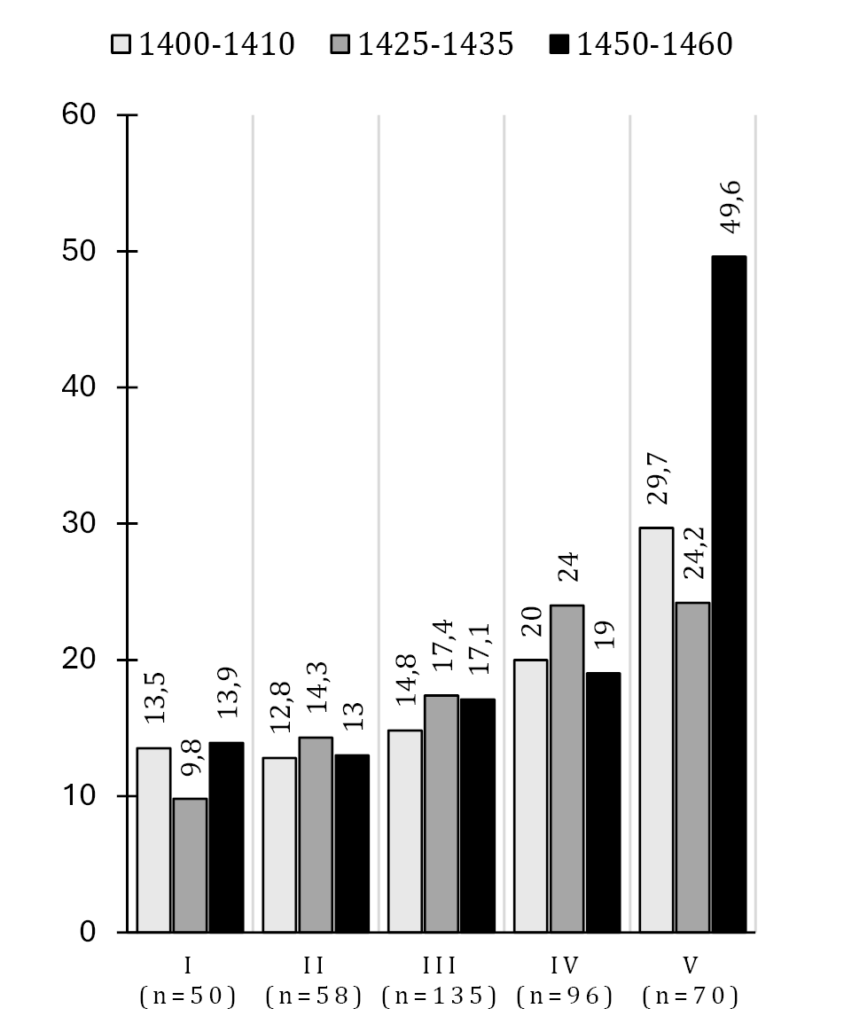
The statistical analysis of the after-death inventories from Barcelona and Vic suggests that, in the early fifteenth century, a median wardrobe of a Catalan urban citizen contained between 12 and 30 garments, depending on the size of the urban center and the social position of the household (Tables 2 & 3, annex, and Fig. 1). In Barcelona, a family typically owned three gowns (gonelles), often paired with four tunics, two doublets and three gramalles or overtunics. Undergarments included three shirts and an equal number of breeches and hoses while outerwear was often composed of three cloaks, usually round-shaped mantles (Table 2, annex). In Vic, a median wardrobe was more modest, typically consisting of two gowns, tunics and doublets, accompanied by an equal number of overtunics and mantles. Underwear included a single shirt and a pair of calces, reflecting a simpler but still diverse selection of clothing (Table 3, annex).
SOURCES: see Table 1 (annex).
Early fifteenth-century Catalan after-death inventories reveal a remarkable diversity of garments, with gowns, tunics and overtunics standing out for their wide range of styles. Beyond the basic gonella and cota or túnica —which appear in nearly half of the inventories— Catalan wardrobes included eleven additional types of tunics or overdresses. The most common among these was the gramalla (Tables 2 & 3, annex)10. Alongside the gramalla, another widely worn garment at the beginning of the fifteenth century was the sac de vestir, a sack-like tunic made to simple patterns, as its name suggests. In terms of popularity, sacs de vestir were followed by aljubes and hopalandes, outer garments of Muslim and Northern European origin, respectively. Tunics worn exclusively by women, such as brials and curtapeus, were also relatively common (Tables 2 & 3, annex)11. By contrast, the presence of other types of tunics and overtunics, such as the cotehardie, huca, and samarra, was merely anecdotal.
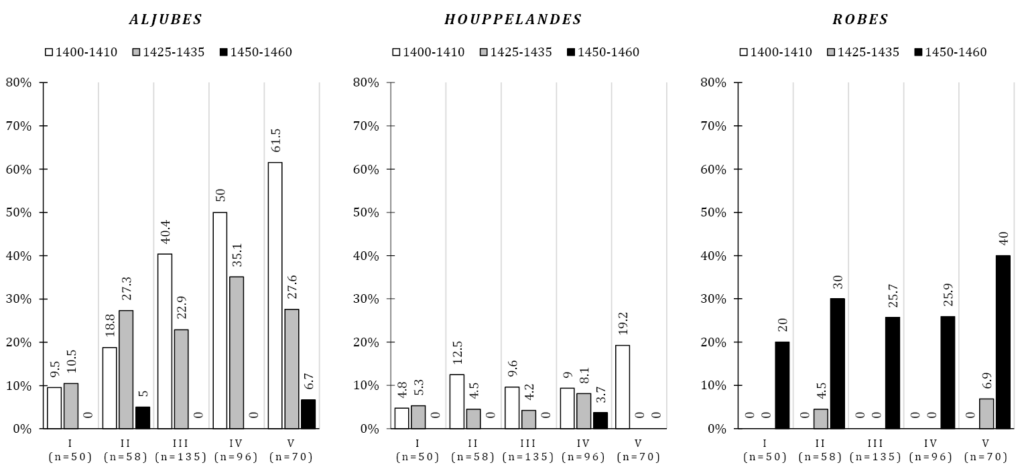
The diversity of garments in early fifteenth-century Catalonia reflected not only stylistic variation, but also social hierarchy. After-death inventories reveal that certain garments were more commonly associated with wealth and higher social status than others. For instance, gramalles were found in 62 to 96 percent of Catalan urban households, depending on geographic location and social position, suggesting that they were not universally worn but rather stratified, with greater prevalence among the elite (Tables 2 & 3, annex, and Fig. 3). Similarly, aljubes were nearly seven times more frequently recorded in inventories belonging to higher social groups than in those of the lower strata. By contrast, hopalandes display no clear social pattern, although they appear more frequently in the wealthiest inventories than in the poorest (Fig. 2). These examples indicate that there was a strong correlation between wealth and the ownership of certain garments, underlining how clothing choices could reflect —and in some cases reinforce— preexisting social divisions12.
SOURCES: see Table 1 (annex).
Over time, some of these garments fell out of fashion, and were replaced by newer styles. For instance, the aljubes and hopalandes experienced a sharp decline that was initially led by the upper social groups, who had been their largest consumers. Their presence persisted slightly longer among the lower-ranking households, likely reflecting a delayed response to changing fashions. However, by the mid-fifteenth century, both garments had virtually vanished from all after-death inventories, regardless of their social position (Tables 2 & 3, annex, and Fig. 2). Their disappearance coincided with the diffusion of the roba, a loose overgarment introduced in the 1430s but only widely adopted from the mid-fifteenth century onwards13. As in the case of the aljubes and hopalandes, the wealthiest groups led this adoption, although by the 1450s, robes were found in inventories from all social groups, reflecting the capacity of lower and middling groups to follow emerging fashions (Fig. 2).
Thus, early fifteenth-century Catalan wardrobes show notable differences in the quantity and typology of garments, which were largely shaped by wealth and place of residence. The wealthiest households possessed significantly more extensive wardrobes than humbler families, often containing twice as many garments (Fig. 1). Moreover, the ownership of certain garments, such as gramalles and aljubes, was deeply stratified, suggesting that the style and cut of clothing could function as markers of social distinction and status. Finally, late medieval Catalan after-death inventories have also shown that stylistic innovations were led by the wealthiest groups, who acted as fashion setters, while the lower social groups sought to emulate them. The aforementioned stylistic changes did not, for the most part, alter the mean and median ownership of garments per household, which remained relatively stable throughout the first half of the fifteenth century (with the exception of the wealthiest social groups) (Fig.1). However, fifteenth-century wardrobes underwent more structural transformations driven by the adoption of new cultural values that will be explored in the following sections.
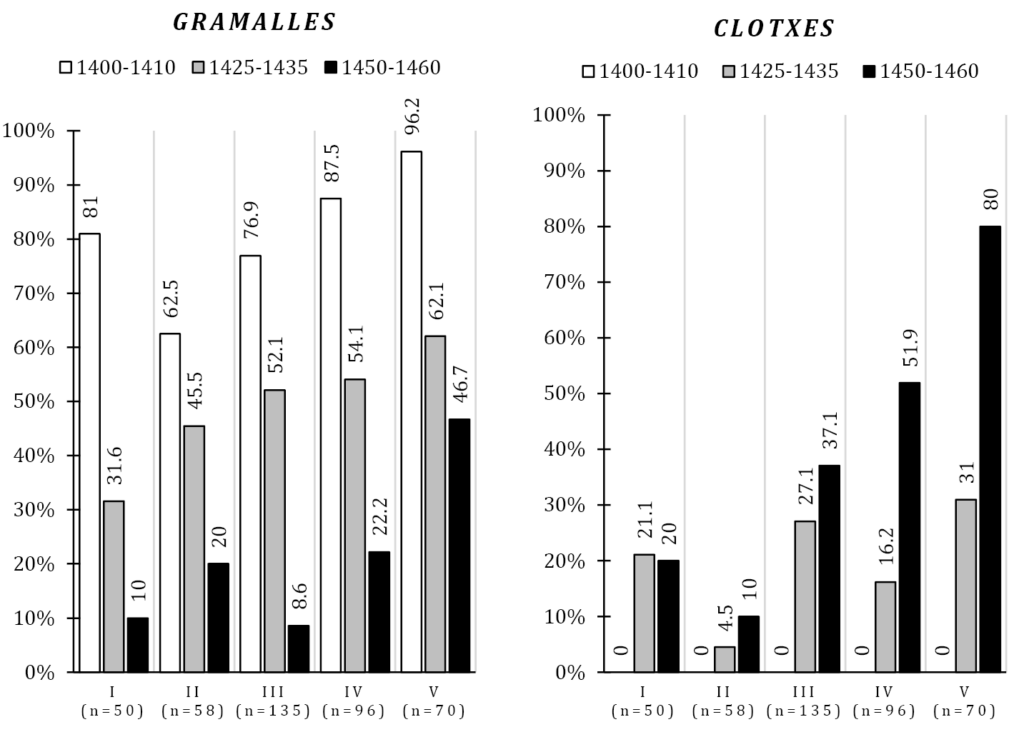
Beyond the aforementioned stylistic developments, the fifteenth century experienced a more profound transformation, centered on mourning and social distinction, that reshaped the way people dressed. Until the first quarter of the fifteenth century, gramalles had served both as functional and ceremonial garments. They covered and protected the body from the cold and rain (gramalles de pluja) like any overtunic, while also functioning as formal garments worn on mourning and festive occasions. At the same time, they served as visual symbols of both political authority and material wealth (Aymeric Bassols, 2018, pp.108-114). Their strong association with grief and death, as well as with wealth and status, contributed to their expansion during the second half of the fourteenth century, particularly after the recurring plagues that devastated the Principality of Catalonia14. In this context of high mortality and growing prosperity, gramalles and their matching hoods (caputxa or caperó) functioned simultaneously as visible reminders of the dead for the wearers and for those who saw them, and as status symbols, given the considerable investment that their elaboration required15. By the early fifteenth century, gramalles reached the peak of their expansion, appearing in 62-96 percent of Catalan urban inventories, while hoods were recorded in 72 to 88 percent of cases (Tables 2 & 3, annex, and Fig. 3).
SOURCES: see Table 1 (annex).
However, after 1410, their popularity sharply declined both in Barcelona and Vic. By the mid-fifteenth century, only a third of the earlier number of consumers in Barcelona —and a fifth in the case of Vic— continued to own gramalles, while hoods also saw a significant drop, falling from 88 to 50 percent in Barcelona and from 72 to 52 percent in Vic(Tables 2, 3 & 6, annex). The decline of gramalles, though widespread across all social groups, was especially notable among the lower ranks. In contrast, the wealthiest households maintained a relatively high level of ownership, signalling a shift in the garment’s cultural significance. Originally worn as an everyday mourning attire and as a status symbol, gramalles gradually lost their earlier appeal in favour of new emblems of mourning. As a result, gramalles were used less frequently for mourning and became more closely associated with civic and political authority16. As in Florence or Venice, where members of city councils wore traditional garments to convey tradition and continuity as a way to legitimate their power, Catalan elites used gramalles to express similar values (McCall, 2022, p.95). These seemingly unchanging garments —made of abundant and costly fabric— served to evoke the civic dignity and enduring authority of those who ruled17. In this context, gramalles persisted primarily among the wealthiest members of Catalan urban society, whose affluence and close ties to public institutions and governance made gramalles a fitting symbol of their elevated status and political influence (Fig. 3)18.
The disappearance of the gramalla was partially compensated for by the adoption of the clotxa, a loose-fitting overgarment, similar to the gramalla, that featured several openings, both at the front and on the sides, and often had lined shoulders, giving its wearer a more robust appearance19. Over the course of the first half of the fifteenth century, the demand for clotxes increased across all social groups, although its use remained most prevalent among the wealthiest households. This socially stratified distribution suggests that clotxes, like gramalles, not only expressed grief and loss, but also wealth and social status. However, despite their growing presence, clotxes never attained the same widespread popularity as the gramalles, especially among the middling and lower social groups, where they appear in no more than 37 percent of the after-death inventories20.
At the same time, black clothing, which was also closely associated with mourning, began to replaced gramalles as a symbol of grief and social distinction21. While in the early fifteenth century black garments accounted for 22 to 25 percent of the inventoried clothing, by the mid-century they represented more than half of the wardrobes of the urban population (Table 4, annex). This chromatic shift suggests that black garments acquired new sociocultural meanings over the course of the fifteenth century. Although the taste for black had already begun to emerge in the aftermath of the Black Death, it was during the first half of the fifteenth century that black became a material expression of deep piety, which reflected the growing influence of new spiritual and devotional currents of that time. Moreover, because of the laborious and expensive processes required to produce a rich and intense black, garments dyed in this shade also became symbols of social distinction and status —gradually displacing red, as black expressed wealth in a more sober and solemn manner (Table 4, annex) (Harvey, 1995, pp.54-56; Pastoureau, 2008, p.96; Hohti, 2022)22.
Black was both difficult and costly to produce. The most common method involved repeatedly immersing the fabric in a woad vat to achieve a deep blue base, which was then mordanted and overdyed in a red madder bath23. The successive application of blue and red dyes produced a fabric known as bruneta, notable for the unique intensity and depth of its black tone. Depending on the number of dyeing baths and the concentration of dyestuff, this technique could produce lighter hues, closer to brown. Independently of the shade of black, this dyeing process was relatively expensive, as it required repeated dye baths and substantial quantities of colorant substances24. Consequently, well-dyed black fabrics could fetch high prices on the Catalan market. According to the early fifteenth-century lists of pending debts recorded in the after-death inventories of Jaume and Tomàs Mateu, cloth merchants of Vic, brunetes were sold, on average, for s.20 d.5 per cana (1.555 m). This price was comparable to that of red textiles — s.21 (excluding those dyed with grana)— or fabrics dyed using more than one colouring substances, such as green —s.21 d.11— or purple —s.2125. This said, high-quality brunetes could fetch over 30 sous per cana, a price rarely surpassed by other fabrics with the exception of imported woolens, which were sometimes dyed with kermes26.
Black could also be obtained using a simpler and less expensive method that combined iron salts and tannin-rich plant substances, such as alder bark, walnuts, chestnuts, and oak galls. When combined in a dye bath with vitriol or iron filings, these materials produced a deep and colourfast black.27 However, cloths dyed without alum—known as molades—were more prone to fading and lost their ‘beautiful black’ more quickly, and consumers could feel they had been deceived28. To preserve the reputation and quality of the local production, the Barcelonese authorities banned these corrosive dyeing techniques, particularly when applied to high-quality English woolens.29 This official concern seems to have aligned with consumer preferences, as molades appear only rarely among the dark garments listed in post-mortem inventories from Barcelona and Vic. Instead, Catalan consumers seemed to favour undyed black cloth, known as burell, which was notably the cheapest fabric on the market, costing on average 12 sous30. This low-cost choice allowed individuals to embrace the social and spiritual connotations of black without the associated expense (Table 4, annex). In doing so, burell, rather than molada, contributed to the broader diffusion of black clothing across different strata of Catalan society.
To conclude, this section has demonstrated how cultural values and fashion functioned as powerful drivers of consumer change in fifteenth-century Catalonia. Traditional gramalles were gradually replaced by clotxes and black clothes as the new symbols of grief and social distinction. Gramalles did not completely disappear, but they became exclusive emblems of civic authority and status. Meanwhile, clotxes gained ground across the Catalan urban population without ever achieving the widespread popularity of their predecessor. Similarly, black clothing grew in importance as a popular expression of mourning and piety. Its value lay not only in its symbolic meaning, but also in the complexity and cost of producing a deep and durable black, often achieved through multiple baths of woad and red madder. These qualities transformed black garments into potent markers of virtue and social standing, allowing their wearers to display wealth and status through a language of restraint rather than ostentation.
New conceptions of status in late medieval Catalonia extended beyond the ownership of clotxes and black garments to include new social standards of sartorial cleanliness. From the mid-fifteenth century onwards, white clean undergarments became markers of social distinction and wealth, particularly among Catalan urban elites, who increasingly changed and washed their linen to maintain a pristine appearance, in accordance with their social rank. This emphasis on personal cleanliness, however, had earlier roots. In the aftermath of the Black Death, undergarments came to be seen as a means to maintain the body clean from sweat, dirt, and other body excretions, substances that were linked to the spread of skin diseases, fleas, and lice. This perception transformed linen into an essential component of the wardrobe, valued not only for the physical comfort it provided, as it shielded the skin from the rough texture of the woolen outerwear, but also for its hygienic function (Vigarello, 1988, pp.43-59).
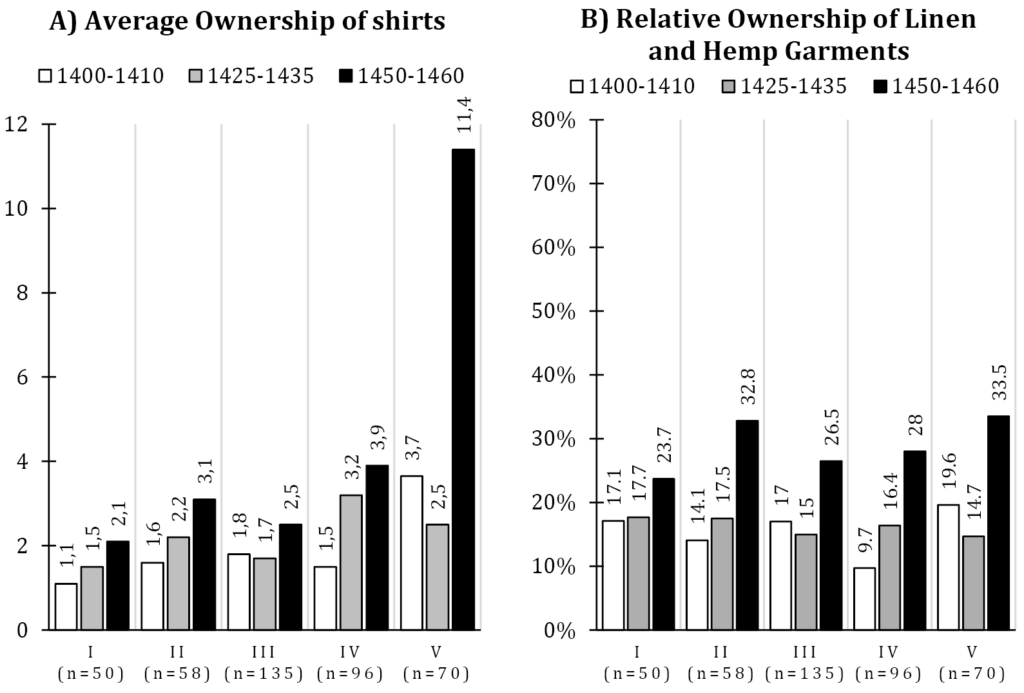
Catalan after-death inventories reflect these new sociocultural attitudes towards linen through a steady increase in the ownership of shirts from 1348 onwards (Palarea Marimón, 2025, p.19). By the early fifteenth century, shirts had become widespread among the Catalan urban population, appearing in nearly 80 percent of inventories in Barcelona and in 50 percent of those in Vic (Tables 2 & 3, annex). Yet, linen shirts were rarely counted in dozens, suggesting that their purpose was more hygienic than social. However, this began to change around the mid fifteenth-century, when the average number of shirts per household rose from 1-4 to 2-11, with the wealthiest experiencing the most notable growth (Fig. 6.A and Tables 2 & 3, annex). At that time, urban households, such as those of Francesc Maldà, Eloi Navel, Galceran de Sentmenat, and Joan Sallent, prominent merchants and nobles from Barcelona and Vic, each came to own twenty shirts or more31. The increase in the amount of personal linen, especially among the urban elites, suggest that the frequency of changing undergarments was accelerated, as the whiteness of shirts became a sign of social distinction (Vigarello, 1988, pp.67-72).
SOURCES: see Table 1 (annex).
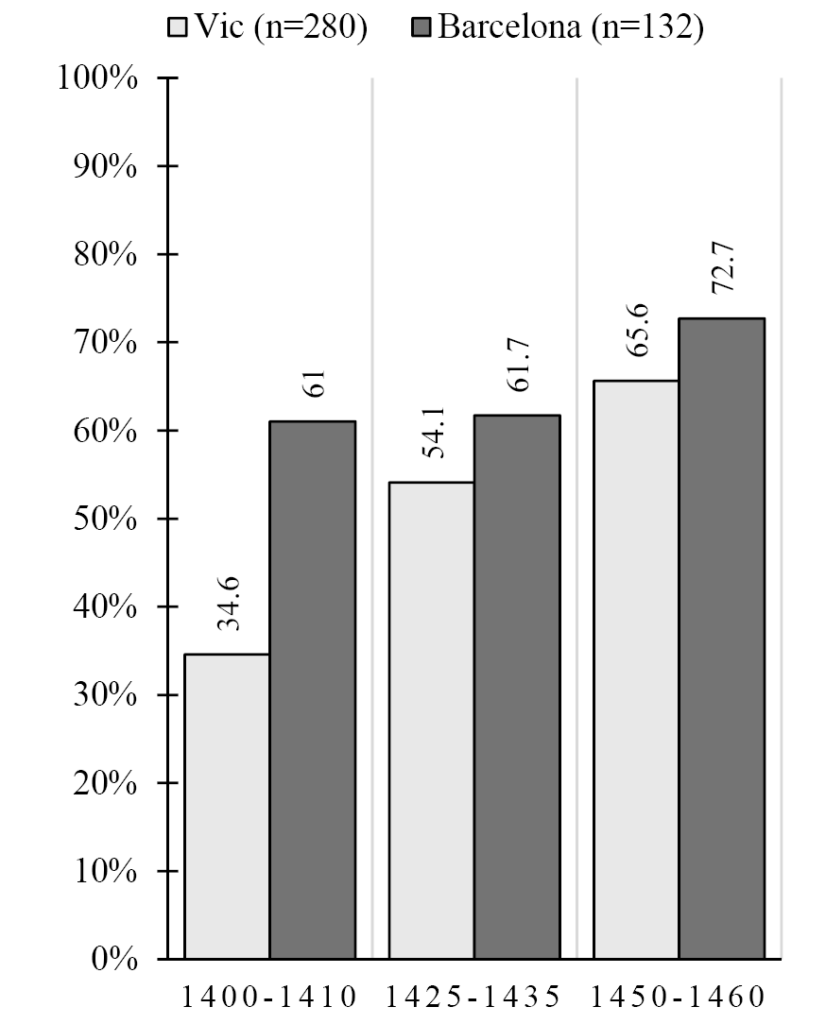
Sartorial cleanliness became a status symbol because maintaining a clean appearance was not a simple task. It required not only a substantial number of linen undergarments for regular changes but also the means to wash them frequently. To wear soiled shirts —which were easily dirtied— not only caused physical discomfort or unpleasant odours but also carried negative social connotations, as it was strongly associated with poverty or low social standing (Vigarello, 1988, p.53). Consequently, the laundering of linens became an essential aspect of everyday domestic life in respectable households. As a result, Catalan post-mortem inventories reveal a significant increase in the ownership of laundry equipment during the first sixty years of the fifteenth century. Washing vats (bugader or cossí), ladles (cassa), sometimes with their associated cauldrons (caldera) and benches (banca), appear increasingly frequently in both Barcelona and Vic, with the latter showing the most pronounced growth (Fig. 5). The rise of all this laundering equipment was driven not only by the need to keep undergarments clean, but also by the care of veils and household linens such as tablecloths, napkins, bedsheets, towels, and cushion covers32. Altogether, these freshly laundered textiles projected an image of cleanliness and respectability, not only for the wearer but also for the household as a whole.
SOURCES: see Table 1 (annex).
The growing presence of laundering equipment in Catalan urban households suggests that the washing of clothes became a more routine aspect of domestic life during the fifteenth century. This task typically fell on the women of the household. However, the physical effort needed for soaking, scrubbing, beating, and rinsing dirty linens, combined with the social stigma of handling soiled items, made this activity unsuitable for women of higher social standing. As a result, it was often necessary, or socially preferable, to hire a professional laundress, although the work might have still been supervised by wives or other female members of the household. In addition to serving wealthy clients or institutions —such as hospitals, which required frequent laundering of their extensive bedding supplies— professional laundresses would have also tended to men without female relatives to carry out this essential domestic task (Ajmar-Wollheim, 2006, pp.152-156; Rawcliffe, 2009, pp.151-152; Robinson, 2021, pp.6-7). This would have been the case of Berenguer Pujals, a Barcelonese priest, whose inventory recorded 2.5 somades of firewood set aside to be sent to a laundress for washing his dirty linen33.
In addition to the growing reliance on female labour —whether domestic or professional— for laundering undergarments, the growing association between sartorial cleanliness and social distinction also had a notable impact on the material composition of clothing. Until the mid-fifteenth century, wool had dominated clothing production, as it made up the majority of garments (62-73 percent). In contrast, linen and hemp were far less common, only representing 12-21 percent of all garments, while other textile fibers like cotton, silk, leather or camlet only appeared sporadically, never exceeding 7 percent of all garments. However, this distribution started to change during the fifteenth century, as linen and hemp undergarments became increasingly more common. Driven by the growing demand for shirts, these vegetable fibres came to represent between a quarter and a third of all the clothing items listed in the Catalan after-death inventories (Tables 2 & 3, annex, and Fig. 4.B). This material shift marked the transition from a European clothing system dominated by wool to a new one largely defined by the interplay between linen and wool, laying the foundation for early modern textile culture.
Thus, this section has shown how personal linens evolved from functional garments used to maintain health and hygiene into markers of social distinction and status during the fifteenth century. From the mid-fifteenth century onwards, the growing emphasis placed by Catalan urban elites on the whiteness of shirts and the frequent changing of undergarments transformed sartorial cleanliness into a key indicator of status. This sociocultural shift had two main implications. First, it redefined gendered domestic labor, as the new standards of cleanliness depended on the regular laundering of garments —a task that largely fell to women. While it increased the domestic workload and further confined women to the home, it also generated a greater demand for professional laundresses, many of whom were widows or the wives of sick, unemployed, or absent men (Ajmar-Wollheim, 2006, pp.152-156; Rawcliffe, 2009, p.151). Second, it reshaped the material composition of clothing, with linen and hemp becoming increasingly predominant alongside woolens. The rising demand for shirts contributed to the expansion of the linen and hemp industries, establishing them as key sectors within the European clothing production.
In terms of gender, fifteenth-century wardrobes also underwent significant changes. Until the beginning of the century, most garments had been worn by both men and women alike, although certain distinctions did exist. The main difference lay in male dress, particularly in the doublet (gipó or farset) with its attached stockings (calçes). Tightly cinched at the waist and padded at the chest and shoulders, the doublet sculpted a V-shaped male torso in accordance with the ideal of belligerent masculinity of that time. Its short cut left the legs fully exposed. These were covered with closely fitted stockings that aimed to accentuate their length, slenderness, and agility, projecting an image of strength when in motion. Together, the doublet and stockings revealed almost every part of the male body, contributing not only to its stylization but also to its eroticization (Blanc, 2002, pp.157-172; McCall, 2022, pp.106-109 and 112). The adoption of the doublet and stockings progressed steadily during the fourteenth century, and by the early fifteenth century, this ensemble had become a defining feature of male attire, appearing in 71 to 83 per cent of the inventories (Tables 2 & 3, annex) (García Marsilla and Almenar Fernández, 2022, pp.351-353; Palarea Marimón, 2025, p.10).
The invention of the doublet in the fourteenth century implied that men could be easily recognizable through their attire. In contrast, women had no equivalent gender-specific markers that enhanced the aesthetic ideals of femininity to the same degree. Early fifteenth-century female wardrobes included several gender-specific tunics —such as the brial, the curtapeus, and during the 1420s-1430s, the albergó— as well as other gowns and tunics that were closely fitted at the bodice and arms, with front or underarm openings that extended to the hips and were secured with buttons and laces (Tables 2 & 3, annex)34. These garments accentuated the female body but did not reshape the figure. Thus, in the early fifteenth century, sartorial gender distinctions were primarily articulated through male dress —especially the doublet— that defined the aesthetic ideal of masculinity. However, this situation would begin to change in the fifteenth century, with the emergence of the bodice or short tunic (cosset) and the skirt (faldeta)35.
The adoption of the cosset and the faldeta was a slow and gradual process. At the beginning of the fifteenth century, bodices were still relatively uncommon, appearing in only one fifth of households, primarily in larger urban centres. Over time, their presence increased, and, by the mid-fifteenth century, the cosset had become a widely accepted garment, even if not universally adopted (Tables 2 & 3, annex). Around this time, women began to wear a faldeta, an under-skirt worn beneath the tunic or overtunic that added volume around the hips, especially when several were worn one on top of the other (Bernis, 1978, p. 14; Bernis, 1979, p. 86). The combination of a tightly laced bodice with voluminous faldetes came to accentuate the chest and hips of women in accordance with the aesthetic ideals of femininity. In doing so, women’s dress came to mirror the predominant fashion trend in men’s attire, emphasizing the distinct body shapes associated with each gender’s ideal.
This distinct female attire was further enriched by the introduction of the pordomàs, a shorter female mantle that emerged during the central decades of the fifteenth century and gradually replaced the larger and more traditional mantell or mantó (Tables 2 & 3, annex)36. Additionally, female headwear became increasingly more elaborate, with crinkled and puffed veils (vels cespats and estufats) standing out for their popularity, alongside hair nets (gandalles) and braids (trenes), which were often made of silk and gold threads and richly adorned with silver and gold leaves (Table 6, annex)37. Finally, among the wealthiest households, women’s appearance was completed with a pair of cork-soled platform shoes (tapins or patins) designed to increase the wearer’s height and elongate the female figure while at the same time they restricted movement, forcing women to take short and careful steps38. Due to their impracticality, tapins were largely restricted to elite households, appearing in no more than 10 percent of inventories and predominantly in Barcelona39.
Thus, much like men’s fashion, women’s garments increasingly remolded the body, enhancing its most feminine traits. This process continued throughout the second half of the fifteenth and the early sixteenth century, with the introduction of the farthingale (verdugo), a skirt reinforced with rigid hoops that gave a rounded silhouette to its female wearer (Bernis, 1979, p. 38-41; Martínez Martínez, 2006, pp. 346 and 351; Bernis and Descalzo, 2014, pp. 48-50 and 59-62)40. In parallel, men’s clothing also adopted new sartorial innovations. From the mid-fifteenth century onwards, traditional mantles were replaced by shorter and more tailored jackets and coats (jaquetes and gavardines), which further outlined the male silhouette, while hats and bonnets became the preferred choice of headwear among Catalan men (Table 6, annex)41. These developments in tailoring would further contribute to the growing differentiation between men and women, as part of a broader process of identity construction in which clothes rendered gender visible. As a powerful form of visual language, dress came to manifest sexual difference in accordance with the prevailing conventions of masculinity and femininity and in doing so, it participated in the construction of gender itself, shaping men and women both physically and socially42.
This article has analyzed the consumption of clothing in fifteenth-century Catalonia. Drawing on 410 after-death inventories from Barcelona and Vic, it has demonstrated the ways in which the ownership and social distribution of garments was shaped by purchasing power and market access. Moreover, it has also shown that structural changes in consumption patterns were closely tied to evolving cultural values, especially those associated with status and gender. Over the course of the century, new conceptions of status emerged —defined by a preference for black clothing and clean undergarments— which reflected a shift toward more complex forms of luxury, which were further reinforced by material distinctions and the adherence to contemporary fashion trends, such as the roba or the clotxa43. At the same time, clothing also came to express gender differentiation more explicitly, with the adoption of distinct garments and accessories for women. The cosset and faldeta came to highlight feminine beauty in a manner comparable to how the tight-fitting doublet and stockings had enhanced the ideals of masculine strength and agility in the previous century. In doing so, dress became a key instrument in the social construction of gender and status44.
These sartorial shifts had far-reaching economic and gendered consequences. The increasing demand for well-dyed black fabrics and new garments and accessories across Catalan urban society contributed to the professionalization and specialization of dyers, tailors, and related professions45. In parallel, the growing emphasis on sartorial cleanliness stimulated the development of local linen and hemp industries, while also fostering the importation of high-quality linens and mercery goods from Northern Europe46. Additionally, maintaining a respectable and clean appearance required substantial quantities of linen (and hemp), which increased inequality in the ownership of garments, as evidenced by the rising standard deviation between 1400 and 1460 (Tables 2 & 3, annex). While wealthy households used large amounts of personal linen to distinguish themselves through cleanliness, garment ownership among the rest of Catalan urban society remained relatively stable throughout this period (Fig.1). Finally, the growing emphasis on sartorial cleanliness also reconfigured labor dynamics as the need for frequent laundering increased both the domestic workload of women and the demand for professional laundresses47.
Arxiu de la Catedral de Barcelona (ACB)
Arxiu Històric de Protocols de Barcelona (AHPB)
Arxiu Històric de la Ciutat de Barcelona (AHCB)
Arxiu i Biblioteca Episcopal de Vic (ABEV): Arxiu de la Cúria Fumada (ACF)
AGUILÓ I FUSTER, Mariàn. 1916. Diccionari Aguiló. Materials lexicogràfics aplegats. III. Barcelona: Institut d’Estudis Catalans-Palau de la Diputació.
AJMAR-WOLLHEIM, Marta. 2006. Housework. In Marta AJMAR-WOLLHEIM; Flora DENNIS (eds), At Home in Renaissance Italy. London: V & A Publications, 152-163.
ARKELL, Tom. 2006. The Probate Process. In Tom ARKELL; Nesta EVANS; Nigel GOOSE (eds), When Death Do us Part: Understanding and Interpreting the Probate Records of Early Modern England. Hatfield: University of Hertfordshire Press, 3-13.
AYMERICH BASSOLS, Montse. 2018. La moda a la Catalunya del segle xiv. Retalls de la vida medieval. Barcelona: Índex.
BARTHES, Roland. 1990. The Fashion System. Los Angeles & London: University of California Press.
BATLLE I GALLART, Carme. 2007. Estudi Històric del ‘Llibre del Consell’. In Carme BATLLE I GALLART; Maria T. FERRER I MALLOL; Maria C. MAÑÉ I MAS; Josepfina MUTGÉ I VIVES; Sebastià RIERA I VIADER; Manuel ROVIRA I SOLÀ (eds), El ‘Llibre del Consell’ de la ciutat de Barcelona. Segle xiv: les eleccions municipals. Barcelona: CSIC, 13-47.
BENAVIDES HELBIG, Jesús. 2017. Para una historia de las sociedades mercantiles catalanas. Estudio complete del Dietari Honzè de la Compañía Torralba (10 de mayo del 1434-agosto del 1437). PhD dissertation. Universidad de Barcelona. Available at: https://www.tesisenred. net/handle/10803/462139 (Accessed: 1 May 2025).
BERNIS, Carmen. 1949. El tocado masculino en Castilla durante el último cuarto del siglo xv: los bonetes. Archivo Español de Arte 21(81): 20-42.
BERNIS, Carmen. 1978. Trajes y modas en la España de los Reyes Católicos. I. Madrid: Instituto Diego Velázquez.
BERNIS, Carmen. 1979. Trajes y modas en la España de los Reyes Católicos. II. Madrid: Instituto Diego Velázquez.
BERNIS CARRO, Carmen; DESCALZO LORENZO, Amalia. 2014. El vestido femenino español en la época de los Austrias. In José Luis COLOMER; Amalia DESCALZO LORENZO (eds), Vestir a la española en las cortes europeas (siglos xvi y xvii). Madrid: Centro de Estudios Europa Hispánica, 39-76.
BLANC, Odile. (2002). From Battlefield to Court: The Invention of Fashion in the Fourteenth Century. In Desiree G. KOSLIN; Janet SNYDER(eds), Encountering medieval textiles and dress: objects, texts, images. New York: Palgrave Macmillan, 157-172.
BLONDÉ, Bruno; VAN DAMME, Ilja. (2010). Retail growth and consumer changes in a declining urban economy: Antwerp (1650-1750). Economic History Review 63(3): 638-663.
BONNASSIE, Pierre. 1975. La organización del trabajo en Barcelona a fines del siglo xv. Barcelona: CSIC.
CARDON, Dominique. 2007. Natural dyes: sources, tradition, technology and science. London: Archetype.
CIFUENTES COMAMALA, Lluís; CÓRDOBA DE LA LLAVE, Ricardo. 2011. Tintorería y medicina en la Valencia del siglo xv: El manula de Joanot Valero. Barcelona: CSIC.
CRANE, Susan. 2002. The Performance of Self: Ritual, Clothing and Identity during the Hundred Years War. Philadelphia: University of Pennsylvania Press.
DYER, Christopher. 1989. The consumer and the market in the later Middle Ages. Economic History Review 42 (3): 305-327.
FERNÁNDEZ TRABAL, Josep. 1999. De prohoms a ciudadanos honrados: Aproximación al estudio de las elites urbanas de la sociedad catalana bajomedieval (s. xiv-xv). Revista d’historia medieval 10: 331-370.
FRANCESCHI, Franco. 2015. Woollen luxury cloth in late medieval Italy. In Bart LAMBERT; Katherine A. WILSON (eds), Europe’s rich fabric. The consumption, commercialisation, and production of luxury textiles in Italy, the Low Countries and neighbouring territories (fourteenth-sixteenth centuries). Burlington: Ashgate, 181-204.
GARCÍA MARSILLA, Juan V. 2014. El lujo cambiante. El vestido y la difusión de las modas en la Corona de Aragón (siglos xiii-xv). Anales de Historia del Arte 24: 227-244.
GARCÍA MARSILLA, Juan V. 2017. La moda no es capricho. Mensajes y funciones del vestido en la Edad Media. Vínculos de Historia 6: 71-88.
GARCÍA MARSILLA, Juan V.; ALMENAR FERNÁNDEZ, Luis. 2022. Fashion, emulation and social classes in late medieval Valencia. Exploring textile consumption through probate inventories. In Giampiero NIGRO (ed), La moda come motore economico: innovazione di processo e prodotto, nuove strategie commerciali, comportamento dei consumatori/Fashion as an economic engine: process and product innovation, commercial strategies, consumer behavior. Florence: Firenze University Press, 341-366.
HARVEY, John. 1995. Men in Black. London: Reaktion Books.
HEERS, Jacques. 1976. La mode et les marches des draps de laine: Gênes et la montagne a la fin du Moyen Âge. In Marco SPALLANZANI (ed), Produzione, commercio e consumo dei panni di lana (nei secoli xii–xviii). Florence: Leo S. Olschki, pp. 199-220.
HELLER, Sarah G. 2007. Fashion in medieval France. Cambridge: Brewer.
HOHTI, Paula. 2022. Power, Black Clothing, and the Chromatic Politics of Textiles in Renaissance Europe. In Jenny BOULBOULLÉ; Sven DUPRÉ (eds), Burgundian Black: Reworking Early Modern Colour Technologies. Santa Barbara: EMC Imprint. Available at: https://burgundianblack.tome.press/chapter/power-black-clothing-and-the-chromatic-politics-of-textiles-in-renaissance-europe/ (Accessed: 1 May 2025)
JONES, Ann R.; STALLYBRASS, Peter. 2000. Renaissance clothing and the materials of memory. Cambridge: Cambridge University Press.
MCCALL, Timothy. 2022. Brilliant Bodies. Fashioning Courtly Men in early Renaissance Italy. Pennsylvania: Pennsylvania State University Press.
MARANGES I PRAT, Isidra. 1991. La indumentària civil catalana: segles xiii–xv. Barcelona; Institut d’Estudis Catalans.
MARTÍNEZ MARTÍNEZ, María. 2006. La creación de una moda propia en la España de los Reyes Católicos. Aragón en la Edad Media 19: 343-380.
MARTÍNEZ VINAT, Juan. 2018. Cofradías y oficiós. Entre la acción confraternal y la organización corporativa en la Valencia medieval (1238-1516). PhD dissertation. Universitat de València. Available at: https://producciocientifica.uv.es/documentos/5eb09d0a29995276411 240a0 (Accessed: 1 May 2025)
MARTORELL, Joanot. 2008. Tirant lo Blanch (edició i notes d’Albert Hauf). Valencia: Tirant lo Blanch.
MAS FERRER, Josep. 2024. Late pre-industrial production and consumption in poor rural households (north-eastern Catalonia, 1750-1807). Historia Agraria 93: 1-30.
MORENO CLAVERÍAS, Belén. 2018. Els inventaris post-mortem: una font per a la història econòmica i social. Girona: Universitat de Girona.
MUNRO, John H. 2007. The anti-red shift to the ‘Dark Side’: Colour changes in Flemish luxury woollens, 1300-1550. Medieval Clothing and Textiles 3: 55-95.
MUZZARELLI, Maria Giuseppina. 1999. Guardaroba medievale. Vesti e società dal xiii al xvi secolo. Bologna: Il Mulino.
NEWTON, Stella Mary. 1980. Fashion in the Age of the Black Prince. A study of the years 1340-1365. Woodbridge and Totowa: Boydell Press.
PALAREA MARIMÓN, Aina. 2024a. Methodological Puzzle: The Representativeness of after-death inventories without monetary valuations. The case of Vic (1400-1460). Espacio, Tiempo y Forma. Serie III Historia medieval 37: 881-912.
PALAREA MARIMÓN, Aina. 2024b. Silk consumption and dressing practices in late-medieval
Catalonia: the cases of Barcelona and Vic (1400–1460). Revista de Historia Económica / Journal of Iberian and Latin American Economic History 42(3): 355-385.
PALAREA MARIMÓN, Aina. 2025. The Second Half of the Fourteenth Century, a Golden Age for the Peasantry? Peasant Consumption in Central and North-Eastern Catalonia (1348-1410). Anuario de Estudios Medievales 55 (2): 1-26.
PASTOUREAU, Michel. 2008. Black: The History of a Color. NewJersey: Princeton University Press.
PIPONNIER, Françoise; MANE, Perrine. 1995. Se vêtir au Moyen Âge. Paris: A. Biro.
RAWCLIFFE, Carole. 2009. A Marginal Occupation? The Medieval Laundress and Her Work. Gender & History 21(1): 147-169.
ROBINSON, Michele Nicole. 2021. Dirty Laundry: Caring for Clothing in Early Modern Italy. Costume 55(1): 3-23.
SALES I FAVÀ, Lluís. 2022. Crèdit privat i morositat a la Catalunya baixmedieval: Baronia de Llagostera, 1330-1395. Madrid: Consejo Superior de Investigaciones Científicas.
SHAMMAS, Carole. 1990. The Pre-Industrial Consumer in England and America. Oxford-New York: Clarendon Press-Oxford University Press.
TOSI BRANDI, Elisa. 2014. Il velo bolognese nei secoli xiv-XVI. Produzioni e tipologia. In Maria Giuseppina MUZZARELLI; Maria Grazia NICO OTTAVIANI; Gabriella ZARRI. (eds), Il velo in area mediterranea fra storia e simbolo. Tardo Medioevo-prima Età moderna. Bologna: Il Mulino, pp. 289-305.
VIGARELLO, Georges. 1988. Concepts of Cleanliness: Changing Attitudes in France since the Middle Ages. Cambridge & New York: Cambridge University Press.
VILLANUEVA MORTE, Concepción. 2024. Confección y consumo femenino de chapines en Aragón entre la Edad Media y la Modernidad. Medievalismo 34: 307-354.
WEATHERILL, Lorna. 1988. Consumer Behaviour and Material Culture in Britain 1660-1760. London and New York: Routledge.
1. Although the fourteenth century holds significant importance for the history of fashion, its origins should be traced back to the twelfth century (Heller, 2007, p.53 and pp.56-59). For a brief overview of late medieval fashion, especially centered in the Iberian Peninsula, see: García Marsilla (2017).
2. Regarding the various types of luxury in clothing, see: Muzzarelli (1999, pp. 311-312, 316); García Marsilla (2014, pp. 233-239).
3. Among the few exceptions, it is worth noting the work of Heers (1976).
4. The term after-death inventory is used in preference to probate inventory in order to reflect the specific legal and institutional context of late medieval Catalonia. Unlike English probate inventories—typically compiled under the authority of manorial or ecclesiastical courts as part of the process of proving wills or administrating estates—Catalan inventories were produced within a broader notarial and documentary culture rooted in Roman law traditions. Catalan jurisdictional courts also compiled inventories, but these were typically drawn up in the context of debt enforcement proceedings (Sales i Favà, 2022, pp.320-323). Thus, the use of after-death inventory avoids the implication of an Anglo-centric model of estate administration and highlights the distinctiveness of the Catalan legal framework, where inventories compiled by jurisdictional courts typically served purposes of debt enforcement rather than the distribution of an estate among the heirs. On the Catalano-Aragonese legislation and the recording of after-death inventories, see: PALAREA MARIMÓN (2024a, pp. 885-890) and MORENO CLAVERÍAS (2018). On the English probate process, see: Arkell (2006).
5. On key determinants of consumption, see: WEATHERILL (1988, pp.75-90, 105-109,185-189); DYER (1989); SHAMMAS (1990, pp.103-111, 173-180).
6. In the case of Vic, it was possible to cross-tabulate the households’ position in the local wealth taxes of 1422, 1427, 1453 and 1455 with the number of rooms listed in the after-death inventories. The results reveal a correlation of 0.59-0.61 (with a p-value of <.001). Based on this analysis, it is possible to conclude that the number of rooms listed in the after-death inventories is a valid indicator of wealth, enabling the social classification of after-death inventories with no monetary valuations, such as the Catalan ones (Palarea Marimón, 2024a). The accuracy of this methodology improves over time, as the number of rooms tends to better reflect social stratification in later periods. See: BLONDÉ and VAN DAMME (2010, pp. 661-663) and MAS FERRER (2024, pp. 9-10).
7. This category mainly comprised women (52 percent) —especially widows that lived on their own—, impoverished artisans (20 percent), members of the lower ecclesiastical hierarchy (10 percent), as well as some workers, servants, musicians, officials, and medical professionals.
8. The inventory of Bartomeu Roig includes a loose sheet of paper listing the expenses that Isabela, widow of the deceased, made for the upkeep of her son, Esteve. Between August and October of 1418, she purchased four pairs of shoes, priced at 7 to 9 pence each (AHCB, Arxiu Notarial, I-3. 1418, August-October).
9. This figure has been considered as the bare minimum number of clothes that an individual needed in the fourteenth and fifteenth centuries (García Marsilla, 2014, p. 230; Newton, 1980, p. 4).
10. A gramalla was an overcoat characterized by its short and voluminous sleeves (ales), which were no true sleeves but wide extensions over the shoulders and part of the forearms, that could be unfolded when the arm was moved, creating a striking visual effect (Aymeric Bassols, 2018, p.103).
11. On these feminine garments, see: MARANGES I PRAT (1991, pp.44-45); AYMERIC BASSOLS (2018, pp.188-193); BERNIS (1978, pp. 14-15).
12. Pearson’s chi-square tests indicate that ownership of gramalles (χ²(4) = 11.56, p = 0.021) and aljubes (χ²(4) = 17.56, p = 0.002) was significantly associated with wealth. By contrast, no statistically significant relationship was found between social status and the ownership of hopalandes (χ²(4) = 2.88, p = 0.578)..
13. The roba was a loose overtunic similar to the hopalandes but featuring wide openings, either at the front, on the sides, or both. In Tirant lo Blanch, a fifteenth-century Catalan chivalric novel, it is said that the roba could be“fesa a costats” or “uberta a quatre parts” (Martorell, 2008, p. 485 and p. 1445). These descriptions fit with the one given by Carmen Bernis in: Bernis (1978, p.15).
14. As early as 1345, the sumptuary laws of Barcelona indicate that mourning had become a well-established ostentatious practice in this city: “que null hom ne nulla dona, qui sia de Barchelona de qualque estament o condició sia, no gos fer-ne portar, d’aquí avant, vestadures negunes de dol per neguna persona qui muyra, si donchs no era son senyor o sa dona, o pare o mare, o avi o hàvia, o fill o filla, o germà o germana, o persona qui·l jaquescha hereu, o dona qui perdà marit o marit se puxa vestir si·s vol per sa muller com morra; salvant que hom puxa portar gramayla e caperó de dol blava o altra, e dona puxa portar capa morada o altre el dia que·l cors se soterrarà e VIII dies aprés tant solament” (AHCB, 1B.I-17. Llibre del Consell (1345-1346), ff. 30v-31v. 1345). This prohibition was reiterated in in the years following the plague of 1371-1372 and the famine of 1374-1375, revealing its widespread use in times of high mortality (AHCB, 1B.I-24. Llibre del consell (1373-1376), f. 25r (16 January 1373), f. 79v (4 August 1375), ff. 138r-139r (5 May 1376)). The use of gramalles as mourning garments is futher attested in fourteenth-century funerary sculpture, especially in the figures of the ploraners —male mourners depicted weeping and dressed in gramalles (Aymeric Bassols, 2018, pp.122-125). On the social spread of gramalles in the late fourteenth century, see: Palarea Marimón (2025, pp.10-11).
15. Gramalles were among the most frequently bequeathed garments in Catalan testaments. When newly commissioned by a testator, they were often quite expensive —costing up to 50 sous for a gramalla de (ABEV, ACF, vol. 3544/2, ff.2v-4v. 2 January 1434). That gramalles implied conspicuous amounts of cloth is further confirmed by the fifteenth-century sumptuary legislation of Barcelona, which sought to regulate their length: “gramalles de dol axí largues que·s puxen roçegar I palm de cana de Barchelona, qualcom més o menys” (AHCB, 1B.IV-6. Registre d’ordinacions (1433-1445), ff. 25r-27r. 7 October 1434). On cloth bequests and memory, see: Jones and Stallybrass, 2000, pp.248-260.
16. In the mid-fifteenth century, Catalan after-death inventories frequently mentioned mourning gramalles. See, for instance: “un gramaya de dol e caperó, molt sotil” (ABEV, ACF, vol. 3780, ff. 213r-215v. 2 March 1458) and “una gramaya de dol de pocha valor negra” (ABEV, ACF, vol. 3781, ff. 58r-69r. 28 October 1460).
17. In 1476, Gabriel Turell explicitly connected the greatness of Barcelona with the dignity of its municipal councillors, whom he regarded as the successors of the Roman senators (Fernández Trabal, 1999, p.349).
18. The continued ownership of gramalles among middling and lower social groups in the mid-fifteenth century can be attributed both to their enduring role as mourning garments and to the participation of these groups in municipal governance, where representation was shared among ciutadans honrats, merchants, and artisans and artists (Batlle i Gallart, 2007). Moreover, officials, such as the veguers, also wore gramalles (AHCB, 1B. XI-48. Llibre de Clavaria (1433-1434), f. 118r. 12 November 1433).
19. “huna clotxe o gramalla de dol” (AHPB, 175/91, f. 133r-146v. 28 November 1457), “una gramaya de bruneta, nova, feta a manera de clotxa” (ABEV, ACF, vol. 3766, ff. 149r-168v. 23 October, 1431). Regarding the openings on this garment, see: Aguiló i Fuster (1916), p. 191. On its lined shoulders, see: “una clotxa de bruneta, folrade a les spatles de tela negre, bona” (ABEV, ACF, vol. 3780, ff. 193r-198v. 11 August 1458) and “una clotxa de bruneta, nova, ab les spatles folrades de tela negra” (ABEV, ACF, vol. 3777, ff. 58r-86v. 15 January 1454).
20. Even when the ownership of clotxes and gramalles is considered jointly, their combined presence in the mid-fifteenth century did not match the early diffusion of gramalles alone. In the mid-fifteenth century, 30 percent of households in categories I and II owned either a gramalla or a clotxa; this figure rose to 45.7 percent for category III and 63 percent for category IV. The highest level of ownership was found among the wealthiest households belonging to category V where gramalles or clotxes appeared in 86.7 percent of the inventories.
21. On the symbolic and social connotations of black clothing, see: Harvey, 1995, pp.45-69 and Pastoureau, 2008, pp.95-103. In the Catalan context, the testament of Guillem Mas, a canon of the cathedral of Barcelona, provides a clear example of black clothing being used as mourning attire. In his last will, he stipulated that “all the members of his house were to be dressed in black (sien vestits de drap negre)” after his death (AHPB Pere Pasqual 191/71 ff.7v-9v. 26 May 1456).
22. On the early expansion of dark garments, see: García Marsilla and Almenar Fernández (2022, p.361); Palarea Marimón (2025, pp.10-11).
23. On woad and black, see: Cardon (2007, pp. 369-374); Cifuentes Comamala and Cordoba De La Llave (2011, pp. 103-104, 175 and 235-237).
24. In Barcelona, the municipal ordinance identified twenty different shades of blues. According to their price, blue tones ranged from 20 sous to 200 sous. Black cloths (brunetes) had to be dyed in a blue of at least 60 sous while luxury black cloths made of English wool had to be dyed in a blue of 120 sous or above (AHCB, 1B. XXXVI-3. 22 November 1438).
25. These figures exclude textiles of foreign origin but include those held in stock at the time of their death (ABEV, ACF, vol. 3884, ff. 13r-42v and ff. 81v-97r. 22 March 1409 and 5 October 1415).
26. It is important to note that the value of woolens in the fourteenth and fifteenth centuries was not determined solely by their dyeing, but also by the quality of the raw materials and the density of the warp (Franceschi, 2015, p. 196).
27. Cardon (2007, pp. 409-410, 415-417, 431-434); Cifuentes Comamala and Cordoba De La Llave (2011, pp. 75, 175, 185); Hohti (2022).
28. “Item, ordonare los dits consellers e prohomens de la dita ciutat que d’ací avant no puxen ésser portades, messes ne tallades en la dita ciutat ne semblanement en aquella no puxen ésser fetes brunetes menys de alumenar e acolorades de vedriol ne altres colors sofisticades per çó com són comprades per lo bell negre que mostren haver e tentost perden la color e lo públich és ha decebut” (AHCB, 1B. XXXVI-3. 14 June 1435).
29. AHCB, 1B. IV-4, f. 78r. 21 April 1417 and AHCB, 1B. XXXVI-3. 22 November 1438.
30. ABEV, ACF, vol. 3884, ff. 13r-42v and ff. 81v-97r. 22 March 1409 and 5 October 1415.
31. They each owned 25, 38, 20, and 31 shirts, respectively (AHPB, 175/91, f. 117r-132v. 10 November 1457; AHCB, Arxiu Notarial, Inventaris, I-10.4 July 1457; AHCB, Arxiu Notarial, Inventaris, I-9. 7 September 1450; ABEV, ACF, vol. 3779, ff. 238r-267v. 19 August 1457).
32. The inventory of Pere Valladolid, butcher from Vic, listed three washing vats, including one specifically used for veils. That of Eloi Navel, merchant from Barcelona, included a list of freshly laundered linens (“la roba qui és exida de la bugada”) which comprised six tablecloths, fourteen napkins, thirteen shirts, eleven bedsheets, ten towels, and two cushion covers (ABEV, ACF, vol. 3779, ff. 49r-54r. 20 September 1457; AHCB, Arxiu Notarial, Inventaris, I-10. 4 July 1457).
33. ACB, Julià de Roure, vol. 513, ff. 155r-163v. 3 February 1433.
34. On albergons, Catalan after-death inventories indicate that they were female garments. See, for instance: “I albarjó de dona de drap de lana scur de pocha valor” (ACB, Julià de Roure, vol. 513, ff. 176r-177v. 4 February 1433), “un alberyó de drap blau de na Eulàlia, fila del dit deffunt, de pocha valor” (ACB, Gabriel Canyelles, vol. 348. 17 January 1431); “I albergó de baguinat d’ús de la dita dona” and “I albergonet blau d’infanta” (ABEV, ACF-3770, f. 142r-156r. 19 September 1431); “I albergó vermey o de sanguínea de la dita dona” (ABEV, ACF, vol. 3773, f. 211r-222v. 23 September 1430). On tight-fitting female garments, see: Piponnier and Mane (1995, p. 98). Additionally, Catalan after-death inventories contained numerous examples of smaller, buttoned or lace female garments, for instance: “una gonella de dona de verví vermell, ab brahons, sens punyets, ab cordadura devant” (ABEV, ACF, vol. 3753, ff. 419r-435v. 29 July 1402); “una cota de dona, fesa, ab botons, quaix de la dita color” (ABEV, ACF, vol. 3708, ff. 103r-108v. 13 August 1410); “I samarró de dona de drap vermell de verví, botonat devant, en les mànegues orles de bays” (ABEV, ACF, vol. 3753, ff. 355r-362v. 4 August 1402); “IIes gonelles blanques, botonades devant, de pocha valor” (ACB, Gabriel Canyelles, vol. 343, plec 14. 8 June 1406); “I çamarró de drap tanat, ab botons a cascun costat” (ACB, Gabriel Canyelles, vol. 341, plec 15. 24 September 1404); “una aljuba de dona, cordonera a dos costats, de drap beguinat de la terra” (ACB, Gabriel Canyelles, vol. 342, plec 28. 25 April 1404).
35. “unum corset sive gonel de blanqueto modice valoris” (AHCB, Arxiu Notarial, Inventaris, I-3. 15 January 1408); “II cossets de dona de drap de li, la I brodat de seda verda, l’altre de seda blava, ab una ligadeta d’or cascu” (AHCB, Arxiu Notarial, Inventaris, I-9. 5 November 1450); “I cosset de seda groch ab ligada d’or, sotil” (ABEV, ACF, vol. 3787. 20 September 1476).
36. The sumptuary legislation of Barcelona mentioned the pordomàs together with other types of mantles such as mantetes and mantos navarreschs (AHCB, 1B. IV-6, ff. 25r-27r. 7 October 1434). According to the account books of Joan Torralba, a prominent Barcelonese merchant, the pordomàs was no longer than 1.6 meters (1 cana) (Benavides Helbig, 2017, p. 399 and p. 562). In comparison, large mantells could double the size of the pordomàs (“I mantell gran de bruneta de III canes e mige” (ABEV, ACF, vol. 3787. 30 June 1477)).
37. “una trena de fil d’or ab fulletes” (ABEV, ACF, vol. 3779, ff. 140r-163v. 15 November 1457); “una gandalla d’or ab fulletes, bona” (AHPB, 175/91, f. 095r-098v. 13 September 1457); “una gandalla d’or ab fulletes ab se trena” (ABEV, ACF, vol. 3779, ff. 9r-22r. 2 November 1457). From 1434 onwards, sumptuary legislation in Barcelona began to regulate the value of gold used in personal adornments, setting a maximum price of 20 sous for braids (trenes) and 5 florins for hair nets (gandalles). Similarly, sobrecaps and trascolls were not to exceed 4 florins (AHCB, 1B.IV-6. Registre d’ordinacions (1433-1445), ff. 25r-27r. 7 October 1434). In 1460, these limits were revised, allowing sobrecaps valued up to 6 florins and gandalles up to 10 florins (AHCB, 1B.IV-8. Registre d’ordinacions (1456-1462), ff. 113r-120r. 10 March 1460). Crinkled veils were luxurious head coverings distinguished by their finely pleated or crimped texture, which was obtained through a labor-intensive finishing process involving boiling the fabric in gallnut-infused water, drying it, applying gum for stiffness, stretching it on reels, heating it for several hours, and carefully folding it to set the pleats (Tosi Brandi, 2014).
38. On tapins, see: Bernis and Descalzo (2014, p. 51); Villanueva Morte (2024, pp. 309-310).
39. Footwear was not systematically recorded in Catalan after-death inventories. However, because of their durable nature and higher cost, tapins were probably more frequently documented than other types of shoes. Based on the available evidence, tapins appear in 7.6 percent of the after-death inventories of Barcelona, and in 70 percent of those cases, they belonged to individuals from wealthy households.
40. Carmen Bernís, Amalia Descalzo and Maria Martínez have all linked this style of female dress specifically to Iberian fashion culture.
41. On bonnets, see: Bernis (1949).
42. On clothes as markers of gender difference, see: Jones and Stallybrass (2000, pp.216-217).
43. For a discussion of luxury textiles in fifteenth-century Catalonia, see: Palarea Marimón (2024b).
44. On clothing as a system capable of communicating and reinforcing sociocultural values, like gender and status, see: Barthes (1990).
45. This process is exemplified by the Barcelonese ordinances regulating black dyeing issued in 1438, which reflect a growing concern for quality and standardization. A further step in the process of professionalization of clothing professions was the formal incorporation of hat-makers (capellers, later barreters) into the confraternity of Sant Julià alongside mercers in 1455, with their own veedor to represent their interests within this association (Bonnassie, 1975, p. 33 and p. 165). Similarly, in Valencia, boneters or barreters were granted independent corporate status in 1490 and gained political representation on the city council in that same year (Martínez Vinat, 2018, p. 446).
46. From the mid-fifteenth century onwards, Catalan after-death inventories began to register high-quality linen textiles imported from Northern Europe. See, for instance: “XXI sobrecap de Cambray” and “VIII peçes de vels de Cambray” (AHCB, Arxiu Notarial, Inventaris, I-10. 4 July 1457); “duas camisas d’oma d’Olande prima” (AHPB, 175/91, ff. 133r-146v. 28 November 1457); “dues camises d’Olanda noves del dit defunt” (AHCB, Arxiu Notarial, I-13. 11 June 1476); “II camises de dona, una d’Olanda, altre de lli, ia usada” (ABEV, ACF, vol. 3787. 19 June 1475); “I cabet de Cambray e I cabet de lli” (ABEV, ACF, vol. 3787. 3 October 1475).
47. For instance, Antònia Lledó was a professional veil washer (lavatrici velorum) in Barcelona during the middle decades of the fifteenth century (AHPB Guillem Jordà sr. 134/72 ff.106v-108r. 16 October 1456)