Venality, or public office sales, represents a pivotal institutional phenomenon in early modern Europe. Particularly in Castile, venal offices played a significant role in the kingdom’s political economy, influencing governance, fiscal policy, and society. While this phenomenon has been the subject of extensive historiographical debate, much of the scholarship has focused on its implications for corruption (Andújar Castillo, 2024), social mobility (Hernández Benítez, 2004), and royal finances (Marcos Martín, 2011). By contrast, the economic dimensions of venality, particularly its market fundamentals, have received relatively limited attention (Dedieu and Artola Renedo, 2011; Jiménez Estrella, 2012).
This article addresses the gap by exploring the market for local offices in early modern Castile through a capital returns framework. Drawing on original documents from the Fiscal Council (Consejo de Hacienda) and the Chamber of Castile (Cámara de Castilla), it offers a systematic analysis of both profitability and market scale. The study is grounded in a novel dataset comprising 1,910 office sales, 4,157 resignations, 388 perpetuations, and detailed data on salaries and earnings across a broad range of municipal offices in several cities between 1543 and 1714.
The findings reveal that venal offices were financially lucrative investments, contrary to the prevailing view that officeholding offered low returns without illicit practices.1 Fixed-salary offices yielded earnings-to-price ratios between 3% and 5%, while variable-pay positions, such as notaries and commodity brokers, offered returns exceeding 7.5%, often approaching 10%. The study also highlights the existence of a rental market for offices that provided average returns on capital of 5%, further solidifying the appeal of offices as financial investments.
Another key contribution of this article is the estimation of the total market value of offices in Castile. The Castilian office market is shown to have been worth approximately 21 million ducats in 1599, representing 27% of the market for juros de alcabalas (Marcos Martín, 2006, p. 232). This substantially revises previous estimates that undervalued the size of the venal system in the kingdom.
These findings contribute to two main strands of literature. First, this study significantly advances our knowledge on venality by offering, for the first time, extensive empirical evidence on the returns and market scale of officeholding in Castile (Andújar Castillo, 2018; Castellano, 2007; Domínguez Ortiz, 1970; Faya Díaz, 2003; Fortea Pérez, 2017; Gil Martínez, 2017; Hernández Benítez, 1997; Jiménez Estrella, 2012; Marcos Martín, 2011; Tomás y Valiente, 1970, 1982). Second, by providing granular data on the salaries, financial returns and profitability metrics, this research contributes to the historiography of Spanish living standards and financial history in the pre-industrial era (Allen, 2001; Álvarez & Ramos-Palencia, 2018; Álvarez-Nogal & Chamley, 2014; Andrés Ucendo & Lanza García, 2014; Drelichman & González Agudo, 2014; Drelichman & Voth, 2014; Gelabert, 1997; Grafe, 2012; Hamilton, 1975; Ruiz Martín, 1968).
While previous studies have documented the earnings of specific officeholders —such as town councilors, fortress governors, and notaries (Arroyal Espigares, 2011; Domínguez Guerrero, 2019; Jiménez Estrella, 2004; Mosácula María, 2001)— this article is the first to systematically analyze a broad and diverse set of offices across multiple Castilian municipalities. Moreover, unlike Gómez-Blanco (2024), whose work is limited to the analysis of financial transactions and office characteristics in eight cities, this study adopts a broader and more integrated approach. Rather than focusing on financial operations alone, it analyzes officers’ earnings, rental returns, and market size across a wider range of offices and locations.
The article is organized as follows. The next section reviews the literature on venality in Castile, offering new evidence on the institutional development of the Castilian venal system. Section 3 outlines the primary sources used in the study. Section 4 analyzes salaries and profitability metrics, categorizing offices by type. Section 5 estimates the total value of the Castilian office market. Finally, section 6 briefly concludes.
Venality was a widespread phenomenon during the early modern period, particularly in France and Castile (Swart, 1949). While some differences arose over the years, French and Castilian systems developed in parallel.
In the Kingdom of Castile, sales of local offices began to take shape during the Late Middle Ages when Juan II (1405-1455) introduced the canonical rule resignatio in favorem (Tomás y Valiente, 1982, p. 37). This rule allowed public officers to designate a successor for their positions under specific conditions: the officer was required to renounce their office “into the hands of the king”, who retained the ultimate authority to approve the successor, and no monetary compensation could be involved.
Although public offices were considered a regalía (royal privilege) —with the monarch holding exclusive rights to create, appoint, and abolish such positions— a practical dichotomy emerged regarding the ownership of offices. Over time, the near-universal acceptance of designated successors by monarchs diminished their royal prerogative. Officeholders thus began to exercise control over the succession of their posts, selecting relatives or others to succeed them. Even though pecuniary transactions were explicitly forbidden, resignatio in favorem became a tool for the under-the-counter sale and hereditary transfer of offices, as in France (Mousnier, 1984, p. 28). As a result, offices were increasingly treated as family patrimony, a process that Tomás y Valiente (1970) described as the “patrimonialization” of offices.
Despite the inherent risks associated with office sales given the unenforceability of sale contracts, a thriving hidden market for local offices developed in Castile. This phenomenon sparked intense debate among scholars and politicians, who condemned venality as both immoral and detrimental to the kingdom’s administration (Fortea Pérez, 2017). Members of Cortes also criticized royal authorities for their failure to enforce prohibitions, pointing out that “resignations by price” (i.e., office sales) were publicly known despite formal bans (Marcos Martín, 2012, p. 66).
In response to these criticisms, Castilian monarchs attempted to limit venal practices2, but it was not until the reign of the Catholic Monarchs (1479–1504) that significant progress was achieved.
Queen Isabel I (1474-1504) led a series of reforms designed to tighten regulation and control over office resignations. Among the most notable measures were the 62nd and 84th rules of the Cortes of Toledo (1480), which established the twenty-day rule, requiring any officer resigning from their position to remain alive for at least 20 days after the resignation date, and the revocation of perpetual offices —positions created by Enrique IV (1454-1474) that could be inherited without renunciation.
Additional regulations were introduced to eradicate hidden sales. The Decree of December 20, 1494, strictly prohibited all sales of offices and required recipients of offices to swear under oath that no cash or goods had been exchanged.
Similar measures were observed in France during this period. Since 1493, French officers were also required to swear that they had not paid for their appointments, and a forty-day rule comparable to Castile’s twenty-day rule was established in the 1520s (Doyle, 1996, pp. 3–4).
Although these regulations helped reassert royal control over office appointments (Castillo de Bobadilla, 1775, p. 231), the 16th century brought significant changes that reignited venal practices. The expanding royal bureaucracy created a need for a greater number of local officers. The Crown then strategically embraced venality as a tool to bolster its precarious public finances, particularly during times of heightened financial strain caused by wars (Domínguez Ortiz, 1970, p. 149; Jiménez Estrella, 2004, p. 9; Marcos Martín, 2011, pp. 85–89).
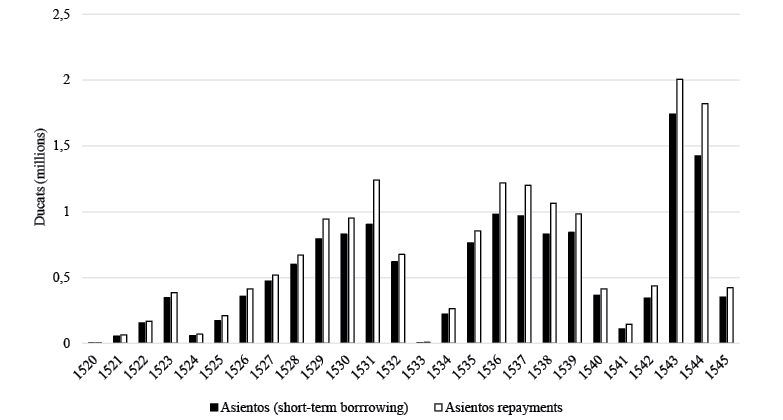
The turning point in the Crown’s policies was marked by Carlos I’s departure to Northern Europe in 1543. Unlike his previous absences, this time he transferred authority to his son, Prince Felipe (Kamen, 1997, pp. 10–11).
Faced with the new military challenges, the Crown encountered its greatest financial demands prior to the 1550s, as evidenced by the dramatic surge of asientos (royal short-term loans) in Figure 1. This was exacerbated by the fact that revenues from the most relevant royal taxes (alcabalas and tercias) were fixed since 1537 (Artola Gallego, 1982, p. 73). Consequently, Prince Felipe was compelled to seek alternative methods of raising extraordinary funds.Table 1. Funds raised through sale of offices in the 18 cities with voting power in the Castilian Cortes in 1543-44 (ducats).
TABLE 1. Funds raised through sale of offices in the 18 cities with voting power in the Castilian
Cortes in 1543-44 (ducats).
| Alderman | Jury | Notary of the number | |||||
|---|---|---|---|---|---|---|---|
| City | Number | Price | Number | Price | Number | Price | Total value collected |
| León | 2 | 700 | 2 | 160 | 1720 | ||
| Burgos | 3 | 2000 (one sold at 1550) | 3 | 133 | 5950 | ||
| Zamora | 2 | 600 | 2 | 400 | 2000 | ||
| Valladolid | 3 | 1000 | 3 | 300 | 3900 | ||
| Toro | 2 | 400 | 800 | ||||
| Soria | 6 | 1000 | 1 | 500 | 6500 | ||
| Ávila | 3 | 900 | 3 | 600 | 4500 | ||
| Segovia | 3 | 1200 (one sold at 1500) | 3 | 1000 | 6900 | ||
| Salamanca | 2 | 1000 | 4 | 500 | 4000 | ||
| Guadalajara | 4 | 800 | 2 | 447** | 4093 | ||
| Cuenca | 4 | 2000* | 2 | 1200** | 10400 | ||
| Madrid | 3 | 1000* | 3 | 800 | 5400 | ||
| Toledo | 3 | 1800* | 2 | 550* | 2 | 1005* | 8510 |
| Sevilla | 3 | 3200* | 3 | 850 | 12150 | ||
| Córdoba | 3 | 1950 | 3 | 500* | 3 | 800* | 9750 |
| Jaén | 3 | 1300* | 3 | 500 | 3 | 800 | 7800 |
| Murcia | 8 | 1200* | 3 | 500 | 3 | 640 | 13020 |
| Granada | 3 | 2670 | 3 | 1000* | 3 | 1300* | 14910 |
| Total | 58 | 17 | 44 | 122304 | |||
Note: Royal decrees were issued between October 1543 and October 1544, although some transactions extended into 1545. Price data marked with an asterisk (*) were estimated using 1557 prices.
Source: Author’s own database. Number of offices sold from AGS, CCA, REL, 7; prices collected from the previous source and CCA, CON, file 20 and CJH, book 351 (AGS); Cuartas Rivero (1984); Marcos Martín (2011).
Although Carlos I recommended confiscating private imports of gold and silver from the Americas, the prince rejected the proposal. He reasoned that such an action would cause significant harm to bankers and merchants while yielding only a modest sum (Carande, 1990, p. 250). Instead, Felipe introduced the large-scale sale of offices in Castile for the first time.
Table 1 details the offices sold and the funds collected in the 18 cities with voting rights in the Cortes.3 The amount raised in these 18 cities alone exceeded 122,304 ducats, a substantial quantity equivalent to 36% of the annual revenue from alcabalas and tercias collected this year (Artola Gallego, 1982, p. 74).4
Despite the existing restrictions on secondary transfers, these sales generated substantial revenue for the Crown. Strengthening the legal enforceability of sales, as well as enabling key practices of the early modern period —such as mortgaging offices or incorporating them into entailed estates—, could significantly increase the appeal of offices as investments, thereby driving up their market value and Crown’s revenues. Therefore, Prince Felipe initiated what was arguably one of the most critical policies in the venal system.
On April 15, 1545, the prince dispatched confidential letters to the corregidores5 of several cities, seeking detailed information about prices and potential buyers for some local offices, including regidores, escribanos del número, jurados, and offices of the Coin House.6 In these letters, he instructed the corregidores to sell licenses, known as facultades de renunciación (resignation licenses). These allowed officeholders to remove most restrictions to renounce their positions, including transferring them to underage relatives, bypassing the twenty-day rule, and even using the office to settle debts.
The facultades de renunciación marked the beginning of a profound institutional transformation within Castilian venality. By legalizing and monetizing office transfers, the Crown laid the foundations for a more secure and lucrative market for offices. Years later, these developments were analyzed by Castillo de Bobadilla, who dedicated a chapter of his legal handbook to the sale of offices.
Castillo details how economic pressures and legal innovations, such as the introduction of facultades de renunciación, eroded the prohibitions originally imposed by the Catholic Monarchs (Castillo de Bobadilla, 1775, p. 231). Even though these prohibitions remained codified in the Nueva Recopilación of 1567, he makes it clear they were no longer enforced. Castillo ultimately concludes that “offices have become another form of real estate” (Castillo de Bobadilla, 1775, pp. 231–232).
By the 1570s, venality had evolved into a regular source of revenue for the Crown (Cuartas Rivero, 1984; Ulloa, 1977, p. 647). This change was driven by the rapid expansion of office markets, as the sale of offices extended into even the smallest villages. Moreover, town councils were authorized to repurchase offices offered for sale by the Crown, increasing the pool of potential buyers (Marcos Martín, 2011, p. 97). The municipal right to reclaim offices —provided they compensated the current officeholder within four years— served dual purposes. It appeased incumbent officeholders, particularly members of the Cortes who had lobbied for this privilege during the preceding decade7, while increasing prices of offices and Crown’s venal revenues due to the growing demand. Regidores were eager to reclaim lucrative offices like those of the fieles ejecutores (market inspectors), sold from the late 1560s, seeking to preserve the personal profits these roles provided.8
In addition to financial gains, the demand for local offices during the early modern period stemmed from two other interconnected drivers: aspirations for upward social mobility and the pursuit of political influence.
The expansion of trade and economic growth in the 16th century fostered a wealthy bourgeoisie eager to ascend the social hierarchy (Marcos Martín, 2007b, p. 75). Within this context, municipal offices became effective tools of social promotion in both Castile and France (Descimon, 1996; Doyle, 1996; Hernández Benítez, 2004; Tomás y Valiente, 1999).
For many Castilian merchants of the period, the ultimate goal was to enter the ranks of the titled nobility (Hernández Benítez, 2004, p. 99). Local offices, particularly town council posts such as regidor or alférez mayor, facilitated this goal. These positions conveyed prestige and visibility, including ceremonial privileged positions at civic and religious ceremonies, and distinctive insignia (Soria Mesa, 2011). The Crown exploited this by monetizing symbols of status. For example, in the 1630s, Bartolomé de Spínola, acting as factor general for Felipe IV, sold regidor offices with the added right to enter councils with “cape, dagger, and sword,” a powerful symbol of legitimacy.9
Municipal offices also conferred control over legal instruments such as the padrones de hidalgos, used to certify noble status (Marcos Martín, 2007b); provided access to elite networks; facilitated regular contact with high-ranking bureaucrats; created opportunities to render services to the Crown —services which could lead to royal rewards and further elevation in status—; and provided significant influence over local governance, including the management of public assets and the regulation of municipal markets (Hernández Benítez, 2004; Marcos Martín, 2007b). Altogether, this combination of benefits transformed local offices, especially those from the town council, into what Mauro Hernández has described as “springboards” for social mobility.
Another example of the political influence of officeholders emerged between 1601 and 1630, following the introduction of the third servicio de millones (Gelabert, 1997; Miranda, 2016).10 After the renewal of this extraordinary tax in 1596, the political power of municipalities increased significantly (Fortea Pérez, 1990). In exchange for their support, municipal representatives secured specific agreements with the Crown (Ruiz Rodríguez, 1992). One condition was a moratorium on the office primary sales. Members of the Cortes likely aimed to reinforce their control over access to local elites and to drive up the value of existing offices by limiting the creation of new ones. Although this measure was only partially enforced (Marcos Martín, 2007a), it led to a notable decline in the Crown’s revenues from venality. As a result, by the 1610s, King Felipe III (1598-1621) turned to alternative means of raising funds from the venal system, most notably through the sale of facultades de perpetuación (Marcos Martín, 2007a, pp. 32–33).
These licenses, sold by the Fiscal Council to officeholders, conferred substantial and permanent rights. Among them were the rights to incorporate offices into mayorazgos (entailed estates), to appoint deputies to serve in their stead, and to bypass the twenty-day rule. Thus, the perpetuations finalized the transition of offices into fully inheritable private assets, culminating with the institutionalization process.
During the same period, France adopted a different approach to managing its venal system. On December 12, 1604, Henri IV (1589-1610) introduced the paulette, a regular tax on venal offices. This measure replaced the one-time exemption fee for the forty-day rule with an annual payment equal to one-sixtieth of the office’s value. The majority of officeholders subscribed to the paulette, enabling the Crown to convert an unpredictable source of income into a stable revenue stream (Janczukiewick, 2002, pp. 3–4). While this system offered French officeholders greater financial security, it was not without risk. Under a fait du prince (i.e., an arbitrary act by the monarch) the king retained the prerogative to breach his commitments, threatening officeholders’ investments and preserving a measure of royal sovereignty over office ownership (Descimon, 2006).
Despite these limitations, the French venal system thrived between 1604 and 1664, when Colbert introduced stricter controls (Bonhoure et al., 2024, p. 83). The market experienced fluctuations thereafter, but venality was not eradicated until the French Revolution in 1789 (Doyle, 1996).
In contrast, the Castilian venal system followed a divergent trajectory. Though perpetuation licenses remained in high demand and office sales strongly resumed in the 1630s, local offices in Castile gradually lost their appeal. By the mid-17th century, the Crown sought new markets, particularly in the Americas, where venality became a more lucrative fiscal source (Andújar Castillo, 2018; Sanz Tapia, 2011). Over the course of the 18th century, the system steadily declined in significance, and it was ultimately abolished with the liberal reforms of the 19th century (Dedieu and Artola Renedo, 2011, pp. 38–39; Domínguez Ortiz, 1970, pp. 172–175; Hernández Benítez, 2007).
A thorough understanding of the evolution of venality in Castile requires an in-depth analysis of records from the Fiscal Council and the Chamber of Castile.
The Fiscal Council (Consejo de Hacienda), established between 1523 and 1525 to advise the monarch on economic matters, was jointly responsible for managing the Crown’s budget and debt alongside the Contaduría Mayor de Hacienda (Main Fiscal Accounting Office) (De Carlos Morales, 2001, p. 99). When offices became a recurrent source of revenue in 1543, Francisco de Almaguer, the lieutenant of the Contador Mayor de Hacienda, initiated the maintenance of registers to systematically document office-related operations (Hernández Esteve, 1998, p. 105). These registers evolved into the books of offices following the establishment of the Contaduría de la Razón (Royal Accounting Office) on May 25, 1554. The Contaduría de la Razón was specifically tasked with recording extraordinary revenues and was responsible for maintaining office registers within the Fiscal Council.
In addition to the books of offices, separate files managed by the Contadores de la Razón, as well as the books of information on offices, were key for tracing primary sales, writs, decrees, and other reports related to venal offices. These records serve as the fundamental sources for understanding office primary sales. Complementary sources, such as the General Treasurer’s ledgers and files from the Junta de Incorporación11, also provide valuable insights.
The Chamber of Castile (Cámara de Castilla), established between 1518 and 1523, was tasked with proposing and managing royal grants, appointing officers, and overseeing the Patronato Real (Royal Patronage of the Church) (Elliott, 1965, pp. 144–145). This council had the specific duty of issuing titles and licenses for offices and regulating the resignations, ensuring comprehensive administrative control over the venal system. Among its records, the deeds of resignatio in favorem stand out as key documents for tracing activity in the secondary office market.
Table 2 provides a summary of the key archival sources analyzed, encompassing 103 original books and 412 archival files, which collectively include 4,157 recorded resignations, 388 perpetuations, 315 rentals and other office-related information. These primary sources have been supplemented with secondary data from previous studies, focusing on sales of specific offices —mostly town councillors— within particular periods and cities (Cabañas García, 2002; Casey, 2008; Cuartas Rivero, 1984; Cuesta Martínez, 1997; Fernández Martín, 2019; Guerrero Mayllo, 1993; Gutiérrez Alonso, 1989; Ocaña Cuadros, 2012).
TABLE 2. Summary of sources, 1543-1714
| Source | Institution | Archive | Period | Type of information | Market | Signature |
|---|---|---|---|---|---|---|
|
Books of Offices (libros de Oficios) |
Contaduría de la Razón (Council of Finance) |
AGS AHN |
1543-1609 1595-1640 | Accounting |
Primary Primary |
CCA, REL books 7, 20 and 27 CON, book 545 |
| Files of Contadores de la Razón |
Contaduría de la Razón (Council of Finance) | AGS | 1543-1690 | Accounting and reports | Both | DGT, Inventario 24, books from 316 to 332 |
| Books of Information on Offices |
Contaduría de la Razón (Council of Finance) | AGS | 1562-1690 | Writs and decrees | Both | CJJ, books from 351 to 384 |
| General Treasurer’s books | Council of Finance | AHN | 1543-1584 | Accounting | Both | DGT, books from 316 to 332, 490 to 499 and 815, 1299, 1432, and 1458 |
| Junta de Incorporación | Council of Finance | AHN | 1706-1714 | Reports | Both | Diversos, 32 legajos from 36 to 11,656 |
| Books of Information on Offices | Chamber of Castile |
AGS AHN |
1543-1638 1638-1690 | Writs and decrees |
Both Both |
CCA, books from 323 to 359 CON books from 434 to 447 |
| Files of torn titles | Chamber of Castile | AGS | 1543-1700 | Office titles | Both | CCA, Títulos Rasgados |
| Files of resignation | Chamber of Castile |
AGS AHN |
1500-1700 1700-1714 | Contracts and resignations | Secondary |
CCA, Renuncias, legajos from 2295 to 2552 Consejos, legajos from 13745 to 13806 |
| Escribano’s books | Local | AHPV, AHPMd, and AHPMl | 1543-1714 | Contract | Secondary | Libros de protocolos notariales (various volumes) |
NOTE: For acronyms, see Archival Sources section.
Given the extensive scope of the market and the available sources, the analysis of this article is confined both temporally and geographically. In particular, this study focuses on the period from 1543 to 1714, encompassing the entire Habsburg monarchy’s rule in Castile since the institutionalization of venality. Moreover, certain aspects of the analysis are concentrated on specific offices and cities to provide a detailed examination.
The data collection on salaries, returns, and prices —used to estimate the profitability of local offices— has primarily focused on cities with voting rights in the Cortes, as well as the city of Málaga. The sample includes all offices for which such information was available. These offices represent a broad range of Castilian venal positions, covering various functional categories: political-policing roles (e.g., standard bearers, wardens, governors of fortresses), administrative roles (e.g., notaries, distributors of judicial processes, attorneys), financial roles (e.g., treasurers, accountants), and commercial roles (e.g., meat receivers, fish market brokers, and exchange brokers).
To evaluate the size of the Castilian office market, a quantification exercise was conducted by compiling data on the prices and quantities of the most prominent offices in cities with Cortes representation across three benchmark years. Tables A4 and A5 in the online appendix provide a detailed summary of analyzed offices and their primary functions.
Finally, in order to understand the key features of office rentals, a longitudinal analysis on secondary transactions was undertaken. Due to the extensive volume of available sources, this analysis focused on eight major Castilian cities (Burgos, Córdoba, Granada, Madrid, Málaga, Seville, Valladolid, and Zamora) and seven office types: regidores-veinticuatros (town councillors), escribanos del número (notaries of the number), procuradores del número (attorneys of the number), escribanos del ayuntamiento (clerks of the town hall), escribanos de cámara y crimen (law court clerks), escribanos de provincia (provincial clerks-notaries) and escribanos de censos (loan notaries).
The selection of offices and sources provides a solid empirical foundation for analyzing the institutional and economic mechanisms underlying venality in Habsburg Castile. However, the sample is predominantly composed of cities with voting rights in the Cortes, which were generally larger, wealthier, and more politically influential than the average Castilian municipality. As such, the findings may reflect the upper tier of the urban administrative hierarchy and not the full spectrum of the kingdom’s officeholding practices. Rural areas, as well as small and medium-size cities, remain underrepresented. Consequently, while the selected cases are highly informative, the results should be interpreted with caution when generalizing to the broader Castilian context.
Spanish historiography has extensively explored two main mechanisms by which officeholders accrued wealth: tax-farming and corruption. Tax-farming was, however, not exclusively a function performed by local officeholders, but rather by private investors who acquired the temporary right to collect specific taxes in exchange for a fixed sum paid to the Crown (Carretero Zamora, 1999). The tax-farming process typically began with a public auction where the Crown —or the cities following the encabezamiento in 1536-7— offered rights to collect taxes such as the alcabalas and tercias or sisas. The highest bidder became the arrendador mayor (chief tax farmer). In practice, the arrendador mayor frequently sublet these rights to tax-farmers operating at a more local level or specializing in particular goods, thereby creating complex financial and social networks (Alonso García, 2006).
While tax-farming had the potential to be highly profitable, it was also intrinsically risky. Overbidding, fraudulent practices, and unpredictable fluctuations in local economies could easily undermine expected gains (Ortega Cera, 2010). Nonetheless, tax-farmers benefited from relatively low initial auction prices and employed various strategies to mitigate risk. A common approach was the consolidation of local power through the purchase of municipal offices that granted commercial oversight and political influence.
A case in point is Don Rodrigo de Silva y Mendoza, Duke of Infantado and Pastrana, who purchased a regidor office in Valladolid and appointed Don Francisco de Bonilla to exercise its functions. Notably, Bonilla also oversaw the collection of alcabalas and tercias across several towns within the jurisdiction of Valladolid, where the duke was the chief tax farmer.12 Despite numerous references to the profitability of this practice, precise data on profits remains scarce due to limited archival evidence.
In parallel with tax-farming, corruption functioned as a widespread and highly profitable strategy to enhance the economic returns of public offices throughout the Hispanic Monarchy. The phenomenon was neither isolated nor exceptional: it was the product of structural incentives embedded in the system of officeholding (Andújar Castillo, 2024, pp. 12–13).
However, a crucial distinction must be drawn between venality and corruption. Venality was a recognized and institutionalized practice, actively encouraged by the Crown as a source of revenue. Although the economic logic of venality often fostered corrupt behavior, as buyers of offices sought to recover their initial investments through illicit activities13, corruption was not exclusive to venal offices. Royal officials who held their posts by royal appointment rather than purchase (e.g., viceroys, oidores, and corregidores) also participated in corrupt practices.
Corruption took different forms such as bribery (cohecho), widely practiced across judicial and administrative spheres (Gómez González, 2019); smuggling facilitation (Cañón García, 2018, p. 234); and patronage abuse, with viceroys appointing relatives or allies to profitable posts in open defiance of ordinances (Andújar Castillo and Heredia López, 2018, p. 124).
While control mechanisms such as juicios de residencia and visitas were intended to curtail abuses, their effectiveness was limited (Gómez González, 2018). The ability of officials to purchase exemptions, or to benefit from the complicity of local elites, rendered many of these checks useless. As a result, both venal and non-venal offices provided fertile ground for illicit enrichment, making corruption a core driver of the profitability of public positions in the Spanish Empire.
In contrast to the extensive literature on tax-farming and corruption, the legal earnings of officeholding have received little attention. One reason for the limited focus on legal returns is the difficulty of accessing consistent data. Unlike central administration officials, local officeholders were paid from municipal treasuries, and their incomes were not systematically recorded in royal registers. While the Crown issued some salary regulations, most offices relied on variable or performance-based compensation, making legislation alone an unreliable indicator of total returns. To address this gap, this section provides evidence on the legal salaries, earnings, and profitability metrics of several municipal offices.
In Castile, officers’ remuneration came in several forms. These included ordinary income such as salaries or fee-based earnings, subsistence allowances, as well as extraordinary revenues like royal graces, gifts, and tips. Subsistence allowances were typically modest and allocated for specific purposes. For instance, town council clerks (escribanos del cabildo) often received clothing stipends on ceremonial occasions, such as royal entries or religious festivals.14 Similarly, chancery clerks (escribanos de la Chancillería) received reimbursements for writing supplies like paper and ink.15 In exceptional cases, especially in offices based in Madrid, like contadores del entretenido (accountants), officials were granted substantial subsidies, including free rental houses, which could significantly enhance their wealth.16 Nevertheless, only salaries and fee-based income can be traced with sufficient consistency for meaningful analysis. This section hence focuses on those components of remuneration, acknowledging that the actual returns on officeholding were likely higher than what the data can fully capture. Moreover, unlike in France, where offices were taxed via the paulette, Castile lacked any direct tax on officers’ income.17 As a result, gross earnings figures represent net earnings for Castilian officials.
The key metric used to evaluate the financial return of offices is the earnings-to-price ratio: the ratio of annual revenue (salaries or earnings) to the market price of the office each year. This provides a proxy for the annual return on investment, analogous to yield in capital markets, and allows for cross-sectional and temporal comparisons.
For analytical purposes, the study classifies offices based on the nature of their remuneration. The first category includes positions with partially or fully fixed salaries, which can be regarded as guaranteed income, independent of individual performance or economic conditions. However, even within this group, many officeholders also earned supplementary income from variable sources. For example, prison wardens received a significant portion of their earnings from fines and enforcement-related fees, while accountants received a fee per payment letter. These additional revenues are not incorporated into the analysis of fixed-salary offices due to the scarcity of surviving documentation. As such, the evidence reported for those positions should be understood as a lower-bound estimate of their total earnings.
This analysis begins with a specific type of fixed-salary office: the alcaides de fortaleza (fortress governors). Jiménez Estrella (2004) offers valuable insights into the profitability of these posts. Unlike most offices sold in Castile, these positions were rare, making it possible to track most holders across the kingdom. Jiménez Estrella identified 22 sales of alcaidías between 1558 and 1646; this sample represents approximately 56.25% of all alcaidías sold in Castile since 1543. Table 3 summarizes the main statistics on the prices, salaries, and salary-to-price ratios of these offices.
Table 3 . Prices, salaries and salary-to-price ratios of alcaidías de fortaleza, 1558-1646
| Variable | Minimum | Maximum | Average | Standard deviation |
|---|---|---|---|---|
| Price (current ducats) Obs=22 | 800 | 30,000 | 10,948.2 | 7,190 |
| Salary (current ducats) Obs=18 | 53.3 | 560 | 334.5 | 160.21 |
| Salary-to-price ratio (%) | 1.06 | 14.81 | 4.43 | 3.50 |
Source: Author’s elaboration from data by Jiménez Estrella (2004).
The prices of alcaidías exhibited high variability, with a coefficient of variation of 65.7%. Salary-to-price ratios averaged 4.43%, spanning a wide range from 1.06% to 14.81%. The average annual salary for alcaides was 334.5 ducats, a remarkably high figure for the period.18
Table 4 . Prices, salaries and salary-to-price ratios of alcaides mayores de la cárcel, 1567-1587
| City | Base salary (ducats) | Price (ducats) | Salary-to-price ratio (%) |
|---|---|---|---|
| Ávila | 40 | 1,100 | 3.60 |
| Burgos | 40 | 2,000 | 2.00 |
| Cuenca | 53 | 2,000 | 2.70 |
| Granada | 53 | 4,500 | 1.20 |
| Guadalajara | 0 | 500 | 0.00 |
| Jaén | 53 | 2,000 | 2.70 |
| Madrid | 53 | 2,000 | 2.70 |
| Málaga | 67 | 2,600 | 2.60 |
| Murcia | 53 | 2,000 | 2.70 |
| León | 40 | 1,133 | 3.50 |
| Salamanca | 40 | 1,500 | 2.70 |
| Segovia | 53 | 2,000 | 2.70 |
| Seville | 107 | 7,000 | 1.50 |
| Valladolid | 53 | 2,000 | 2.70 |
| Zamora | 27 | 1,000 | 2.70 |
| Average (without Guadalajara) | 52 | 2,381 | 2.60 |
| Max | 107 | 7,000 | 3.60 |
| Min | 0 | 500 | 0.00 |
| Min (without Guadalajara) | 27 | 1,000 | 2.00 |
Source: AGS-DGT-Inventory 24, file 322.
A similar analysis can be conducted for the positions of alcaide mayor de la cárcel (chief prison warden). The Crown sold most of these offices in the largest Castilian cities during the late 1560s through the 1580s. While the warden’s income from fines on prisoners is not available, their base salaries and prices have been documented for several cities. Table 4 presents the salary-to-price ratios for most Cortes cities (78%) and Málaga, offering a representative sample of Castilian wardens.
Salary-to-price ratios typically exceeded 2.6%, with the exceptions of Seville and Granada, where exceptionally high prices reduced the ratios to 1.5% and 1.2% respectively, and Guadalajara, where the prison warden position carried no base salary. Excluding Guadalajara, the average ratio was 2.6%, with a mean base salary of 52 ducats per year.
Guadalajara offers a unique case study. A comparison of office prices in this city versus other Cortes cities shows a price ratio of approximately 2 to 1 on average (see Tables A1, A2, and A3). However, in the case of the alcaidía de cárcel, this ratio jumps to 5 to 1.
Using the methodology described in the following section, a “synthetic” price for a Guadalajara prison warden position can be estimated. The “synthetic” price, which can be assumed as a proxy of an alcaide de cárcel of Guadalajara with a standard base salary, is 1,582 ducats, significantly higher than the observed price of 500 ducats. This highlights the significant influence of legal economic returns on office valuations, with salary accounting for 68.3% of the total office value in this case.Table 5 . Prices, salaries and salary-to-price ratios of Castilian offices in the 17 th century
| Office | Office | Official salary | Price | Salary-to-price |
|---|---|---|---|---|
| (Spanish) | (English) | (ducats) | (ducats) | ratio (%) |
| Alguacil mayor de Valladolid | Main constable from Valladolid | 400 | 12,000 | 3.3 |
| Contadores del entretenido | Accountant of entertainment | 250 | 8,000* | 3.1 |
| Contadores de mercedes | Accountants of mercies | 266 | 8,000* | 3.3 |
| Contador de millones | Accountants of millones | 267 | 5,500 | 4.9 |
| Receptores del número en la Corte | Assigners of commissions | 500 | 15,500 | 3.2 |
| Obrero de muros de Badajoz | Wall maintenance official | 8 | 84 | 9.5 |
Sources: AGS-CJH book 359, 372 and 382, and CCA-CON file 30 and 34.
Tables 5 and 6 display the salaries and profitability metrics for various Castilian offices. Table 5 includes fixed-salary offices such as accountants, the main constable from Valladolid, the assigners of commissions at Cortes, and the wall maintenance official from Badajoz. In contrast, Table 6 provides data on positions with variable compensation, such as tesoreros de rentas reales (royal treasurers) and depositarios generales (general depositors) in seven cities, and the escribano mayor de rentas (chief tax notary) of Seville. While these variable-pay offices depended on the institutional sums collected, they also included a minimum guaranteed income, which is treated as the lower bound of earnings for the purposes of this analysis.
Salaries for all the offices analyzed were substantial, frequently exceeding 100 ducats annually, even in smaller cities such as Soria, Zamora, and Toro. An exception to this trend was the wall maintenance official, a low-ranking and operational post that paid roughly the equivalent of a yearly laborer’s wage. Notably, even lower-tier offices, such as the wall maintenance post, offered non-trivial salary-to-price ratios. This evidence suggests that the market valuation of offices was generally consistent with their expected economic returns.Table 6. Prices, salaries and salary-to-price ratios of tesoreros de rentas reales and depositarios generales and Escribano Mayor of Seville, 1567-1587
| City | Base salary (ducats) | Price (ducats) | Salary-to-price ratio (%) |
|---|---|---|---|
| Madrid | 138.7 | 2,800 | 5.0 |
| Málaga | 160 | 3,200 | 5.0 |
| Guadalajara | 98.1 | 1,965 | 5.0 |
| Toro | 156 | 3,250 | 4.8 |
| Soria | 109.3 | 1,920 | 5.7 |
| Seville | 133.3 | 12,000 | 1.1 |
| Zamora | 165.3 | 3,267 | 5.1 |
| Average Tesoreros and Depositarios | 109.5 | 3,723 | 3.6 |
| Escribano mayor from Seville | 5,000 | 90,000 | 5.6 |
Note: Escribano mayor was the chief notary for incomes of almojarifazgo, Indies, moneda forera, 10% of wool tax and tercias and custom office of Castile and Portugal. This officer received variable earnings derived from percentages of total tax collection (1%), but it included a minimum guaranteed income of 5,000 ducats.
Source: AGS-CJH book 359, 372 and 382, and CCA-CON file 30 and 34.
Profitability metrics varied according to the nature of the office. Fixed-salary positions yielded salary-to-price ratios averaging around 3.2%, whereas variable-pay offices offered minimum returns of 5% and higher, reflecting greater potential earnings. It is also worth noting that three fixed-salary positions (contadores del entretenido, contadores de mercedes, and receptores) included generous subsistence allowances, as their holders were provided with rent-free housing in Madrid. Moreover, the reported figures represent only base salaries. In practice, contadores received additional variable payments —2 reales per recudimiento (tax settlement) and 0.5 reales per payment letter issued— often raising their total annual remuneration above 400 ducats and pushing effective returns closer to 5%.
While the analysis of variable-pay offices is inherently more complex due to the scarcity and fragmentation of income sources, Table 7 provides average earnings and office prices for various officials in Málaga and Madrid during the late 16th century.
The average earnings-to-price ratio across these offices was 8%, with only two falling below 7.5%. These results closely align with expected returns for the most common office in early modern Castile: notaries of the number.
Tables 8 and 9 summarize the earnings and market prices of notarial offices in Valladolid throughout the 17th century, and in four Andalusian cities in 1749, based on data compiled by Arroyal (2011) from Catastro de Ensenada.
Table 7 . Prices, earnings and earnings-to-price ratio of variable-pay offices in Málaga and Madrid, 1586-1597
|
Office (Spanish) |
Office (English) | City | Year |
Wage (ducats) |
Price (ducats) |
Wage-to-price ratio (%) |
|---|---|---|---|---|---|---|
| Alcaide de la mar | Warden of the seaside | Málaga | 1586 | 150.0 | 2,000 | 7.50 |
| Recibidor de la carne | Receiver of meat | Málaga | 1586 | 100.0 | 850 | 11.80 |
| Corredor del pescado | Broker of fish market | Málaga | 1589 | 600.0 | 7,500 | 8.00 |
| Fiel del depósito | Warehouse inspector | Málaga | 1595 | 100.0 | 2,000 | 5.00 |
| Corredor del cambio | Broker of exchange | Madrid | 1597 | 56.0 | 1,200 | 4.70 |
| Fiel de la seda | Silk market inspector | Málaga | 1597 | 108.0 | 1,000 | 10.80 |
| Average | 185.7 | 2,425 | 8.00 |
Note: Receiver of meat and silk market inspector figures reflect estimates of average earnings, as reported by the city’s corregidor. The rest of offices reflect actual mean earnings.
Source: AGS-DGT-Inventory 24, file 322.
Table 8 . Wages and prices for escribanos del número in Valladolid
| Year | Deeds | Extra pages | Wage (inflation-indexed) (ducats) | Office price (ducats) | Earnings-to-price ratio (%) |
|---|---|---|---|---|---|
| 1614 | 849 | 1,385 | 184 | 900 | 20.5 |
| 1626 | 766 | 1,263 | 221 | 4,450 | 5.0 |
| 1634 | 783 | 1,414 | 195 | 3,818 | 5.1 |
| 1642 | 489 | 770 | 128 | 2,364 | 5.4 |
| 1664 | 463 | 633 | 158 | 1,500 | 10.5 |
| 1681 | 349 | 501 | 98 | 1,636 | 6.0 |
| Average | 616 | 994 | 164 | 2,445 | 8.7 |
Note: The legal fee for deeds was established in 1567 at 1 real per deed, with an additional charge of 15 maravedís for each extra page. These fixed prices were indexed from that year onward using Hamilton’s price series for northern Castile (Hamilton, 1947; 1975).
Source: Author’s own elaboration from AGS, AHN, and Hamilton (1947; 1975).
For Valladolid, notarial earnings have been estimated by counting the number of contracts executed by all notaries and the average number of pages per contract. Since the actual fees charged per deed were rarely specified in the documents, they have been approximated using the official fee tariff set in 1567 (1 real per deed and 15 maravedís per additional page), adjusted for inflation using Hamilton’s price indices (Hamilton, 1947; 1975).
The results show that earnings-to-price ratios averaged 8.7% in Valladolid and 9.6% in the Andalusian cities, figures that are significantly higher than those associated with fixed-salary offices, and comparable to other variable-pay positions. Variation within the Andalusian cities appears to correlate with levels of competition. For example, Granada’s lower profitability (5.4%) is likely attributable to its higher concentration of escribanos reales (69), compared to Córdoba (17) and Seville (18). In relative terms, Granada had 5‰ royal notaries per inhabitant, while Córdoba and Seville had 1.8‰ and 1‰, respectively.
Table 9 . Wages and prices for escribanos del número in 1749
| City | Minimum earnings | Maximum earnings | Mean earnings | Price | Earnings-to-price ratio (%) |
|---|---|---|---|---|---|
| Córdoba | 18.2 | 690.9 | 173.8 | 2,000 | 8.7 |
| Granada | 200.0 | 300.0 | 234.5 | 4,348 | 5.4 |
| Málaga | 50.0 | 600.0 | 326.3 | 3,318 | 9.8 |
| Seville | 136.4 | 1,200.0 | 571.5 | 4,000 | 14.3 |
| Average | 101.1 | 697.7 | 326.5 | 3,416.7 | 9.6 |
Note: The prices for these escribanos were gathered in the 1710s and adjusted for inflation using a price index estimated with regidores prices. To ensure consistency in the analysis, escribanos who received multiple salaries have been excluded.
Source: Data on escribanos wages from Arroyal (2011). Data on prices of offices from the author´s database.
In Valladolid, the earnings-to-price ratio peaked at an impressive 20.5% in the early 17th century. However, this figure declined sharply afterwards due to soaring office prices in the 1620s and 1630s, and deteriorating economic conditions in Castile between the 1640s and 1680s (Gómez-Blanco, 2024). Nevertheless, even in the most adverse periods, return on capital never fell below 5%.
In addition to generating direct earnings, offices could be monetized through rentals. As shown in Table 10, rentals proved to be a lucrative practice, yielding an average return on capital of 5%, with returns ranging from 2% to 13%.
Table 10 . Statistics on leases of offices in Castile, 1588-1714
| Office | Number of cases | Average duration (years) | Minimum rental payment (%) | Maximum rental payment (%) | Average rental payment (interest rate) |
|---|---|---|---|---|---|
| Alderman | 45 | 3.6 | 5% | 5% | 5.0% |
| Solicitor | 174 | 2.9 | 2% | 5% | 5.0% |
| Notary of the number | 57 | 2.7 | 4% | 5% | 4.9% |
| Other clerks | 39 | 2.1 | 5% | 13% | 6.0% |
| All | 315 | 2.9 | 2% | 13% | 5.0% |
Source: Author’s database from AGS-CCA-REN files from 2295 to 2552 and AHN-CON files from 13,745 to 13,806.
To contextualize the previously discussed earnings and profitability statistics, Figures 2 and 3 present them alongside time series for representative annual wages and returns from various financial assets in early modern Castile.
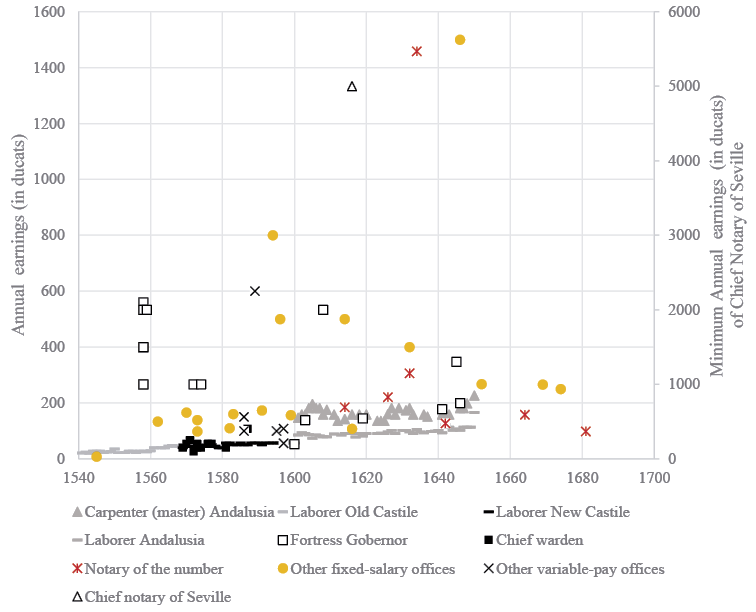
Source: Author’s database and Hamilton (1947; 1975).
Figure 2 displays office earnings in comparison with the annual salaries of rank-master carpenters and laborers, based on data from Hamilton (1947; 1975). These occupations were chosen due to their consistency across the entire period for which office salary data is available.
As illustrated in the figure, earnings from variable-pay offices significantly exceed those of both carpenters and, especially, laborers. In contrast, fixed-salary positions are more closely aligned with the income levels of higher-ranking skilled workers in Andalusia.
The notable exception is the base salary of chief prison warden, which appears relatively modest. However, it is important to emphasize that this remuneration constituted only a portion of the officer’s total earnings.
Overall, the data suggests that most local officials in Castile —particularly those occupying fee-based compensation— enjoyed considerably higher earnings than both low- and high-skilled workers across the kingdom.
Figure 3 presents the earnings-to-price ratios of all analyzed offices, alongside the nominal interest rate of juros (Comín, 2016, p. 74), the yield on juros (Toboso Sánchez, 1987, pp. 147–148), and the yield on censos (loans) issued by the Cathedral of Zamora (Álvarez Vázquez, 1987, pp. 240–248). Ideally, office profitability would be compared directly with juros yields, but such data is extremely scarce. Anecdotal evidence suggests that effective interest rates during the 16th century closely tracked coupon rate (Ruiz Martín, 1970). This is plausible given the strong demand for juros prior to the 1590s, which likely kept yields aligned with nominal rates due to downward pressure in the secondary market.19
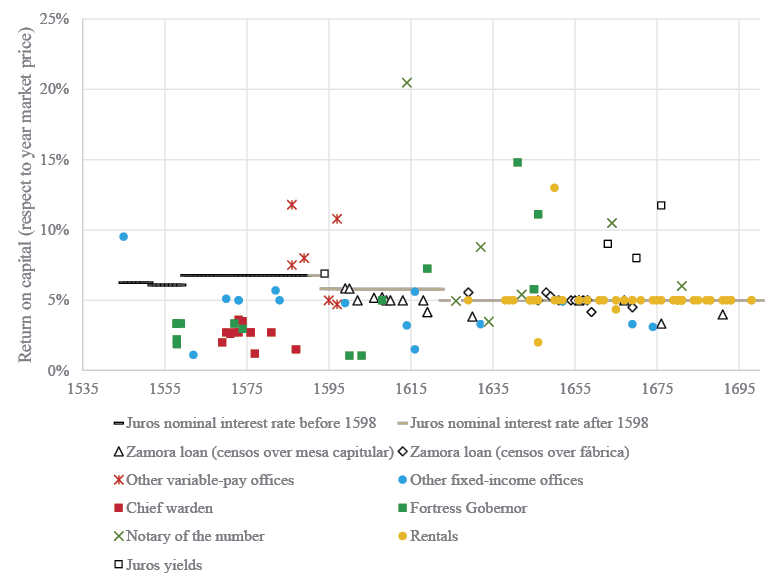
In contrast, the 17th century witnessed a growing divergence between nominal rates and yields, driven by rising fiscal risks and political instability. New juros were frequently issued at a discount, increasing their effective return (Álvarez-Nogal, 2009; Toboso Sánchez, 1987). To reflect this shift, the nominal interest series after 1590 is plotted in a different color, highlighting the need for caution when comparing returns in this period. In addition, available data of juros yields in 1594 and between 1663 and 1676 have been incorporated to enrich the comparison.
As the figure reveals, the profitability of officeholding was far from negligible. Variable-pay offices almost systematically exhibited higher returns than traditional financial assets in Castile. Their earnings-to-price ratios exceeded the nominal rate and yields on juros during the 16th century, and surpassed loan yields during the 17th century. The only exception arises when comparing these office earnings with the yields on juros in the second half of the 17th century. According to Álvarez Vázquez (1987, p. 265), juros yields ranged between 8% and 9% from 1663 to 1676, with one remarkable secondary sale reaching 11.75%. However, these figures should be interpreted with caution, since the Crown often appropriated between 20% and 50% of the total juros returns through the media anata de juros tax during this period (Comín, 2016, p. 86; Álvarez Nogal, 2009, pp. 33-34).
Fixed-salary offices, while generally offering slightly lower returns, still approached the profitability levels of other financial instruments. An exception is again the base salary of chief prison wardens, which remained exceptionally low. Fortress governors also display modest returns from the 1550s to 1580s, as highlighted by Jiménez Estrella (2004). However, contrary to his final conclusions, these offices provided high profitability rates during the 17th century, clearly exceeding loan rates. Perhaps the most insightful comparison emerges from office rentals and yields on censos during the 17th century. In this context, offices were treated by their owners as purely financial investments, stripped of social prestige, additional revenues, and obligations of service. Notably, average returns from renting offices consistently exceeded those from loans extended by the Cathedral of Zamora, underscoring the profitability of offices as investment vehicles relative to other contemporary financial instruments.
Having assessed the profitability of officeholding, this section explores the scale and growth of the office market in Castile. Understanding the market’s overall size is crucial for contextualizing its fiscal and financial significance within early modern Castile. To date, only one estimate of the total size of the market for offices exists. This approximation was made in 1599 by Hernando de Quiñones, a member of Cortes representing the city of León. Quiñones calculated the total value of the office stock to advise the king on the potential revenue from selling perpetuaciones.
Quiñones assessed the Castilian office market value at 12.173 million ducats, developing his calculations in three steps. He first calculated the value of regidores-veinticuatros and jurados in cities with Cortes representation. He determined that these offices were collectively worth 2,293,500 ducats. Second, he projected that the same offices in non-Cortes cities were worth three times as much, citing consultations with experts. Based on this assumption, Quiñones valued these offices at 6,879,500 ducats.20 Finally, Quiñones attributed an additional value of 3,000,000 ducats to all other offices throughout the kingdom, but he did not provide any justification for this final figure (Congreso de los Diputados, 1599, pp. 556–564).
To gain further insights into the Castilian office market, I conducted a quantification exercise focusing on offices in the 18 cities with voting rights during 1581, 1599, and 1640. For 1581, specific reports from corregidores detailing office numbers and prices were available. For 1599 and 1640, I updated these figures using records from the Chamber of Castile and the Fiscal Council referenced above.
Where prices were not recorded, I employed a regression-based imputation method to estimate the missing values. Specifically, for each city lacking price information, I identified a set of “instrumental cities” from among those with complete data. These instrumental cities were selected based on the power of their relationship in an OLS model. The cities yielding the highest coefficient of determination (R²) values—using the known office prices— were used as predictors to estimate synthetic office prices for the cities with missing data. In sum, this method estimates synthetic office prices for a given city, derived from a weighted composite of the most similar cities in terms of office characteristics. Table A6 in the online appendix details the instrumental cities selected for each imputation model, along with the corresponding mean absolute prediction error.21
The results are presented in Tables A1, A2, and A3 in the online appendix, broken down by the city, the number of offices, and their prices. The total value of office stock at primary market prices in the 18 cities amounted to 2,802,712 ducats in 1581, 5,358,871 ducats in 1599, and 10,919,189 ducats in 1640.
These findings suggest that Hernando de Quiñones significantly underestimated the value of the Castilian venal system. While his figure for regidores and jurados was close to the actual value, being underestimated by only 141,525 ducats or 6.2%, his final approximation of 3 million ducats for all other offices throughout the kingdom was far off. Only considering those offices in the 18 Cortes cities plus fortress governors —using Jiménez Estrella’s data (2004) adjusted for inflation— the value amounts to 3,227,938 ducats in 1599, already surpassing Quiñones’ figure for the entire kingdom. It is important to note that the 18 cities included in these estimates accounted for only 8.7% of the total Castilian population in the late 16th century (Fortea Pérez, 1995).
Assuming Quiñones’ claim that offices in non-Cortes cities were worth three times as much as those in Cortes cities22, the total value of the Castilian venal system in 1599 could have been approximately 21.435 million ducats, nearly double his original estimate. This figure represents about 26.8% of the consolidated juros stock (long-term public debt) based on Marcos Martín (2006).
Further comparative analysis with Álvarez-Nogal’s (2009) study of juros de alcabalas al quitar in Burgos, Murcia, and Cádiz provides additional context. In 1599, the market value of offices accounted for 35% and 47% of the juros al quitar stock in Burgos and Murcia, respectively. As juros al quitar represented approximately 87.5% of all juros de alcabalas in the kingdom (Ulloa, 1977, p. 875), this suggests the office market represented 36% of all juros de alcabalas in these two cities —close to the earlier estimate of 27%.
Table 11 also illustrates the office market’s rapid growth relative to the juros de alcabalas market between 1581 and 1640. In Burgos the office stock increased from 22% of the juros stock in 1581 to 59% in 1640, while in Murcia it rose from 72% to 81%. Despite contrasting economic trajectories —Burgos faced economic decline from the 1570s due to reduced wool exports, while Murcia saw economic growth and doubled its stock of public debt between 1581 and 1599 (Álvarez-Nogal, 2009, p. 11)— these figures clearly underscore the growing importance of offices as an investment market in late 16th-century Castile.
Table 11 . Interest payments and capital of juros de alcabalas and office stock value, 1581-1640
| City | Year | Interest payments of juros al quitar de alcabalas (ducats) | Capital of juros al quitar (in ducats) |
Number of juros |
Office stock value (ducats) |
Number of offices | Share of office to juros capital (%) |
|---|---|---|---|---|---|---|---|
| Burgos | 1581-82 | 25,163 | 385,740 | 314 | 83,644 | 75 | 22 |
| 1599-1600 | 31,362 | 541,662 | 349 | 187,960 | 79 | 35 | |
| 1640 | 30,000 | 599,993 | 326 | 354,741 | 89 | 59 | |
| Murcia | 1581-82 | 15,471 | 237,164 | 66 | 169,811 | 117 | 72 |
| 1599-1600 | 35,058 | 605,493 | 101 | 284,657 | 136 | 47 | |
| 1640 | 37,390 | 747,801 | 117 | 605,146 | 167 | 81 |
Note: To calculate the capital value of juros based on interest payments, I utilized the average interest rates provided by Marcos Martín (2006, p. 232). Interest payments for juros in 1640 have been estimated using exponential interpolation based on the data series for 1630 and 1680 provided by Álvarez-Nogal (2009).
Source: Álvarez-Nogal (2009, p. 25).
This study examines the phenomenon of venality in early modern Castile by shedding light on the market size and financial returns of local offices.
Contrary to traditional views that downplay their profitability or frame offices as viable investments only when tied to corruption or informal revenues, the evidence presented here shows that most offices yielded substantial legal returns. Fixed-salary offices provided minimum guaranteed yields of 3-5%, while the earnings-to-price ratios of variable-pay positions, such as notaries or commodity inspectors, regularly exceeded 7.5%. Moreover, offices could be leased, yielding average returns of 5% and offering investors stable income streams equivalent to other contemporary assets such as juros or church loans.
A second contribution of this article is the reassessment of the overall scale of the Castilian office market. Revisiting the only known estimate, made by Hernando de Quiñones in 1599, and employing modern quantitative methods to fill historical data gaps, this paper estimates that the market for venal offices was worth approximately 21.4 million ducats —nearly double Quiñones’ original figure. This represented about 27% of the consolidated stock of juros across the kingdom. In major cities such as Burgos and Murcia, offices accounted for up to 47% of the value of juros al quitar.
These findings suggest that venal offices offered Castilian investors profitable assets, especially valuable for diversifying portfolios at times when juros grew riskier. Venality thus emerges not only as a mechanism of social mobility and political power, but also as a central component of the kingdom’s financial architecture.
Archivo General de Simancas (AGS).
Archivo Histórico Nacional (AHN).
Archivo Histórico de Protocolos de Madrid (AHPMd).
Archivo Histórico Provincial de Málaga (AHPMl).
Archivo Histórico Provincial de Valladolid (AHPV).
CONGRESO DE LOS DIPUTADOS. 1599. Actas de Las Cortes de Castilla. XVIII. Madrid: Congreso de los Diputados, [1893].
ALLEN, Robert C. 2001. The Great Divergence in European Wages and Prices from the Middle Ages to the First World War. Explorations in Economic History 38 (4): 411–47. DOI: https://doi.org/10.1006/exeh.2001.0775.
ALONSO GARCÍA, David. 2006. Poder financiero y arrendadores de rentas reales en Castilla a principios de la Edad Moderna. Cuadernos de Historia Moderna. 31: 117–38.
ÁLVAREZ, Begoña; RAMOS-PALENCIA, Fernando. 2018. Human Capital and Earnings in Eighteenth-Century Castile. Explorations in Economic History 67: 105–33. DOI: https://doi.org/10.1016/j.eeh.2017.10.005.
ÁLVAREZ VÁZQUEZ, José Antonio. 1987. Rentas, precios y crédito en Zamora en el antiguo régimen. Salamanca: Colegio Universitario de Zamora.
ÁLVAREZ-NOGAL, Carlos. 2009. Oferta y demanda de deuda pública en Castilla. Juros de alcabalas (1540-1740). Banco de España, Unidad de Publicaciones, Estudios de historia económica, no. 55. Madrid: Banco de España. https://repositorio.bde.es/handle/123456789/7395.
ÁLVAREZ-NOGAL, Carlos; CHAMLEY, Christophe. 2014. Debt Policy under Constraints: Philip II, the Cortes, and Genoese Bankers. Economic History Review 67 (1): 192–213. DOI: https://doi.org/10.1111/1468-0289.12010.
ANDRÉS UCENDO, José Ignacio; LANZA GARCÍA, Ramón. 2014. Prices and Real Wages in Seventeenth-Century Madrid. The Economic History Review 67 (3): 607–26.
ANDÚJAR CASTILLO, Francisco. 2018. El mercado de venta de cargos de Indias durante el último cuarto del siglo xvii. Una nueva interpretación. Magallánica: revista de historia moderna 5 (9): 80–110.
ANDÚJAR CASTILLO, Francisco. 2024. Formas de corrupción y fraude: negocios privados de los agentes de gobierno en la América española (1670-1709). Revista Complutense de Historia de América 50 (1): 11–14.
ANDÚJAR CASTILLO, Francisco; HEREDIA LÓPEZ, Alfonso Jesús. 2018. Sobre la corrupción en la América española en el siglo xvii: A propósito de un “tratado” de prácticas ilícitas. In Francisco ANDÚJAR CASTILLO; Pilar PONCE LEIVA(eds.), Debates sobre la corrupción en el mundo ibérico, siglos xvi–xviii. Alicante: Biblioteca Virtual Miguel de Cervantes, 115-131.
ARANDA PÉREZ, Francisco José. 1992. Poder municipal y cabildo de jurados en Toledo en la edad moderna: (siglos xv–xviii). Concejalía del Área de Cultura.
ARROYAL ESPIGARES, Pedro J. 2011. Nómina de notarios, escribanos y oficiales de pluma en Andalucía a mediados del siglo xviii según el catastro de Ensenada. Preprint, December 16. https://riuma.uma.es/xmlui/handle/10630/4860.
ARTOLA GALLEGO, Miguel. 1982. La Hacienda del Antiguo Régimen. Madrid: Alianza.
BONHOURE, Emilie; MUSY, Olivier; TALLEC, Ronan. 2024. Exploring French Venality in the Seventeenth Century: Insights from a New Database on Offices. Historical Methods: A Journal of Quantitative and Interdisciplinary History 57 (2): 80–99. DOI: https://doi.org/10.1080/01615440.2024.2378794.
CABAÑAS GARCÍA, Jorge. 2002. Los regidores de la ciudad de Burgos (1600-1750): acceso al poder municipal y perfil social. Boletín de la Institución Fernán González, 225: 401–34.
CAÑÓN GARCÍA, Pablo. 2018. El comercio ilícito en los dominios americanos de la Monarquía Hispánica durante la Unión de Coronas. In Francisco ANDÚJAR CASTILLO; Pilar PONCE LEIVA (eds), Debates sobre la corrupción en el mundo ibérico, siglos xvi–xviii. Alicante: Biblioteca Virtual Miguel de Cervantes, 209–227
CARANDE, Ramón. 1990. Carlos V y sus banqueros. Barcelona: Crítica.
CARRETERO ZAMORA, Juan Manuel. 1999. Los arrendadores de la Hacienda de Castilla a comienzos del siglo xvi (1517-1525). Studia Historica: Historia Moderna 21:153-190.
CASEY, James. 2008. Familia, poder y comunidad en la España moderna: los ciudadanos de Granada (1570-1739). Valencia: Universitat de Valencia-Servei de Publicacions.
CASTELLANO, Juan Luis. 2007. La movilidad social. Y lo contrario. In Inés GÓMEZ GONZÁLEZ; Miguel L. LÓPEZ MUÑOZ (EDS.) La movilidad social en la España del Antiguo Régimen. Granada: Comares, 5-18.
CASTILLO DE BOBADILLA, Jerónimo. 1775. Politica para corregidores, y señores de vasallos, en tiempo de paz, y de guerra, y para jueces eclesiasticos y seglares. II. Madrid: Imprenta Real de la Gaceta (Original work published 1597).
COMÍN, Francisco. 2016. La crisis de la deuda soberana en España (1500-2015). Madrid: Catarata.
CUARTAS RIVERO, Margarita. 1984. La venta de oficios públicos en Castilla-León en el siglo xvi. Hispania: Revista Española de Historia 44 (158): 495–516.
CUESTA MARTÍNEZ, Manuel. 1997. Oficios públicos y sociedad: administración urbana y relaciones de poder en la Córdoba de finales del Antiguo Régimen. Córdoba: Universidad de Córdoba.
DE CARLOS MORALES, Carlos Javier. 2001. El gobierno de la hacienda real de Castilla en tiempos de Carlos V. Carlos V. Europeísmo y universalidad: [congreso internacional. Granada, mayo 2000]. II. Madrid: Sociedad Estatal para la Conmemoriación de los Centenarios de Felipe II y Carlos V, 95-112.
DEDIEU, Jean-Pierre; ARTOLA RENEDO, Andoni. 2011. Venalidad en contexto: Venalidad y convenciones políticas en la España Moderna. In Francisco ANDÚJAR CASTILLO; María del Mar FELICES DE LA FUENTE (eds), El poder del dinero: ventas de cargos y honores en el Antiguo Régimen. Madrid: Biblioteca Nueva, 29-45.
DESCIMON, Robert. 1996. L’invention de la noblesse de robe: La jurisprudence du parlement de Paris aux XVIe et XVIIe siècles. In Jacques POUMARÈDE; Jack THOMAS (eds), Les Parlements de province : Pouvoirs, justice et société du xve au xviie siècle. Toulouse. Presses universitaires du Midi, 677–690. DOI: https://doi.org/10.4000/books.pumi.27641.
DESCIMON, Robert. 2006. La vénalité des offices comme dette publique sous l’Ancien Régime français : Le bien commun au pays des intérêts privés. In Jean ANDREAU; Gérard BÉAUR; Jean-Yves GRENIER (eds), La dette publique dans l’histoire : «Les Journées du Centre de Recherches Historiques». Vincennes: Institut de la gestion publique et du développement économique, 677–690. DOI: https://doi.org/10.4000/books.igpde.1834.
DOMÍNGUEZ GUERRERO, María Luisa. 2019. Las escribanías del antiguo reino de Sevilla bajo el reinado de Felipe II (1556-1598). Sevilla: Universidad de Sevilla. http://hdl.handle.net/11441/52256.
DOMÍNGUEZ ORTIZ, Antonio. 1970. La venta de cargos y oficios públicos en Castilla y sus consecuencias económicas y sociales. Anuario de Historia Económica y Social 3: 105–37.
DOMÍNGUEZ ORTIZ, Antonio. 1985. Las clases privilegiadas en el Antiguo Régimen. Madrid: Istmo.
DOYLE, William. 1996. Venality: The Sale of Offices in Eighteenth-Century France. Oxford: Oxford University Press. DOI: https://doi.org/10.1093/acprof:oso/9780198205364.001.0001.
DRELICHMAN, Mauricio. 2005. The Curse of Moctezuma: American Silver and the Dutch Disease. Explorations in Economic History 42 (3): 349–80. DOI: https://doi.org/10.1016/j.eeh.2004.10.005.
DRELICHMAN, Mauricio; GONZÁLEZ AGUDO, David. 2014. Housing and the Cost of Living in Early Modern Toledo. Explorations in Economic History 54 (October): 27–47. DOI: https://doi.org/10.1016/j.eeh.2014.08.001.
DRELICHMAN, Mauricio; VOTH, Hans-Joachim. 2014. Lending to the Borrower from Hell. New Jersey: Princeton University Press.
ELLIOTT, John H. 1965. La España Imperial. Barcelona: Vicens Vives.
FAYA DÍAZ, María Ángeles. 2003. Gobierno municipal y venta de oficios en la Asturias de los siglos xvi y xvii. Hispania 63 (213): 75–136. DOI: https://doi.org/10.3989/hispania.2003.v63.i213.235.
FERNÁNDEZ MARTÍN, Javier. 2019. Venalidad de oficios y honores en el concejo granadino durante el primer tercio del siglo xvii: poder, conflicto y ascenso social. Chronica Nova, 45: 259–95.
FORTEA PÉREZ, José Ignacio. 1990. Monarquía y Cortes en la Corona de Castilla. Las ciudades ante la política fiscal de Felipe II. Salamanca: Cortes de Castilla y León.
FORTEA PÉREZ, José Ignacio. 1995. Las ciudades de la Corona de Castilla en el Antiguo Régimen: una revisión historiográfica. Revista de Demografía Histórica-Journal of Iberoamerican Population Studies 13 (3): 19–60.
FORTEA PÉREZ, José Ignacio. 2017. El debate en torno a la venta de oficios concejiles en Castilla bajo los Austrias (1601-1630): algunas reflexiones. In Bernard VINCENT; Cecilia LAGUNAS; Emir REITANO, et al. (eds), Estudios en Historia Moderna desde una visión Atlántica: libro homenaje a la trayectoria de la profesora María Inés Carzolio. La Plata: Universidad Nacional de La Plata. Facultad de Humanidades y Ciencias de la Educación, 350-375.
GARCÍA ULECIA, Alberto. 1986. El papel de corredores y escribanos en el cobro de las alcabalas. Historia. Instituciones. Documentos, 13: 89–110.
GELABERT, Juan E. 1997. La bolsa del rey: Rey, reino y fisco en Castilla (1598-1648). Barcelona: Crítica.
GIL MARTÍNEZ, Francisco. 2017. Venalidad y economía institucional en la Monarquía Hispánica. Revista Escuela de Historia 16 (1): 1-21.
GÓMEZ GONZÁLEZ, Inés. 2018. Corrupción moral versus corrupción profesional: percepción, persecución y castigo en el Antiguo Régimen. In Francisco ANDÚJAR CASTILLO; Pilar PONCE LEIVA (eds), Debates sobre la corrupción en el mundo ibérico, siglos xvi–xviii. Alicante: Biblioteca Virtual Miguel de Cervantes, 103-114.
GÓMEZ GONZÁLEZ, Inés. 2019. Las visitas y el control del fraude en los tribunales: la administración de penas de cámara y gastos de justicia en la Chancillería de Granada. Memoria y Civilización 22 (December): 247–62. DOI: https://doi.org/10.15581/001.22.017.
GÓMEZ-BLANCO, Víctor M. 2021. When Safety Becomes Risky. Essays on Venality, Safe Assets, and the Bubble for Offices in Early Modern Spain. Doctoral thesis. Universidad Carlos III de Madrid. https://e-archivo.uc3m.es/handle/10016/32300.
GÓMEZ-BLANCO, Víctor M. 2024. A Safe Asset in Early Modern Castile, 1543–1714. The Economic History Review 77 (1): 212–43. DOI: https://doi.org/10.1111/ehr.13259.
GRAFE, Regina. 2012. Distant Tyranny: Markets, Power, and Backwardness in Spain, 1650-1800. Princeton: Princeton University Press.
GUERRERO MAYLLO, Ana. 1993. El gobierno municipal de Madrid (1560-1606). Madrid: Instituto de Estudios Madrileños.
GUTIÉRREZ ALONSO, Adriano. 1989. Estudio sobre la decadencia de Castilla: la ciudad de Valladolid en el siglo xvii. Valladolid: Universidad de Valladolid.
HAMILTON, Earl J. 1947. War and Prices in Spain: 1651-1800. Cambridge: Harvard University Press.
HAMILTON, Earl J. 1975. American Treasure and the Price Revolution in Spain,1501–1650 (A. Abad, Trans.). Barcelona: Ariel (Original work published 1934).
HERNÁNDEZ BENÍTEZ, Mauro. 1995. Y después de las ventas de oficios ¿qué? (Transmisiones privadas de regimientos en el Madrid moderno, 1606-1808). Anuario de historia del derecho español, 65: 705–48.
HERNÁNDEZ BENÍTEZ, Mauro. 1997. Cuando el poder se vende: venta de oficios y poder local en Castilla: siglos xvii y xviii. In Javier ALVARADO PLANAS (ed), Poder, economía, clientelismo. Madrid: Marcial Pons, 71-95.
HERNÁNDEZ BENÍTEZ, Mauro. 2004. Ayuntamientos urbanos, trampolines sociales. Reflexiones sobre las oligarquías locales en la Castilla moderna. Mélanges de la Casa de Velázquez, no. 34: 91–114. DOI: https://doi.org/10.4000/mcv.1295.
HERNÁNDEZ BENÍTEZ, Mauro. 2007. Venalidad de oficios municipales en la Castilla del siglo xviii: un ensayo de cuantificación. Chronica Nova, 33: 95–129. DOI: https://doi.org/10.30827/cn.v0i33.1766.
HERNÁNDEZ ESTEVE, Esteban. 1998. Las Contadurías de Libros de la Contaduría Mayor de Hacienda a mediados del siglo XVI. Revista de contabilidad – Spanish accounting review 1 (1): 103-136.
JANCZUKIEWICK, Jérôme. 2002. Le renouvellement de la Paulette en 1648. Dix-septième siècle 214 (1): 3–14. DOI: https://doi.org/10.3917/dss.021.0003.
JIMÉNEZ ESTRELLA, Antonio. 2004. El precio de las almenas: ventas de alcaidías de fortalezas reales en época de los austrias. Revista de Historia Moderna: Anales de la Universidad de Alicante, 22: 143–72. DOI: https://doi.org/10.14198/RHM2004.22.05.
JIMÉNEZ ESTRELLA, Antonio. 2012. Poder, dinero y ventas de oficios y honores en la España del Antiguo Régimen: un estado de la cuestión. Cuadernos de Historia Moderna, 37: 259–71.
KAMEN, Henry. 1997. Felipe de España. Madrid: Siglo XXI Editores.
MARCOS MARTÍN, Alberto. 2006. ¿Fue la fiscalidad regia un factor de crisis en Castilla del siglo xvii?. In Geoffrey PARKER (ed), La crisis de la monarquía de Felipe IV. Barcelona: Crítica, 173-254.
MARCOS MARTÍN, Alberto. 2007a. Las ventas de oficios en Castilla en tiempos de suspensión de las ventas (1600-1621). Chronica Nova, 33: 13–35.
MARCOS MARTÍN, Alberto. 2007b. Movilidad social ascendente y movilidad social descendente en la Castilla moderna. In Inés GÓMEZ GONZÁLEZ; Miguel L. LÓPEZ MUÑOZ (eds), La movilidad social en la España del Antiguo Régimen. Granada: Comares, 19-48.
MARCOS MARTÍN, Alberto. 2011. Las caras de la venalidad: Acrecentamientos, <<criaciones>> y consumos de oficios en la Castilla del siglo xvi. In Francisco ANDÚJAR CASTILLO; María del Mar FELICES DE LA FUENTE (eds), El poder del dinero: ventas de cargos y honores en el Antiguo Régimen. Madrid: Biblioteca Nueva, 85–118.
MARCOS MARTÍN, Alberto. 2012. De Monarquía compuesta y Reinos descompuestos: la idea de “conservación” y las enajenaciones del patrimonio regio en la Castilla de los siglos xvi y xvii. In Juan Luis Castellano and Miguel Luis LÓPEZ-GUADALUPE MUÑOZ (eds), Actas de la XI Reunión Científica de la Fundación Española de Historia Moderna: ponencias y conferencias invitadas. Granada: Editorial Universidad de Granada, 45–75.
MIRANDA, Marcella. 2016. Aspectos práticos de uma teoria absoluta: a monarquia e as Cortes na Espanha de Felipe II (1556-1598). Belo Horizonte: Fino Traço.
MOSÁCULA MARÍA, Francisco Javier. 2001. Los regidores municipales de Segovia durante los reinados de Felipe II, Felipe III y Felipe IV. Espacio, tiempo y forma. Serie IV, Historia moderna, 14 (January): 245–314. DOI: https://doi.org/10.5944/etfiv.14.2001.3423.
MOUSNIER, Roland. 1984. The Institutions of France Under the Absolute Monarchy, 1598-1789. II: The Organs of State and Society. Chicago: University of Chicago Press.
OCAÑA CUADROS, Ivanova. 2012. Las regidurías acrecentadas en Málaga durante la edad moderna: una recompensa por servicios económicos. In María José PÉREZ ÁLVAREZ; Laureano M. RUBIO PÉREZ; Alfredo MARTÍN GARCÍA (eds), Campo y campesinos en la España Moderna: culturas políticas en el mundo hispano. Madrid: Fundación Española de Historia Moderna, 1719–1730.
ORTEGA CERA, Agatha. 2010. Arrendar el dinero del rey: fraude y estrategias financieras en el Estrado de las Rentas en la Castilla del siglo xv. Anuario de estudios medievales, 40: 223–49.
RUIZ MARTÍN, Felipe. 1968. Las finanzas españolas durante el reinado de Felipe II (alternancias de participación que se ofrecieron para Francia). Hispania, 2: 109–74.
RUIZ MARTÍN, Felipe. 1970. La banca en España hasta 1782. Madrid: Banco de España.
RUIZ RODRÍGUEZ, José Ignacio. 1992. Estructura y recaudación del servicio de Millones (1590-1691). Hispania 52 (182): 1073–88.
SANZ TAPIA, Ángel. 2011. Provisión, beneficio y venta de oficios americanos de Hacienda (1632-1700). Revista Complutense de Historia de América 37: 145–72. DOI: https://doi.org/10.5209/rev_RCHA.2011.v37.7.
SORIA MESA, Enrique. 2011. La imagen del poder. Un acercamiento a las prácticas de visualización del poder en la España Moderna. Historia y Genealogía, 1: 5–10.
SWART, Koenraad Wolter. 1949. Sale of Offices in the Seventeenth Century. The Hague: Springer Dordrecht.
TOBOSO SÁNCHEZ, Pilar. 1987. La deuda pública castellana durante el Antiguo Régimen (Juros) y su liquidación en el siglo xix. Madrid: Ministerio de Hacienda.
TOMÁS Y VALIENTE, Francisco. 1970. Origen bajomedieval de la patrimonialización y la enajenación de los oficios públicos en Castilla. In Actas del I Symposium de Historia de la Administración. Madrid: IEA, 1970, 123-159.
TOMÁS Y VALIENTE, Francisco. 1982. La venta de oficios en Indias (1492-1606). Madrid: Instituto Nacional de Administración Pública.
TOMÁS Y VALIENTE, Francisco. 1999. Gobierno e Instituciones en la España del Antiguo Régimen. Madrid: Alianza Editorial.
ULLOA, Modesto. 1977. La hacienda real de Castilla en el reinado de Felipe II. Madrid: Fundación Universitaria Española.Table 2. Summary of sources, 1543-1714
| Source | Institution | Archive | Period | Type of | Market | Signature | ||
|---|---|---|---|---|---|---|---|---|
| information | ||||||||
| Books of Offices | Contaduría de la Razón | AGS | 1543-1609 | Accounting | Primary | CCA, REL books 7, 20 and 27 | ||
| (libros de Oficios) | (Council of Finance) | AHN | 1595-1640 | Primary | CON, book 545 | |||
| Files of Contadores | Contaduría de la Razón | AGS | 1543-1690 | Accounting | Both | DGT, Inventario 24, books | ||
| de la Razón | (Council of Finance) | and reports | from 316 to 332 | |||||
| Books of Information | Contaduría de la Razón | AGS | 1562-1690 | Writs and decrees | Both | CJJ, books from 351 to 384 | ||
| on Offices | (Council of Finance) | |||||||
| General Treasurer’s | Council of Finance | AHN | 1543-1584 | Accounting | Both | DGT, books from 316 to 332, 490 | ||
| books | to 499 and 815, 1299, 1432, and 1458 | |||||||
| Junta de Incorporación | Council of Finance | AHN | 1706-1714 | Reports | Both | Diversos, 32 legajos from 36 to 11,656 | ||
| Books of Information | Chamber of Castile | AGS | 1543-1638 | Writs and decrees | Both | CCA, books from 323 to 359 | ||
| on Offices | AHN | 1638-1690 | Both | CON books from 434 to 447 | ||||
| Files of torn titles | Chamber of Castile | AGS | 1543-1700 | Office titles | Both | CCA, Títulos Rasgados | ||
| Files of resignation | Chamber of Castile | AGS | 1500-1700 | Contracts | Secondary | CCA, Renuncias, legajos | and resignations | from 2295 to 2552 |
| AHN | 1700-1714 | Consejos, legajos from 13745 to 13806 | ||||||
| Escribano’s books | Local | AHPV, AHPMd, | 1543-1714 | Contract | Secondary | Libros de protocolos notariales | ||
| and AHPMl | (various volumes) |
Note: For acronyms, see Archival Sources section.
1. . The notion that holding an office was not economically profitable has been a recurring theme in the literature. Scholars such as Hernández Benítez (1995, p. 185), Domínguez Ortiz (1985, p. 181) and Jiménez Estrella (2004, p. 18) have all emphasized this point in their analyses.
2. . Juan II issued a decree in 1428 mandating the revocation of all offices created during his reign. Similar decrees were subsequently issued in 1432, 1433, 1435, and 1447. During the reign of Enrique IV (1454–1474) comparable decrees were issued in 1469 and 1473 ( Fortea Pérez , 2017, pp. 356–357).
3. . AGS, CCA, REL, file 7.
4. . Alcabalas and tercias’ yearly collection amounted to 824,000 ducats for the period 1537-1560. 342,990.4 ducats (41.3% out of the total sum) were collected in the 18 cities with the vote in Cortes ( Artola Gallego , 1982, pp. 73–75).
5. . Corregidor was a royal official (non-venal) appointed by the Crown to oversee the administration, governance, and justice in towns and cities ( Elliott , 1965, pp. 76–79).
6. . AGS, CCA, DIV, file 47-33.1.
7. . This privilege had been formally requested by municipal councilors through their representatives during the Cortes of 1566–1567 ( Marcos , 2011, p. 96).
8. . The office of fiel ejecutor (market inspector) was particularly lucrative for regidores , as it granted them significant influence over the regulation of the local commodity market. Beyond the power to enforce price controls and quality standards, the position also yielded substantial personal income through the imposition of fines on market vendors.
9. . One of these sales can be found in AGS, CCA, file 2415.
10. . Servicios were extraordinary revenues granted by the Cortes to the king. In 1590, following the defeat of the Spanish Armada, the first servicio de millones was approved by the Cortes to support the monarch.
11. . The Junta de Incorporación was a governing body established by Felipe V in 1706. Its primary objective was to reclaim certain royal assets that had been sold in previous decades, including venal offices.
12. . AGS, CCA, file 2517.
13. . Castillo de Bobadilla considered profits from corruption as one of the primary reasons because offices of regidor were in high demand in Castile ( Castillo de Bobadilla , 1775, p. 231).
14. . AGS, CCA, REL, 7.
15. . AGS, CJH, book 382.
16. . AGS, CJH, book 372.
17. . A tax known as media annata de mercedes was introduced in 1632. However, this tax specifically targeted the resignation of offices, not their income (AHN-CON book 545).
18. . A comparison with other contemporary salaries is provided at the end of this section to contextualize these earnings.
19. . According to Toboso Sánchez (1987, p. 146), juros traded at par throughout the 16th century, with the exception of the period between 1562 and 1574, and again from the late 1580s onwards, when the revenues backing them were virtually consumed by interest payments.
20. . There appears to be a minor calculation error in his estimate, as three times the earlier figure would amount to 6,880,500 ducats
21. . An in-sample evaluation using the complete set of office prices across all cities indicates that the method performs well, with a relatively low mean absolute prediction error of approximately 15-17%.
22. . This estimate likely derived from insights provided by the Fiscal Council staff or city corregidores . If we assume that the allocation of offices was proportional to population (the coefficient of correlation between population and number of offices is 0.76) and knowing that the population of the rest of the kingdom was 10.54 times greater than that of the Cortes cities ( Fortea Pérez , 1995), it implicitly suggests the average prices of offices in the rest of the kingdom were approximately 3.5 times lower than those in the Cortes cities. This average price fits with the evidence observed in the 1581 corregidores’ reports. Overall, this evidence makes Quiñones’ claim plausible.