Occupational training in preindustrial economies took place primarily through practice in the workplace itself (De Munck and Soly, 2007; Wallis, 2019). Most of our knowledge about the organization of training processes in trades comes from studies addressing guild-based apprenticeship in workshops, mainly through the analysis of apprenticeship contracts (Wallis, 2008; De Munck, 2010, p. 338; López Barahona and Nieto Sánchez, 2019). However, the organization of the training process could take multiple forms, both within and outside the guild framework (Ogilvie, 2004, pp. 312-314; Crowston and Lemercier, 2019).
One aspect to consider is that the apprentice could be regarded as a member of the production unit and receive compensation. Reith (2007) has emphasized that the apprentice can be understood as an unskilled worker capable of carrying out relevant tasks and receiving wages. In the Netherlands, apprentices were productive from the beginning, and their wages increased with experience (Schalk, 2017). In Barcelona, apprenticeship could even be considered a mere source of income, without necessarily achieving to become a journeyman (Moreno Claverías, 2015, p. 70). Outside the guild environment, apprentices in the indianas textile factories of eighteenth-century Barcelona paid for their training through low wages, which rose as they gained experience (Mora-Sitjà, 2011, p. 23).
In the iron industry, where guild organization did not use to exist, even across different geographic or technological contexts, apprentices were typically part of the work team. In the bloomery iron industry, the apprentice (known as aprestador) was in charge of roasting the iron ore before being smelted or opening the water gates to operate the bellows or hammers (Carrión Arregui, 1991, p. 148; Ceballos Cuerno, 2001, p. 254). In blast-furnace based ironworks, knowledge was transmitted through the joint work of the apprentice and the master (Morelli, 1993, p. 151; Florén et al., 1998, p. 92).
Although most of the literature focuses on occupational training, on-the-job training affects income throughout the working life. In this regard, García-Zuñiga and López Losa (2021), using payroll records as a source, have studied the composition of labour markets and the structure of career paths in the construction of the Royal Palace of Madrid. Training took place by means of on-the-job training and wages were linked to pay scales defined by the worker’s skill level. Wage progression differed from what is observed in the nineteenth century, when wages were heavily influenced by age (Boot, 1991, 1995). In this case, wages increased as they acquired skills that allowed them to access higher pay scales, rising more rapidly during the first years of work. Buscemi (2024) finds similar dynamics in the works of the Royal Palace of Palermo.
The aim of this paper is to study training and career progression at the Royal Artillery Factories of Liérganes and La Cavada. This was an ironworks located in what is now the Autonomous Community of Cantabria, dedicated to the production of cast-iron cannons. Methodologically, this study is close to García-Zúñiga and López Losa (2021) and Buscemi (2024), as it is based on the analysis of payroll records and the reconstruction of wage profiles. The main source are the payrolls of the Royal Factories between 1764 and 1800. This source makes it possible to identify the structure of the company’s labour and wage hierarchy. Moreover, since each entry includes a first name and at least one surname, we can reconstruct the working lives of specific workers, allowing us to build wage profiles and analyze the evolution of career paths over long periods of time.
The article makes three main contributions. First, it expands our knowledge of how training and learning functioned outside the context of urban guild apprenticeship. In line with the existing literature, training took place on the job. In fact, going through a formal apprenticeship was not even necessary, as training by means of an informal apprenticeship was common, based on moving up to increasingly skilled positions. Formal apprenticeship did exist, but it was not comparable to the guild-based system based on apprenticeship contracts. It functioned as just another job position, from which the apprentice could acquire skills while working and become eligible for promotion.
Second, it provides evidence on how remuneration was assigned and the impact of training on earnings throughout the career. Acquiring training was essential, as it allowed access to better-paid positions. However, access to these roles depended on the availability of vacancies, and skilled workers were characterized by having high job stability, which could make upward mobility more difficult.
Third, this paper also contributes to the literature highlighting that certain institutions and production centers were able to organize internal labour markets in the late eighteenth or early nineteenth centuries. An internal labour market is characterized by on-the-job training, wages tied to the administrative organization of the company, and the use of promotions to fill vacancies (Doeringer and Piore, 1985). At the Bank of England, the creation of an internal labour market was driven by the need to structure employee training (Murphy, 2015). In the Almadén mines, there were clearly defined entry points, and training took place on the job (Dobado González, 1989, pp. 338, 367–373). In our case study, we can identify the essential elements of internal labour markets, mainly the result of the specificity of skills required, which could not be found in the surroundings. Skilled positions, especially those related to ironworking, were filled by workers trained within the company itself. Training was carried out on the job, and the wage was determined by a defined wage hierarchy.
The rest of the paper is organized as follows. Section 2 outlines the history of the Royal Artillery Factories of Liérganes and La Cavada, presents the source, and describes the main features of work organization and wages. Section 3 analyzes how on-the-job training functioned within the company, both formal and informal apprenticeship. Section 4 examines the obstacles faced by workers at the Royal Factories when trying to get promoted. The paper ends with some conclusions.
The blast-furnaces of Liérganes and La Cavada originated in the seventeenth century to meet the state’s demand for cast-iron cannons (Alcalá-Zamora, 1974a, pp. 66–67). Although the initiative was private and initially intended to be located in the Basque Country, local opposition thwarted the project. The construction required preferential access to timber resources, which would have reduced both revenues from wood sales and the availability of fuel for local bloomery based ironworks (Fernández de Pinedo, 1988, p. 13; Carrión Arregui, 1998, pp. 26–27). Finally, Liérganes was chosen, located 22 km from Santander, a site with abundant timber, the hydraulic power of the Miera River, and access to iron ore, both local and imported from Somorrostro through Santander (Alcalá-Zamora, 1974a, pp. 40–43). Since there were no other blast furnaces in the area, it was necessary to import the know-how for smelting and producing cast-iron cannons (Alcalá-Zamora, 1974a, p. 55).
In technologic terms, this company was an exception in Early Modern Spain, as it was the only one dedicated to the production of cast-iron cannons. There were other blast-furnaces at the time, but these were restricted to those mentioned in our case study, the Royal Foundries of Seville and Barcelona, dedicated to casting bronze cannons (Aguilar Escobar, 2008, 2010), Corduente, Ronda, Eugui, Orbaiceta, Sargadelos, and Trubia (Alcalá-Zamora, 1974b). Except for the case of Ronda, all the others were tied to military demand (Alcalá-Zamora, 1974b, pp. 172–181).
From the seventeenth century until mid eighteenth century, the company was privately owned, but it was nationalized between 1760 and 1769 (Alcalá-Zamora, 1974a, p. 101). This measure was part of King Carlos III’s efforts to modernize the military industry and centralize its control (Helguera Quijada, 1991, p. 69; Torres Sánchez, 2008, pp. 1719–1720, 2013, p. 190; González Enciso, 2013, p. 295). For this purpose, industrial espionage and the hiring of foreign technicians were used (Helguera Quijada, 1988, 2005), which allowed the implementation of the solid casting technique in these foundries1. Between 1764 and 1781, the administration was in the hands of the army, a period marked by quality problems (Alcalá-Zamora, 1974a, p. 106). In 1782, control passed to the Navy, which reintroduced hollow casting with sand moulds, beginning a period of growth until 1793 (Alcalá-Zamora, 1974a, pp. 108–110). From then on, decline began as a result of rising fuel costs, especially after 1800, until its final closure in 1834 (Alcalá-Zamora, 1974a, pp. 112–132).
The source for studying workforce training and career progression in the company are the payroll records produced between 1764 and 1800. Between 1764 and January 1782, the payrolls were weekly, and from then on, monthly. Every observation includes the first name and one or two surnames, the days worked, the daily wage, and the total amount to be paid. This source has already been used previously by Alcalá-Zamora (1999, pp. 57–90) and Bartolomé Marcos and Díaz García (2017) to describe the main features of labour organization at the Royal Factories of Liérganes and La Cavada. In this study, we delve deeper into the training process and the functioning of the company’s labour market. With these payrolls, a database has been created comprising over 100,000 observations and more than one million paid workdays between 1764 and 1800, as shown in table 1. For these years, it has not been possible to fully collect data for 1764, 1788, 1789, 1791, 1796, 1799, and 1800. Neither have we found any documentation for 1797 and 1798.
Utilization of payroll records to study learning and training offers several advantages. Although Carrión Arregui (2014) notes that the apprentice in the bloomeries made a progression, the scarcity of sources prevents him from reconstructing it. Some studies on Royal Factories based on labour regulations mention apprentices and even the mechanisms for their promotion, but again, they do not allow for analysis of career progression (Pastor Rey de Viñas, 1994). In our case, since we know the name, wage, and occupation, we can track individual workers and analyse their progression in the company. This enables to analyse the training process in the company and reconstruct wage profiles of specific workers, and this way studying both on-the-job training and the impact of acquiring skills on earnings throughout a worker’s career, something that, for the preindustrial economy, had previously been limited to studies on construction by García-Zúñiga and López Losa (2021) and Buscemi (2024).Table 1 . Structure of the database created with the payrolls of the Royal Factories of Liérganes and La Cavada
| Workers | |||||
|---|---|---|---|---|---|
| Year | Paid workdays | Observations | Mean | Minimum | Maximum |
| 1764-1781 | 522,893.10 | 97,792.00 | 268.76 | 153.00 | 360.00 |
| 1782-1800 | 637,483.62 | 34,628.00 | 365.10 | 260.00 | 510.00 |
| 1764-1800 | 1,160,376.72 | 132,420.00 | 304.44 | 153.00 | 510.00 |
Source: 1764-1787 (until November): AGS, TMC, legs. 1428-1458; 1787 (December) – 1800: AGMAB, Fábricas de Marina, legs. 4310-4326.
Note: Workers only for the fully reconstructed years.
Since the possible number of different workers over the 36 years covered by this study is excessively high and due to issues with homonymy, this latter analysis is restricted to a portion of the workforce. There was also a group of workers called fixed or daily wage earners, who received their wage every day of the year, whether they actually worked or not. These workers appear at the beginning of each payroll in a separate section, which means we cannot always know the exact composition of each group, but we do know the members of each occupation. Another inconvenience is that the payrolls do not always specify the job category. We can solve this by relying on earlier or later observations of workers in the same occupation to identify transitions between categories. There may also be doubts about whether payroll payments reflected the total remuneration received. We know that workers were given some payments at the end of the casting process, but these were not significant apart from the fact did not alter the hierarchical structure (Bartolomé Marcos and Díaz García, 2017, p. 125)2.
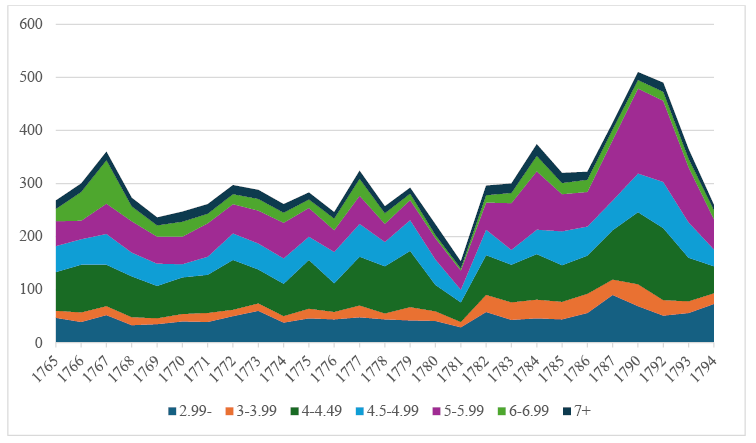
Figure 1, limited to complete years, shows that on average more than 250 workers passed through the Royal Factories of Liérganes and La Cavada each year. The peak in the number of workers between the late 1780s and early 1790s was mainly due to two construction projects: a new chapel and a new blast-furnace3. Therefore, this was a large company for the time, although there were significantly larger workplaces in eighteenth century Spain, such as the Guarnizo Shipyard with 1,259 workers in 1753 (Lanza García, 2010, p. 65) or the Royal Foundry of Seville, where about 350 to 380 daily wage workers and around 80 permanent workers were employed in the second half of the eighteenth century (Aguilar Escobar, 2008, pp. 145–146). The most common wage, as noted by other authors, ranged between 4 and 5.5 reales de vellón (hereafter, rs.vn.) per day, mainly corresponding to labourers, semi-skilled workers, and journeymen (Alcalá-Zamora, 1999, p. 80).
The payrolls record a wide variety of occupations. Some, like stonemasons, were highly present during maintenance or construction works but were not a core part of the production of cast-iron cannons. Moreover, they were easily accessible in the surrounding area. In the Merindad of Trasmiera, where the Royal Factories were located, the stonemason trade was widespread, and it was common to see local stonemasons working on Castilian construction projects (Alonso Ruiz, 1992; Cagigas Aberasturi, 2018). Although factory workers were occasionally assigned to these tasks, it was common to hire external labour4.
This was not possible for occupations linked to the blast-furnace, as the Royal Factories were the only ironworks in the area dedicated to cast-iron cannons, in a region dominated by the bloomery furnace5. As a result, there were few opportunities for training in specialized trades such as founder, loader, or moulder, and their origin was almost always internal. Of the 68 identified hires as loaders, only six were not due to promotion or transfer6. Even some of these hires involved individuals who had previously worked in unskilled positions. For example, José Cavada, a loader in 1773, after working in another position in 17717.
The case of the blacksmiths was mixed. Although it was a permanent trade with tasks such as tool repair, and blacksmiths were available in Cudeyo (Lanza García, 2010, p. 292), they also manufactured the moulding boxes. Their recruitment combined internal promotion and external hiring, especially during periods of increased demand. Thus, between 1773 and 1774, the number of blacksmiths rose from 6 to 22, half of the new workers being internal and the other half hired externally8.
For this reason, the analysis will focus on occupations with internal promotion paths: founders, loaders, moulders, and blacksmiths9.
Table 2 shows the basic pay structure for these trades, along with the rest of job positions of the sections where they were located. We can divide the workers found into three different types: first, skilled workers who took part in specific stages of cast-iron cannon production, such as founders or moulders; later, workers dedicated to supporting them in their tasks, such as labourers; finally, those responsible for preparing raw materials, among whom we find the least skilled workers10. This division of labour is characteristic of large-scale ironworks, such as those in eighteenth century Russia, as opposed to the smaller Swedish ones, with less division of labour (Florén et al., 1998, p. 92).
An essential aspect for understanding how wages were assigned is that, with few exceptions11, the daily wage depended on the job position (Bartolomé Marcos and Díaz García, 2017, p. 93). A single labour category could have more than one wage level, as in the case of blacksmiths. However, this wage could not increase beyond the limits established by their trade and category until they were promoted to the next category. This had two consequences: first, the only way for a worker to increase their pay was to advance within the company’s labour hierarchy. Second, a change in job position could involve a change in wage. This could mean a pay increase if the new position had a higher wage, but the opposite was also true.Table 2 . Selection of occupations in the Royal Factories of Liérganes and La Cavada in January of 1770
| HISCO | ||||
|---|---|---|---|---|
| Wage | code (if | |||
| Occupation | Category in rs.vn Task there is one) | |||
| Blast-furnaces section | ||||
| Moulding workshop section | ||||
| Smithy section | ||||
| Founder | Master | 5.5-17.0 | Controlling the process of smelting the ore | 7-21.20 |
| and deciding when to carry out the casting. | ||||
| Loader | Maestro | 4.5 | Loading the furnace with raw materials and fuel. | |
| Raguador | – | 4.0 | Roasting the iron ore in order to make its smelting easier. | |
| Zarramplín | – | 4.0 | Labourer without a specific task. | |
| Limestore crusher | – | 2.5 | Preparing the limestone. | |
| Cubero | Maestro | 5.5 | Digging the mould in the casting pit. | |
| Cubero | 4.5 | |||
| Cannon lifter | – | 4.5 | Removing the cannon mould from the casting pit | |
| once the iron has cooled. | ||||
| Moulder | Master | 6.0-17.0 | Choosing the raw material and supervising the | 7-25.00 |
| mould manufacturing process. | ||||
| 5.5 | Manufacturing clay mould. | |||
| Moulder | 5.0 | |||
| 4.5 | ||||
| Labourer | 4.0 | |||
| Clay treader | – | 3.0 | Preparing of the raw material for the | |
| manufacturing of the mould | ||||
| 2.5 | ||||
| Blacksmith | Master | 6.0-9.0 | Manufacturing tools and moulding boxes. | 8-31.10 |
| Blacksmith | 5.5 | |||
| 5.0 | ||||
| 4.5 | ||||
| Labourer | 4.0 |
Note: The category equivalent to the journeyman is represented by the name of the trade, as this is how it is recorded in the payrolls.
Source: For the labour and wage structure: AGS, TMC, leg. 1434. For the tasks: Founders, loaders, cuberos and moulders in AGS, SMA, leg. 683. Blacksmiths and zarramplines: Dotación de las Reales Fábricas de Liérganes y La Cavada (1777). The rest are inferred through the occupation name. HISCO codes: van Leeuwen, Maas and Miles (2002).
The previous section has shown that the way for a worker to see an increase in their remuneration was by climbing the company’s hierarchy. This section deals with how this process functioned in the Royal Artillery Factories of Liérganes and La Cavada. To do so, we must understand both the mechanisms by which a worker could improve their skill level and the existing paths for progression.
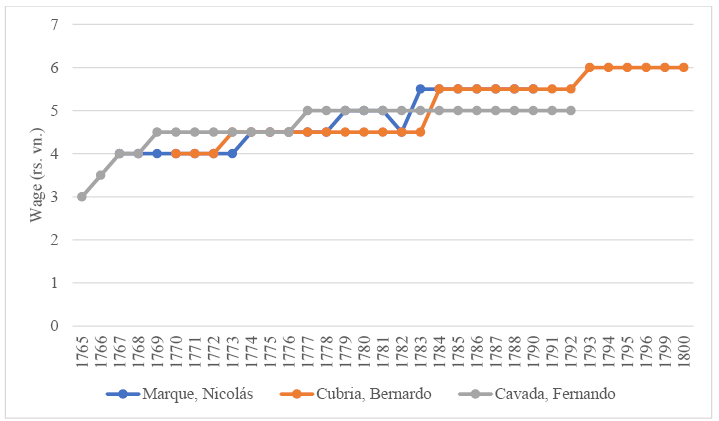
In the case of moulders and blacksmiths, these positions had directly lower, unskilled categories. Therefore, in these positions, we find a relatively structured path, which generally involved passing through the position directly below, that of labourer or assistant. An example of this is Nicolás Marque, who between 1767 and 1773 was a moulder’s labourer and general labourer and in 1774 was promoted to moulder with a wage of 4.5 reales per day. In 1779, his wage increased to 5 reales, and although in 1782 he went back to earning 4.5 reales, in 1783 he was promoted to 5.5 reales per day, maintaining this pay until he stopped working at Liérganes and La Cavada in 1791. Fernando Cavada is an example of a worker who rose from the very bottom of his section to become a skilled worker. He was a clay stomper preparing the raw material for moulds in 1765. After that, he became a moulder’s labourer, and in 1769 he was promoted to moulder with a wage of 4.5 reales. In 1777, he got his last raise to 5 reales, which he maintained until 1791. As the case of Bernardo Cubría shows, a worker could go through multiple job positions before settling into a profession. We can identify this individual for the first time in 1770, when he worked as a stonemason’s labourer and roofer at four reales, and as a cannon tester and cubero at 4.5 reales. In December 1771, he became a blacksmith’s labourer, and in September 1774, he was promoted to blacksmith with a wage of 4.5 reales. In February 1784, his wage increased to 5.5 reales, and in 1793 he began earning 6 reales, thus becoming one of the highest-paid blacksmiths.
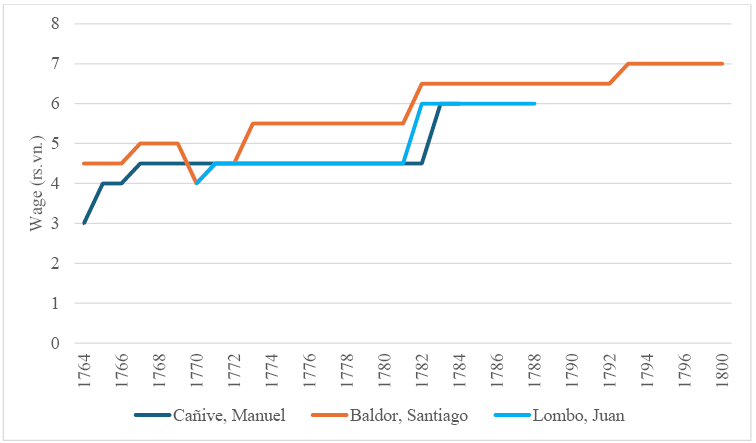
These examples, represented in Figure 2, show the types of wage profiles that can be found in the Royal Factories of Liérganes and La Cavada. We do not see gradual increases in wages as workers gained experience in their trade, but rather promotions to more highly skilled positions or advancement to higher skill levels within the same category. This is similar to what García-Zúñiga and López Losa (2021, p. 709) and Buscemi (2024, p. 234) show in the Royal Palace of Madrid, although it is more difficult to determine whether most of the increase in earnings occurred during the early years of working life.
The previous examples show relatively structured progression paths, in which moving through the position immediately below that of a journeyman stands out. However, in the two trades most closely tied to the operation of the blast-furnace, founders and loaders, this was less true. These workers rose through the hierarchy of furnace trades, but without following a predetermined path. We see Manuel Cañive for the first time as a stonemason’s labourer in 1764. In 1765, he was transferred to the Santa Teresa furnace as a zarramplín. From that point on, he began to move up in the furnace. In 1767, he was a cubero, responsible for burying and unearthing the cannon moulds, and in 1772 he was assigned as a loader at the San José furnace. Santiago Baldor worked as a borer’s labourer between 1764 and 1769, after which he was a carpenter from 1771 to 1772. During most of those years, he combined the aforementioned trades with that of cubero, and in February 1773, he was promoted from cubero to founder. Finally, we have the example of Juan Lombó, who, within the span of a year, went from mason’s labourer to raguador, and finally to loader, between 1770 and 1771.
The examples shown in this section suggest that training was carried out on-the-job. Although we cannot always map out a concrete progression structure, learning involved performing tasks of increasing skill level, but always as part of the production process. Even though we have no description of the training process in the Royal Factories of Liérganes and La Cavada, some statements support the idea that learning was based on “learning by doing”. In 1826, there were complaints that the workers were “a group of purely practical operators” who “mechanically learned what was known a hundred years ago”12 (Alcalá-Zamora, 1974a, p. 220). In the 1783 Instruction it is mentioned that management does not interfere in the workers’ tasks, since they require “a professional intelligence subject to practice”13. Some of these cases can be framed within the models presented by de Munck (2010, p. 338) for preindustrial urban learning, moving from basic material preparation tasks to more complex processes. We must highlight, however, that no apprentices were found. In this regard, Rosés (1998, p. 31) shows how training in Barcelona’s textile industry was carried out through an informal apprenticeship, which required going through preparatory work positions and working alongside experienced workers. We might be facing a similar situation here. At the same time, the mode of skill acquisition and progression within the company, based on on-the-job training and wage increases according to category and position, bears clear similarities to what has been found in the works at the Royal Palace of Madrid (García-Zúñiga and López Losa, 2021).
The training and progression model for founders and loaders, along with moulders, changed starting in 1782–1783, when we can identify the presence of apprentices in the Royal Factories of Liérganes and La Cavada. These apprentices were concentrated mainly in the most specialized trades of iron casting, loaders, founders, and moulders, making up approximately 5% of the workforce, a relatively small proportion. However, this process became the new path to reach the positions of loader and founder, making it a fundamental part of the internal training and progression system of the foundries.
It is difficult to be certain about the reasons that led to the introduction of the apprenticeship. On the one hand, the 1783 Instruction states that “since the advancement of this class is such an important matter for the survival of the Factories and the usefulness of the service, it should be pursued with particular zeal”14. In other European foundries, it was believed that the most important part of knowledge transfer in foundry work took place primarily through the joint work of the master and the apprentice (Florén et al., 1998, p. 92). For this reason, the company’s management may have considered it necessary to establish apprentices as part of the working teams of founders and loaders.
It is also possible that the establishment of formal apprenticeships was an attempt to take control of furnace operation knowledge away from the specialists who held a monopoly over it. Rosenband (2021) shows how some producers in the late eighteenth century created formal apprenticeships and structured internal labour markets in order to take control of knowledge transmission. Although we cannot rule out this possibility, it would not have been successful, since in 1799, the descendants of the Walloon specialists who had arrived in the seventeenth century still made up the majority of the skilled workers dedicated to furnace work (Alcalá-Zamora, 1999, p. 77)15.Table 3 . Loaders at Del Pilar furnace in 1787
| Name | Category | Workdays | Name | Category | Workdays |
|---|---|---|---|---|---|
| Cubría, Leandro | Loader | 30 | Cubría, Leandro | Loader | 31 |
| Camporredondo, Juan | Loader | 30 | Camporredondo, Juan | Loader | 5 |
| Roji, Juan | Loader | 30 | Roji, Juan | Loader | 26 |
| Roji, Juan | Apprentice | 5 | |||
| Aja, Simón | Apprentice | 21.5 |
SOURCE: AGS, TMC, leg. 1458; AGMAB, Fábricas de Marina, leg. 4311.
The apprenticeship we find in this company was not a specific process like guild apprenticeship, but rather a job position or, as described by Carrión Arregui (2000, p. 77) in the seventeenth century Armoury of Tolosa, “a first level of the trade”. It has not been possible to find references to the roles of these apprentices. However, the payrolls show them working alongside the rest of the work team. For example, in March 1785, we find the founder’s apprentice Manuel Baldor Mier working alongside two founders, while the loader’s apprentice José Roqueñi worked with another loader. The moulder’s apprentice Pedro Berno worked with seven other moulders16. This organization of apprentice work in the furnaces suggests that their training, like that of other workers, took place on the job17. At the same time, the apprenticeship was paid, with a wage of three reales that gradually rose to four from 1793 onward. Some authors have associated the payment of a wage to apprentices with the idea that their work provides a certain value to the company (Schalk, 2017, p. 742), something that could be applicable in this case.
Apprenticeship did not conclude in the same way as in guild-based manufacturing; it simply reached a point in which the apprentice was promoted within the company’s hierarchy. A clear example of this is Juan Roji. As shown in Table 3, this apprentice was promoted to loader to fill the position left vacant by Juan Camporredondo, who had been transferred to another section. Therefore, when we speak of apprenticeship in the Royal Factories of Liérganes and La Cavada, we are referring to a job position. In practice, it is possible that they did not differ significantly from labourers in other trades, workers who supported the specialists. This is also related to the duration of the apprenticeship period, which was not fixed but could last anywhere from one to nine years, depending on the case.Table 4 . Duration of apprenticeship, 1783-1800
| Years as an apprentice | Total | Worked as journeymen | Did not work as journeymen |
|---|---|---|---|
| 1 | 21 | 7 | 10 |
| 2 | 20 | 13 | 5 |
| 3 | 7 | 3 | 4 |
| 4 | 4 | 3 | 1 |
| 5 | 4 | 2 | 1 |
| 6 | 2 | 0 | 2 |
| 7 | 2 | 0 | 2 |
| 8 | 6 | 3 | 2 |
| 9 | 1 | 0 | 1 |
Source: Same as table 2.
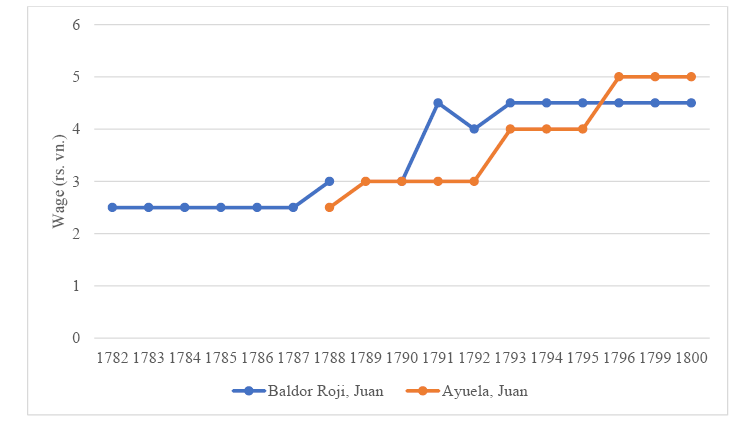
Figure 4 shows some examples of the new career paths that we can find after the introduction of apprenticeships. Between 1782 and 1787, Juan Baldor Rojí held various unskilled positions. In 1788, he became a loader’s apprentice, and in 1791 he was promoted to loader with a wage of 4.5 reales per day, a position he combined with that of labourer and raguador. As was the case for other workers, their wage only increased when they advanced to a different position, which sets them apart from what has been identified in other studies, where apprentices get gradual wage increases as they gain experience (Woodward, 1995, p. 61; Mora-Sitjà, 2011, p. 246; Schalk, 2017, p. 742). The case of Juan Ayuela offers a clue as to where apprenticeship stood within the company’s job hierarchy. His progression from carpenter’s apprentice to skilled worker included an intermediate step as a labourer earning four reales. This confirms the idea of the apprentice as the lowest-ranking position within the trade, since, in the case of carpenters, it ranked even below that of labourer18.
The description of the labour market presented here shows characteristics typical of internal labour markets: recruitment for the most specialized positions was internal, wages were tied to specific pay scales, and training took place at the workplace. According to Doeringer and Piore (1985), internal labour markets are characterized by internal promotion, on-the-job training, and a hierarchical wage structure. In this case, positions related to iron smelting in the blast furnace required specific skills, which, according to these authors, promotes the creation of internal labour markets (Doeringer and Piore, 1985, p. 58). We know that some institutions and companies managed to create internal labour markets between the late eighteenth and early nineteenth centuries (Rosenband, 2000, p. 129; Murphy, 2015). In this case, we do not always find fully defined occupational ladders, something that also occurred in the internal market of La España Industrial in the in the middle of the nineteenth century (Camps, 1995, pp. 212–213).
The previous section has shown the training and promotion process at the Royal Factories of Liérganes and La Cavada. This section deals with the difficulties workers could face to obtain wage increases. Unlike studies that show wage increases with age in the nineteenth century (Boot, 1991, 1995), García-Zúñiga and López Losa (2021, pp. 708–714) show that in the construction of the Royal Palace of Madrid in the eighteenth century, wages depended on skills. Here, I show that even with them, wage increases were not always possible. When a change in job category was required, the company structure could limit it.Table 5 . Apprentices, 1783-1800
| Number of apprentices | Average years | ||||
|---|---|---|---|---|---|
| Group | Total | Get promoted | Total | Get promoted | Do not get promoted |
| Total | 59 | 31(53%) | 3.0 | 2.8 | 3.3 |
| With previous emoployment | 31 | 18(58%) | – | 2.2 | 4.0 |
| Without previous emoployment | 28 | 13(42%) | – | 3.8 | 2.7 |
Source: AGS, TMC, legs. 1451-1458; AGMAB, legs. 4311-4326.
We must first take into account that not all lower-level workers managed to get promoted. This is clearly seen in the case of apprentices, though it was also true for those following other progression paths. As shown in Table 5, only 31 of the 59 apprentices we were able to track, 53%, managed to establish themselves as skilled workers. Wallis (2008, pp. 844–845) cites morbidity and early departure in pursuit of better job opportunities as reasons for failed apprenticeships. Although we do not have data on apprentice deaths, we do know that some abandoned due to the insufficient wages earned as apprentices (Bartolomé Marcos and Díaz García, 2017, p. 102). However, those who did advance spent slightly less time as apprentices, since this was not a fixed period as in guild apprenticeships, but rather ended when they got a promotion.
In some cases, lack of experience may have been the reason that complicated promotion. Apprentices who had worked previously had both shorter apprenticeship periods (2.2 years until promotion) and a higher likelihood of getting promoted. However, experience alone was no guarantee of promotion. Antonio Lombo was an apprentice loader and founder, having worked at the company before. This did not help him, as he failed to obtain a promotion during the six years he worked as an apprentice between 1788 and 1794. During that same period, Juan Arche Vega entered as an apprentice in 1787 and was promoted to founder by 1790. José Otí, with no prior experience, began as a founder’s apprentice in 1788 and became a founder by December 179019. As García-Zúñiga and López Losa (2021, p. 710) observe in the works on the Royal Palace of Madrid, experience and seniority were relevant because they enabled skill acquisition, but ultimately, the apprentice had to demonstrate the necessary ability.
Training made promotion possible, but it was not an automatic process. When a wage increase required moving to a higher job category, the worker had to be promoted to fill a more skilled position. Therefore, this also meant that the possibility of incorporating another worker in that category had to exist
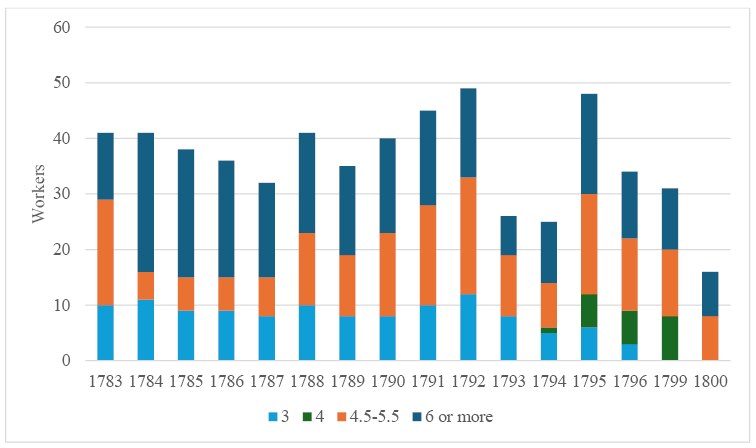
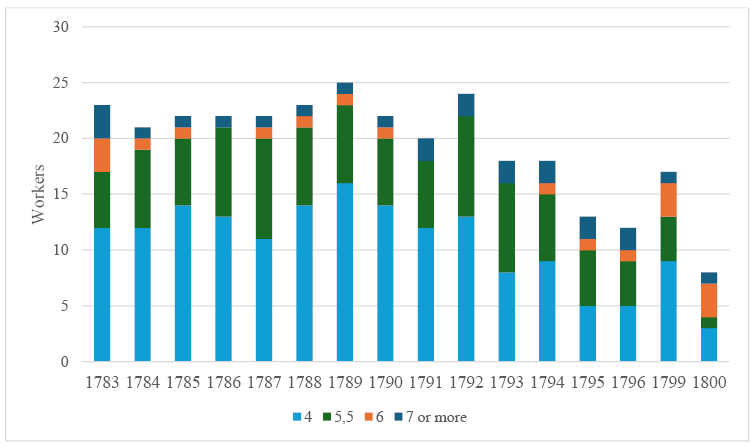
Figures 5 and 6 show the wage structure in the blast-furnace and smithy sections. In order to best represent the composition of the sections, only one month per year is shown. As we can see, although there could be minor changes, the overall ratio of unskilled to skilled workers remained stable. In the blast-furnaces, apprentices, who earned 3 to 4 reales per day, made up around 20 to 25% of the total workforce, except in 1800, when they are no longer identified. The greater variation in skilled workers’ wage levels was due to pay increases between 1783–1784 and in 179320. The furnaces had low flexibility in their labour composition, consisting of about three loaders and founders per apprentice in each trade. For this reason, the decrease in the number of identified workers was due to the number of furnaces in operation rather than a reduction in workers per furnace21. Although this composition, with a higher proportion of skilled than unskilled workers, might suggest numerous opportunities for promotion, this was not the case in practice, as loaders and founders were characterised by high stability. In 1800, the eight loaders still active had been in their positions for an average of 13.75 years. In 1791, when the number of loaders peaked, the average was seven and a half years, despite recent additions22.
In the case of the smithy, in addition to stability, we must note that the proportion of labourers was much higher than that of apprentices in the casting furnaces. They constituted half or more of the total employees in this section most years. The reduction in their proportion as we approach 1800 suggests that staff cuts were mainly carried out among the less skilled workers.
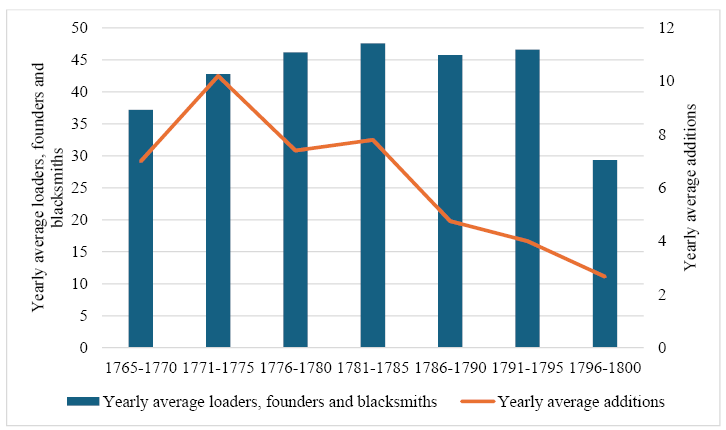
The impact of this was that vacancies for access to these positions were scarce during years of stability. Figure 7 shows the annual averages and additions of loaders, founders, and blacksmiths. We can see that the number of additions increased during periods of workforce expansion, while it declined during periods of stability. Since few skilled workers left their positions voluntarily, promotion opportunities mainly arose when labour demand increased. After 1795, when the workforce began to shrink, opportunities for promotion became even more limited. It was during this period that we most commonly find workers spending extended periods without being promoted. Dionisio Baldor, Francisco Meruelo, and Juan Oti Raba worked as apprentices for 7 to 9 years between 1790 and 1799 before consolidating as journeymen23. Although the contexts differ significantly, workforce expansion was also key to increasing promotion opportunities at the postal service (Correos) between the late nineteenth and early twentieth centuries (Domenech, 2015, p. 477).
Access to a master position followed the same logic as promotion from apprentice or blacksmith’s labourer to loader or blacksmith. The consequence is that we can find very long careers that never surpassed the wage of an ordinary worker or journeyman. A clear example of this is the case of the blacksmith and filer Manuel Abren. This individual, who initially followed a logical career progression from labourer to blacksmith and filer, maintained a wage of 5.5 rs. vn. until 1799, when he received an increase of half a real.
One reason for this may be that masters were not simply highly skilled workers, but that being a master involved taking on responsibility for the work carried out in their section or group, that is, holding a specific job position. According to the 1773 regulations, master founders were in charge of inspecting raw materials, ensuring that workers fulfilled their duties, and requesting the necessary labour. Master moulders were responsible for selecting raw materials and for any imperfections in the moulds24. In the 1783 Instruction, the heads of each section are referred to as “Principal Masters” (Maestros Principales), and they were responsible for reporting the tools they used (Instrucción para el gobierno y régimen de las fábricas de artillería de Liérganes y La Cavada, 1783, p. 28). These examples suggest that masters were not simply highly skilled workers, but that they had specific responsibilities.
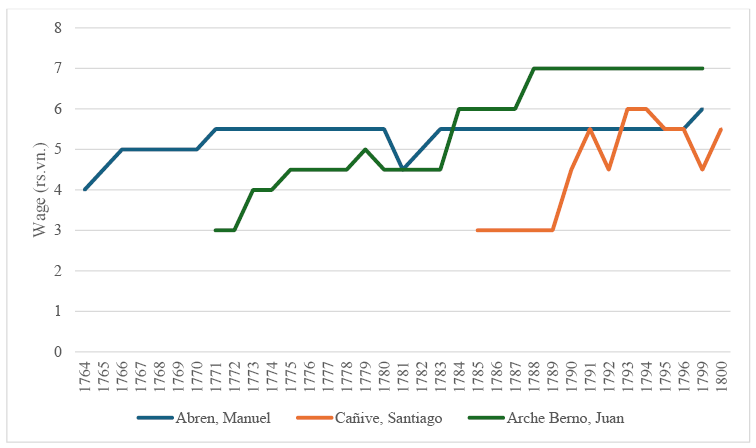
The analysis of Juan Arche Berno’s career illustrates the nature of the master as the head of a specific work group. After holding several positions, he became a moulder at the reverberatory furnaces25 in 1775. Interestingly, starting in 1780, he worked both as a master moulder and as an common moulder. The reason for this is that the moulding team at the reverberatory furnace consisted of a single master and several moulders. When he served as master, he earned 5.5 reales per day, and as an ordinary worker, 4.5 reales26. In fact, the payroll for the week of 15-21 of July 1781, specifies that he worked “six days, four as a master moulder at five and a half reales per day, and two as a moulder at four and a half reales per day”27. In this case, moulding work at the reverberatory furnace always had to be directed by a master, and if the master was absent for any reason, one of the moulders had to take over the position. The wage increases and partial pay reorganization that took place in 1782–1783 make it difficult to determine whether this practice continued. Many masters were assigned a fixed wage, and their salaries began to be recorded in a separate section of the payroll, making it harder to identify specific work groups.
The loss of jobs, which mainly occurred following the closure of a section, not only reduced promotion opportunities but could also result in demotions. One example is Santiago Cañive. This worker combined his apprenticeship as a moulder with other tasks, including work as a zarramplín, assisting the coremaker Ángel Baldor28. In December 1790, he became a moulder with a wage of 4.5 reales, and in 1791 he worked both as a moulder at 4.5 reales and as a stonemason at 5.5 reales. In 1793 and 1794, in addition to these positions, he also worked as a coremaker, earning six reales per day. This suggests that during his time assisting Ángel Baldor, he learned the trade. However, despite having reached the position of coremaker, this role did not continue, and after 1794 he returned to his previous jobs, losing the six reales he earned as a coremaker. The evidence presented in this section shows that experience and skill were essential for promotion, but not sufficient. Ultimately, if a pay raise required a change in job position, the labour structure could limit promotion opportunities.
This study aims to analyse the training processes and career progression at the Royal Artillery Factories of Liérganes and La Cavada between 1764 and 1800. Studying non-guild contexts allows to widen our understanding of the diversity of training and mobility mechanisms in preindustrial economies. Evidence shows the coexistence of characteristics typical of the preindustrial world with some features associated to more modern forms of labour organization.
These workplaces were the only ones that produced cast-iron cannon in Spain. As a consequence, they needed to train their workforce that was specialized in this activity, since there were no training opportunities in the surroundings. As in other trades in the preindustrial economy, training was on-the-job, by means of practice and experience. However, contrary to what we can expect from a preindustrial institution, this training was not always contingent on an explicit apprenticeship. On many occasions, the process consisted of rising through increasingly skilled positions, with some similarities to the process shown by Rosés (1998) in nineteenth century Barcelona. Apprenticeship was established from 1782 onwards, especially for the three more specialized trades, loader, founder and moulder. However, this apprenticeship did not consist of a training period determined by a contract, but a position, and ended when the apprentice got promoted.
Pay rise depended on the worker rising through the company’s predetermined levels. If a certain category had more than one possible wage, the worker could obtain wage rises. If the opposite was true, its wage would not rise unless he managed to get promoted to a higher category. This kind of progression is similar to the one identified by García-Zúñiga and López Losa (2021) in the Royal Palace of Madrid.
The Royal Factories of Liérganes and La Cavada offer additional evidence of the existence of internal labour markets in the eighteenth century. Resorting to internal promotion to fill vacancies, structured pay scales and on-the-job training are features that allow us to frame the functioning of mobility in this company in this model.
Progression depended greatly on the worker’s skills to be eligible for promotions, such as the case of the works of the Royal Palace of Madrid. However, all this was under the company’s labour structure, with little flexibility. This, together with a relatively high stability of skilled workers and a staff that did not undergo a significant growth, had as a consequence the fact that some workers could spend long periods without progressing. Furthermore, since the wage was tied to the position and the category, its loss could force the worker to accept a lower wage. Therefore, even though training was necessary to be eligible for promotions, ultimately, the wage was determined by the worker’s standing in the company’s labour hierarchy.
Archivo General de Marina Álvaro de Bazán (AGMAB)
Archivo General de Simancas (AGS): Secretaría de Marina (SMA), Tribunal Mayor de Cuentas (TMC)
Archivo Histórico de la Nobleza (AHNob)
AGUILAR ESCOBAR, Antonio. 2008. La Real Fundición de Sevilla (1717-1808). Doctoral Dissertation, UNED.
AGUILAR ESCOBAR, Antonio. 2010. Apuntes para la historia de la Real Fundición de Cañones de Barcelona (1775-1800). Revista de Historia Militar 108: 11-37.
ALCALÁ-ZAMORA, José. 1974a. Historia de una empresa siderúrgica española: los altos hornos de Liérganes y La Cavada. Santander: Institución Cultural de Cantabria, Centro de Estudios Montañeses.
ALCALÁ-ZAMORA, José. 1974b. Producción de hierro y altos hornos en la España anterior a 1850. Moneda y Crédito 128: 117-218.
ALCALÁ-ZAMORA, José. 1999. Altos hornos y poder naval en la España de la Edad Moderna. Madrid: Real Academia de Historia.
ALONSO RUIZ, Begoña. 1992. El arte de la cantería: los maestros trasmeranos de la Junta de Voto. Santander: Universidad de Cantabria, Asamblea Regional de Cantabria.
BARTOLOMÉ MARCOS, Luis; DÍAZ GARCÍA, María del Pilar. 2017. Chicas de hierro. El trabajo de las mujeres en las Reales Fábricas de Artillería de Liérganes y La Cavada (Cantabria): 1759-1837. Santander: Editorial de la Universidad de Cantabria.
BONNET, Cristophe. 2008. Furnace Workers: A Quasi-Corporation in Eighteenth Century Rural France. ICON 14: 30-40.
BOOT, H. M. 1991. Salaries and career earnings in the Bank of Scotland, 1730–1880. The Economic History Review 44(4): 629-653. DOI: https://doi.org/10.2307/2597805.
BOOT, H. M. 1995. How skilled were Lancashire cotton factory workers in 1833?. The Economic History Review 48(2): 283-303. DOI: https://doi.org/10.2307/2598404
BUSCEMI, Tancredi. 2024. Working time, careers, and the labour market in the early modern period: Evidence from the Royal Palace of Palermo (1579–1609). Rivista di Storia Economica 40(2): 221-242. DOI: https://doi.org/10.1410/114023
CAGIGAS ABERASTURI, Ana. 2018. Canteros de Trasmiera. Historia social. Santander: Editorial de la Universidad de Cantabria.
CAMPS, Enriqueta. 1995. La formación del mercado de trabajo industrial en la Cataluña del siglo xix. Madrid: Ministerio de Trabajo y Seguridad Social.
CARRIÓN ARREGUI, Ignacio María. 1991. La siderurgia guipuzcoana en el siglo xviii. Bilbao: Universidad del País Vasco.
CARRIÓN ARREGUI, Ignacio María. 1998. La crisis del siglo xvii y la producción de armamento en Gipuzkoa. Revista de Dirección y Administración de Empresas 7: 21-31.
CARRIÓN ARREGUI, Ignacio María. 2000. El trabajo en una manufactura real del siglo xvii: los armeros de la Armería de Tolosa. Vasconia 30: 73-82.
CARRIÓN ARREGUI, Ignacio María. 2014. La producción manufacturera vasca en la época preindustrial: el caso de la industria en Gipuzkoa. In Sesión 16. Industria antes de la Industrialización: la organización del trabajo manufacturero en la España preindustrial, XI International Congress of AEHE, Madrid 4-5 September.
CEBALLOS CUERNO, Carmen. 2001. Arozas y ferrones. Las ferrerías de Cantabria en el Antiguo Régimen. Santander: Universidad de Cantabria.
CROWSTON, Clare; LEMERCIER, Claire. 2019. Surviving the End of the Guilds: Apprenticeship in Eighteenth and Nineteenth-Century France. In Maarten PRAK; Patrick WALLIS (eds), Apprenticeship in Early Modern Europe. Cambridge: Cambridge University Press, 282-308.
DÍEZ AJA, Juan Antonio. 2006. La fusión del hierro y las fábricas de Liérganes y La Cavada. Torrelavega: Cantabria Tradicional.
DOBADO GONZÁLEZ, Rafael. 1989. El trabajo en las minas de Almadén. Doctoral Dissertation, Madrid: Universidad Complutense de Madrid.
DOERINGER, Peter; PIORE, Michael. 1985. Mercados internos de trabajo y análisis laboral. Madrid: Ministerio de Trabajo y Seguridad Social.
DOMENECH, Jordi. 2015. Empleo y carreras laborales en Correos de España, 1890–1935. Revista de Historia Económica / Journal of Iberian and Latin American Economic History 33(3): 455-486. DOI: https://doi.org/10.1017/S0212610915000154
1777. Dotación de las Reales Fábricas de Liérganes y La Cavada. Hoznayo.
FERNÁNDEZ DE PINEDO, Emiliano. 1988. From the Bloomery to the Blast-Furnace: Technical Change in Spanish Iron-Making (1650–1822). Journal of European Economic History 17: 7-31.
FLORÉN, Anders; RYDÉN, Göran; DASHKEVICH, Ludmila; GAVRILOV, D. V.; USTIANTSEV, Sergei. 1998. The Social Organisation of Work at Mines, Furnaces and Forges. In Maria ÅGREN (ed), Iron-making Societies: Early Industrial Development in Sweden and Russia, 1600–1900. New York, Oxford: Berghahn Books, 61-138.
GARCÍA-ZÚÑIGA, Mario; LÓPEZ LOSA, Ernesto. 2021. Skills and human capital in eighteenth-century Spain: wages and working lives in the construction of the Royal Palace of Madrid (1737–1805). The Economic History Review 74(3): 691-720. DOI: https://doi.org/10.1111/ehr.13048
GONZÁLEZ ENCISO, Agustín. 2013. Asentistas y fabricantes: el abastecimiento de armas y municiones al Estado en los siglos xvii y xviii. Studia Historica: Historia Moderna 35: 269-303. DOI: https://doi.org/10.14201/shhmo201335269303
HELGUERA QUIJADA, Juan. 1988. Las misiones de espionaje industrial en la época del Marqués de la Ensenada. In Mariano ESTEBAN PIÑEIRO; Nicolás GARCÍA TAPIA; L.A GONZÁLEZ ARROYO; Mauricio JALÓN CALVO; Fernando MUÑOZ BOX; María Isabel VICENTE MAROTO (coords), Estudios sobre historia de la ciencia y de la técnica. IV Congreso de la Sociedad Española de Historia de las Ciencias y de las Técnicas. Valladolid: Junta de Castilla y León, 671-696.
HELGUERA QUIJADA, Juan. 1991. Las Reales Fábricas. In Francisco COMÍN; Pablo MARTÍN ACEÑA (eds), Historia de la empresa pública en España. Madrid: Espasa-Calpe, 51-88.
HELGUERA QUIJADA, Juan. 2005. La introducción de nuevas técnicas: de la inmigración tecnológica al espionaje industrial. In Manuel SILVA SUÁREZ (ed), Técnica e ingeniería en España III. Zaragoza: Institución «Fernando el Católico», Prensas Universitarias; Madrid: Real Academia de Ingeniería, 47-94.
1783. Instrucción para el gobierno y régimen de las fábricas de artillería de Liérganes y La Cavada. Madrid: Joachin Ibarra.
JACKSON, Melvin H.; DE BEER, Carel. 1973. Eighteenth Century Gunfounding: The Verbruggens at the Royal Brass Foundry. New Abbot: David and Charles Newton Abbot.
LANZA GARCÍA, Ramón. 2010. Miseria, cambio y progreso en el Antiguo Régimen. Cantabria, SIGLOS XVI–XVIII. Santander: Editorial de la Universidad de Cantabria.
VAN LEEUWEN, Marco H. D.; MAAS, Ineke; MILES, Andrew. 2002. HISCO: Historical international standard classification of occupations. Leuven: Leuven University Press.
LÓPEZ BARAHONA, Victoria; NIETO SÁNCHEZ, José Antolín. 2019. Artisan Apprenticeship in Early Modern Madrid. In Maarten PRAK; Patrick WALLIS (eds), Apprenticeship in Early Modern Europe. Cambridge: Cambridge University Press, 44-77.
MORA-SITJÀ, Natalia. 2011. El primer proletariat català. Barcelona quaderns d’història 17: 237-252.
MORELLI, Roberta. 1993. Men of Iron: Masters of the Iron Industry in Sixteenth-Century Tuscany. In Thomas Max SAFLEY; Leonard N. ROSENBAND (eds), The Workplace Before the Factory: artisans and proletarians. Ithaca: Cornell University Press, 146-164.
MORENO CLAVERÍAS, Belén. 2015. El aprendiz de gremio en la Barcelona del siglo xviii. Áreas. Revista Internacional de Ciencias Sociales 34: 63-75.
DE MUNCK, Bert. 2010. Corpses, Live Models, and Nature: Assessing Skills and Knowledge before the Industrial Revolution. Technology and Culture 51(2): 332-356. DOI: https://dx.doi.org/10.1353/tech.0.0454
DE MUNCK, Bert; SOLY, Hugo. 2007. Learning on the Shop Floor in Historical Perspective. In Bert DE MUNCK; Steven L. KAPLAN; Hugo SOLY (eds), Learning on the Shop Floor: Historical perspectives on apprenticeship. New York: Berghahn Books, 3-32.
MURPHY, Anne L. 2015. “Writes a fair hand and appears to be well qualified”: the recruitment of Bank of England clerks, 1800–1815. Financial History Review 22(1): 19-44. DOI: doi:10.1017/S0968565015000013
OGILVIE, Sheilagh. 2004. Guilds, Efficiency, and Social Capital: Evidence from German Proto-Industry. Economic History Review 57(2): 286-333. DOI: https://doi.org/10.1111/j.1468-0289.2004.00279.x
PASTOR REY DE VIÑAS, Paloma. 1994. Historia de la Real Fábrica de Cristales de San Ildefonso durante la época de la Ilustración (1727–1810). Madrid: Fundación Centro Nacional del Vidrio.
REITH, Reinhold. 2007. Apprentices in the German and Austrian Crafts in Early Modern Times. In Bert DE MUNCK; Steven L. KAPLAN; Hugo SOLY (eds), Learning on the Shop Floor: Historical perspectives on apprenticeship. New York: Berghahn Books, 179-200.
ROSENBAND, Leonard N. 2000. Papermaking in Eighteenth-Century France. Baltimore: Johns Hopkins University Press.
ROSENBAND, Leonard N. 2021. Manufacturing Labour Discipline. Historical Reflections 47(1): 14-30.
ROSÉS, Joan. 1998. Measuring the contribution of human capital to the development of the Catalan factory system (1830–61). European Review of Economic History 2(1): 25-48. DOI: https://doi.org/10.1017/S1361491698000021
SARASÚA, Carmen. 2013. ¿Activos desde cuándo? La edad de acceso al mercado de trabajo en la España del siglo xviii. WP-AEHE 1309.
SCHALK, Ruben. 2017. From orphan to artisan: apprenticeship careers and contract enforcement in The Netherlands before and after the guild abolition. The Economic History Review 70(3): 730-757. DOI: https://doi.org/10.1111/ehr.12422
TORRES SÁNCHEZ, Rafael. 2008. Velas sin cañones. In Francisco MORALES PADRÓN (coord), XVII Coloquio de Historia Canario-Americana (2006). Las Palmas de Gran Canaria: Cabildo Insular de Gran Canaria, 1717-1728.
TORRES SÁNCHEZ, Rafael. 2013. Administración o asiento. Studia historica. Historia moderna 35: 159-199. DOI: https://doi.org/10.14201/shhmo201335159199
WALLIS, Patrick. 2008. Apprenticeship and Training in Premodern England. The Journal of Economic History 68(3): 832-861. DOI: doi:10.1017/S002205070800065X
WALLIS, Patrick. 2019. Between Apprenticeship and Skill. Science in Context 32(2): 155-170. DOI: https://doi.org/10.1017/S0269889719000164
WOODWARD, Donald. 1995. Men at work: labourers and building craftsmen in the towns of northern England, 1450–1750. Cambridge: Cambridge University Press.
1. Solid casting involved melting the cannon as a single, uniform piece of iron and then creating the interior diameter by drilling it afterward. In the alternative method, hollow casting, the cannon was typically cast with a wooden piece inside the mould, called a core, which when removed left the interior diameter of the cannon already formed. A detailed explanation can be found in Jackson and de Beer (1973). Between 1761 and 1762, experiments with producing cannons using this technique were already underway. AHNob, Bornos, C 656.
2. As an example, these payments were 1,228 reales and 20 maravedíes in money and wine, distributed between around 38 workers. AGS, TMC, leg. 1451.
3. AGMAB, Fábricas de Marina, legs. 4311-4312.
4. For example, of the 16 stonemasons who worked on the foundations of the new chapel, two were transferred from other sections of the company, and the rest were hired externally. AGMAB, Fábricas de Marina, leg. 4311.
5. On preindustrial ironmaking in Cantabria, see Ceballos Cuerno (2001). A summary of the technological conditions of ironmaking in Early Modern Spain can be found in Fernández de Pinedo (1988).
6. Same sources as table 1.
7. AGS, TMC, legs. 1435-1437.
8. AGS, TMC, leg. 1438.
9. This does not mean they are the only occupations in which we find promotions, but they are those where we can find them more frequently. It also does not mean that no reference to other occupations is made.
10. We know that some of them were young. A document from 1806 defines the clay treaders as “young clay treaders.” AGMAB, Fábricas de Marina, leg. 4328. However, we do not have precise data on their ages. The earliest documented age for entry into Liérganes and La Cavada is 14 years old in the case of women ( Bartolomé Marcos and Díaz García , 2017, pp. 174-175). Sarasúa (2013) suggests ten years old as the average age of entry to work.
11. There could be workers who were assigned a personal wage that did not follow the usual scales. For example, in the case of master moulders, in addition to the more common 5.5 reales, the wage could reach up to 17 reales.
12. Informe de González Azaola al Ministerio, el primero de agosto de 1826. Seen in Alcalá-Zamora (1974a, p. 220).
13. Instrucción para el gobierno y régimen de las fábricas de artillería de Liérganes y La Cavada (1783, p. 10).
14. Instrucción para el gobierno y régimen de las fábricas de artillería de Liérganes y La Cavada (1783, p. 11).
15. This was also the case in other blast furnaces ( Bonnet , 2008, p. 35).
16. AGS, TMC, leg. 1455.
17. Apprenticeship in sixteenth century Tuscan ironworking was similar: it was not regulated by guilds, and apprentices gained experience while they worked in the furnace ( Morelli , 1993, p. 151).
18. In this case, it is possible that the promotion to labourer was based more on age than on skill. Unfortunately, the lack of evidence regarding ages prevents us from exploring this further.
19. Same sources as table 5.
20. These were extraordinary cases of wage increases granted to highly valued workers that, in any case, did not alter the general functioning of wage allocation. They are documented in Bartolomé Marcos and Díaz García (2017, pp. 101, 231–232).
21. In January 1793 and 1794, only four blast-furnaces were active, while in February 1791 and in 1792 there were six. AGMAB, Fábricas de Marina, legs. 4312, 4316, 4318, 4321.
22. AGMAB, Fábricas de Marina, legs. 4311-4326.
23. AGMAB, Fábricas de Marina, legs. 4319-4326.
24. AGS, SMA, leg. 683.
25. The reverberatory furnaces were a different type of furnace from the blast-furnace. At the Royal Factories of Liérganes and La Cavada, they were used to remelt iron scraps. A description of the reverberatory furnace can be found in Díez Aja (2006, pp. 123–125).
26. This worker continued getting promoted until leading the section.
27. AGS, TMC, leg. 1448.
28. The coremaker was responsible for producing the piece that was inserted into the mould so that the internal diameter of the cannon would be formed automatically during casting. HISCO Code: 7-25.50.