Between 1783 and 1789, the Spanish Crown enacted a series of increases in export duties on fine wool as part of Carlos III’s fiscal reforms (Bilbao Bilbao, 2001). These measures dramatically escalated the fiscal pressure on one of the monarchy’s most valuable export commodities. Despite this burgeoning tax burden, Spanish wool exports to European markets remained remarkably resilient throughout the 1780s, continuing unabated until the systemic disruptions of the Revolutionary wars. Their resilience was not accidental: European manufacturers – particularly the producers of high-end woollens – remained structurally dependent on Spanish wool.
This coexistence of heightened fiscal extraction and sustained trade presents a fundamental puzzle: when states impose taxes on internationally traded goods, who ultimately bears the costs? In the late eighteenth century, export duties accounted for more than 20 percent of the commodity’s export value (García Sanz, 1996, p. 105). Such a burden did not simply vanish: it was absorbed, passed forward, or contested across the commodity chain linking Castilian flock owners to foreign looms. By identifying where and how these costs were borne, we gain insight into more than just tax incidence; we reveal the transnational power relations that structured the distribution of economic value in eighteenth-century trade.
Clearly, the mechanics of this distributional process were shaped by the Spanish side of the wool trade but our analysis goes further to encompass France, the principal consumer of Spanish wool during this era. The paper examines the Spanish-French Merino trade between 1764 and 1792, tracing the commodity’s journey from the inland markets of Spain through the fiscal point of Burgos to the ports of Bilbao and Santander, and finally to the manufacturing hubs of Normandy. I argue that export taxation was not a neutral cost passed seamlessly along this wool chain to the final consumer of woollen cloth. Rather, its incidence was determined by deep-seated power asymmetries between wool growers, merchants, the Spanish state, and French woollen manufacturers.
Who bears tax burdens is a question that connects to fundamental issues in economic history. In standard economic theory, tax incidence depends on the relative elasticities of supply and demand: where demand is inelastic relative to supply, buyers bear the burden through higher prices; where supply is inelastic relative to demand, producers absorb it through lower prices. However, early modern commodity chains rarely operated as “textbook” markets; they were defined by trade barriers of all sorts (Findlay and O’Rourke, 2007). The interesting question is therefore not simply the direction of incidence – whether a tax moved “forward” to consumers or “backward” to producers – but the where and the why. This paper argues that to answer those questions, we need to consider the underlying cost structures and power relationships that determined which actors had the leverage to transfer costs and which were forced to absorb them.
The Spanish wool trade offers a unique laboratory for examining distributional effects of fiscal policy precisely because of the structural interdependencies that defined it. By the mid-eighteenth century, the renta de lanas (wool revenue) had become a cornerstone of the Real Hacienda, accounting for 5.17% of total net revenues between 1775 and 1779 (Bilbao Bilbao, 2001, p. 358). For France, this supply was an industrial necessity, underpinning a textile sector that represented half of the kingdom’s total manufacturing value (Cornu and Pinoteau, 2021, p. 20). This mutual dependence, set against the backdrop of Spanish fiscal policy, provides a revealing context for how economic actors transfer – or internalise – fiscal burdens as well as how transnational value distribution operates.
Traditionally, scholars have characterised merchants as the primary beneficiaries of the Spanish wool trade. Carla Rahn Phillips and William D. Phillips argued that “merchants in the wool trade seem to have earned the lion’s share” of economic value, citing price differentials that suggest profits of 10 percent in domestic preparation and a further 15 percent in international transit to markets like Amsterdam (Phillips and Phillips, 1997, pp. 269, 274). This commercial dominance, in the Phillips’s account, was predicated on the Spanish merchants’ control over capital: by providing significant cash advances to producers, merchants effectively secured the raw wool supply, thereby dictating the terms of the relationship from the very start of the commodity chain.
Similarly, Agustín González Enciso described a late-century “nationalisation” of the trade, that allowed Spanish inland merchants to gain independence from foreign houses, suggesting a rebalancing of power in favour of the Spanish merchant class (González Enciso, 2001, p. 17). This shift represented a significant reversal from the seventeenth century; when foreign merchants dominated the Spanish export trade. As Xabier Lamikiz noted, Bilbao’s trade with northern Europe was once “almost entirely in their hands” (Lamikiz, 2010, p. 33), a finding echoed by Regina Grafe, who identified as many English merchants as local ones in Bilbao in 1644 (Grafe, 2005, pp. 196–199). This eighteenth-century “nationalisation” of wool commerce mirrored a broader trend in the Spanish colonial trade, where domestic actors gradually displaced the foreigners who had previously dominated the Carrera de Indias (Le Gouic, 2011; Bartolomei, 2017; Wildbolz-Gallego, 2026).
The limited historical evidence on the distribution of value across the Spanish wool chain makes it difficult to be sure of this interpretation. In fact, this historiographical and empirical gap is a more general characteristic of the historical literature on merchant capitalism. Prominent historians from Fernand Braudel to Sven Beckert attribute a central role to merchants in the history of capitalism but based on limited historical evidence on merchant profitability and dominance (Braudel, 1979; Beckert, 2025). Thus, García Sanz’s observation for the wool trade have a general resonance: “detailed and, at the same time, reliable documentation regarding the profits earned by wool exporting merchants is exceedingly scarce” (García Sanz, 1996, p. 105).
This paper contributes to closing the empirical gap for the late eighteenth century wool trade following the methodology used by Klas Rönnbäck for the sugar trade. Through a combined analysis of aggregate price series and detailed cost reconstruction at multiple nodes along the Spanish-French wool chain, this paper traces the distributional effects of export taxation between 1764 and 1792 to highlight two important features of value capture by merchants and others along the wool chain.
First, both aggregate and firm-level evidence demonstrate that merchants internalised a substantial portion of the tax increases, a process that steadily eroded the commercial profit of the trade. Merchants functioned as the chain’s primary shock absorbers, trapped between a rigid price floor established by growers and a resistant price ceiling maintained by manufacturers. The Dutari ledgers reveal that as the Spanish state and the Castilian growers protected their respective shares, the merchant’s return on investment plummeted.
Second, while their control over capital made firms like Dutari hermanos extraordinarily resilient – allowing them to maintain trade volumes despite negative returns – it did not grant them the leverage to dictate terms, and this resilience proved finite once the French currency devaluation and lengthening credit terms turned a fiscal squeeze into a systemic breakdown after 1789. The paper shows that power was exercised not just through the fiscal point of Burgos, but also through market conditions in Rouen that allowed buyers to deflect price increases.
The paper proceeds with a presentation of the archival sources and methodological framework in the next section, explaining how an analysis of profitability in commodity chain can serve as a window into power dynamics and value distribution. The third section maps the Spanish-French wool chain spatially, identifying key actors and the material and institutional conditions that shaped the chain’s operation. The fourth section provides an empirical assessment of the evolution of the tax burden on Spanish wool exports, tracing how fiscal policy changed between 1764 and 1792, and offering a primary analysis of the redistribution of value among the chain’s actors. The fifth section complements and qualifies the aggregate analysis with a microeconomic analysis based on extensive cost and profit data as well as the qualitative correspondence of both Spanish merchants and French manufacturers. The last section concludes by considering the broader implications for understanding power, economic policies, and value distribution in early modern commodity chains.
This study examines the impact of Bourbon fiscality on the wool chain’s distributional logic, revealing the power dynamics that determined which actors successfully captured value and who bore the risks of the changes in the trade. It traces the movement of wool from the Spanish interior to the French industrial core by bridging two scales of observation: a macroeconomic analysis of value distribution and a micro-historical reconstruction of merchant profitability. Macro-level price trends are first used to assess the scale and direction of tax pass-through. These findings are then verified and refined through micro-historical evidence drawn from the Madrid-based Dutari hermanos company and the Grandin woollen manufacture in Normandy.
The Dutari Hermanos company, whose surviving records can be found in the Archivo Histórico del Banco de España, was based in Madrid, and traded primarily with the Rouen market. They consigned their wool to a concentrated circle of merchants who were the primary suppliers to Grandin in the French town of Elbeuf, a prominent woollen manufacturer whose records are held in the Archives Départementales de la Seine-Maritime. The link between these two prominent actors creates a transnational “archival handshake”, permitting a reconstruction of the wool chain at the micro level. By combining quantitative evidence from both Dutari Hermanos and the Grandin manufacture’s accounting books with qualitative evidence from their letter books, I retrace wool from its purchase to the wool grower in Castile to its reaching of the French industrial sphere.
To analyse the distributional effects of fiscal policy, this study employs a commodity chain approach. While foundational work by Hopkins and Wallerstein (1986) primarily focuses on the integration of labour across production nodes, this paper – inspired by Jason Moore (2000; 2009)’s work and the commodity frontiers literature – shifts the analytical focus towards the organisation and financing of raw wool. For wool, as for other raw materials in the late eighteenth century, merchant capital acted as the connective tissue linking localised pastoral production to distant industrial cores.
In this framework, I define power as the ability to shift the burden of external costs – such as fiscal shocks – away from one’s node. Despite occupying a central position, the merchant node was structurally exposed: while its capital provided the resilience to sustain losses that would bankrupt smaller actors, it did not necessarily confer the leverage to dictate terms to others. Instead, the merchant functioned as the chain’s “shock absorber”: they possessed the liquidity to keep the wool moving but lacked the power to prevent other actors from squeezing their profit.
The central methodological tool used in this paper to highlight power asymmetries in the wool chain is the analysis of tax incidence. From an economic perspective, Findlay and O’Rourke (2007, pp. 306–307) suggest, an export duty functions as a trade barrier, creating a “wedge” between domestic and international prices, and triggering a price divergence. The burden of this wedge, they explain, is shared between the actors at the extremities of the chain: growers bear a “backward pass-through” via lower prices, while manufacturers bear a “forward pass-through” via higher input costs.
While Findlay and O’Rourke provide a framework for how a tax wedge creates price divergence, the actual distribution of that burden in early modern chains was often shaped by power asymmetries. In this context, tax incidence functions not only as a market outcome, but as a direct indicator of which actors possessed the leverage to “deflect” costs away from their own node. By tracing the dramatic Spanish tax increases of the 1780s through the price changes at each node in the wool chain, I evaluate how actors resisted or internalised the pass-through. If merchants were truly dominant, we would expect them to pass the tax burden backward to growers, forward to manufacturers, or to distribute the impact to both ends of the chain simultaneously. Conversely, if the tax was absorbed by the merchant, it reveals a structural vulnerability where the intermediary is squeezed between nodes with greater bargaining leverage.
Methodologically, this study follows an analytical sequence that bridges two scales of observation:
· Value-Added: Adopting the cost and price decomposition method used by Rönnbäck, I estimate value-added at each node (Rönnbäck, 2014). This metric identifies structural shifts in value distribution, showing which segments of the chain grew or shrank in relative economic weight as fiscal pressure intensified. It allows for a broader view of the dynamics, identifying nodes that might have more successfully protected their share of the total value than others, both at the micro and macro levels.
· Merchant profit: Using private accounting records, I reconstruct the profit of specific transactions over time. Consistent with both recent work on merchant profitability (Wildbolz-Gallego, 2026) and the Dutaris’ commercial logic, I define net profit (utilidad) as the net revenue – product of the sale that can be found in the libros de lana, net of foreign commissions, taxes and other costs such as transport or warehouse – minus the total invested capital – raw wool purchase price plus domestic processing, transport, and taxes that they keep trace of in their libros de costes. To enable a rigorous comparison across different shearing years (cortes) and market conditions, I convert net profit into a profit rate.
By integrating these macro and micro perspectives, the analysis moves beyond observing price differentials to isolating the specific commercial mechanisms that historical actors used to navigate changing trade conditions. However, to understand how these economic forces were contested, we must first map the physical and institutional infrastructure that governed the wool’s journey from Castile to Normandy.
This section reconstructs the Spanish-French wool chain through four primary geographical nodes: (a) the production zones of Castile; (b) the fiscal point of Burgos; (c) the export ports of the Bay of Biscay; and (d) the manufacturing centre of Normandy. Following an approach similar to that used for the cochineal chain by Carlos Marichal (2006), I highlight how material flows were shaped by non-material dimensions like credit and taxation. Central to this network was Madrid, though off the physical transport route, it served as the financial hub from where the firm Dutari Hermanos orchestrated the chain’s motion and mobilised the necessary capital.
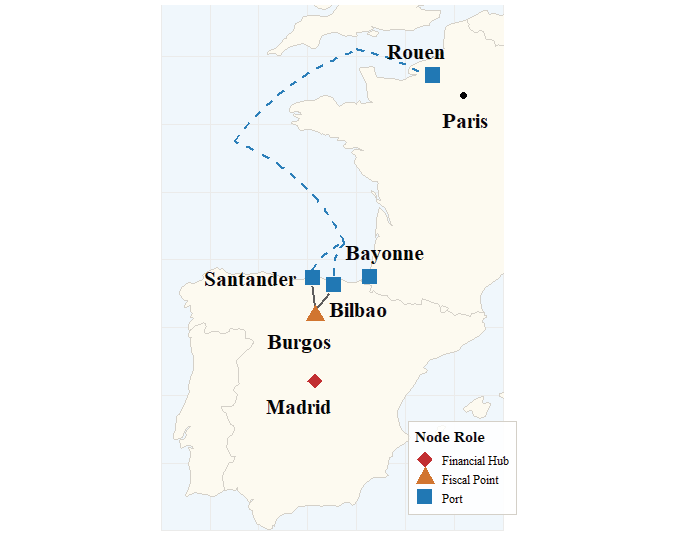
Castile was the epicentre of Spanish fine wool production, offering various qualities of wool (Desaunois, 1769; ‘Traité sur les laines…’, 1791). The purchase typically occurred after shearing, usually performed at the grower’s expense. To secure output, merchants – including Dutari – advanced tens of thousands of reales de vellón to growers to secure a pila – a commercial unit comprising the fleeces of one or several flocks (Torres Sánchez, 2001, pp. 253–255). A pila was necessarily composed of several grades of wool – R, F and S from finest to coarsest depending on its location on the body of the sheep (‘Traité sur les laines…’, 1791, p. 10).
The pila functioned as more than an industrial unit, it was the fundamental unit of commercial accounting. For the Dutari firm, total costs and revenues were calculated at the level of the pila, even when individual bales were sold separately across different months or markets. This initial stage represented the merchant’s most significant capital investment, often exceeding half of the wool’s total export value.
After shearing, washing caused the fleece to lose approximately 60 percent of its weight, marking “the beginnings of wool marketing just as shearing marked the end of its production” (Phillips and Phillips, 1997, p. 148). After washing, wool was sorted and packed into three grades. Lamb’s wool (añinos), however, was handled distinctly: destined for specific fabrics, Dutari often sold it unwashed in the Amsterdam market.
This entire process was governed from Madrid, which sat at the centre of a tight “finance-production” loop linking transhumant flock owners (ganaderos) to the capital’s merchant-financiers such as the Dutari hermanos. The Madrid-based firm typified the “inland merchant” node: they provided the capital that set the chain in motion but relied on a network of local commissioners to execute operations on the ground. Chief among these were the Ligues brothers, whose durable relationship with the Dutaris (Torres Sánchez, 2001, pp. 242–244) allowed the firm to manage the relationships with wool growers and oversee practical operations such as washing. By coordinating with other commissioners, they ensured the wool’s motion through critical points, notably Burgos and the northern ports.
By the mid-eighteenth century, the Spanish Crown had centralised the wool trade through Burgos. Following a 1763 reform, all wool intended for export via the northern ports had to be registered there for the collection of the derecho de lanas (Alcorta Ortiz de Zárate, 2001, p. 176). Burgos thus functioned as a mandatory fiscal point where state power directly intersected with merchant logistics.
In the Dutari ledgers, expenses at this node are grouped as “for carriage from the washing station to Burgos of the X sacks of wool, royal duties, and other expenses in said city”, thus comprising various expenses, such as local taxes and warehousing, on top of the royal duties. To navigate this node, that represented about 20% of the merchants’ expenses (García Sanz, 1996), merchants relied on local correspondents who often had dual roles as traders and tax collectors (Gutiérrez Alonso, 2001).
The wool’s exit from Spain occurred primarily through Bilbao and Santander. A 1763 tax incentive favoured Santander with a 4% duty reduction (Alcorta Ortiz de Zárate, 2001, p. 176). As a result, Santander took over a large part of the woollen exports (Palacio Atard, 1960, pp. 184–185), and was the Dutaris’ primary gateway for France. However, Bilbao remained their preferred exit for lamb’s wool (añinos) and lower qualities from where they were sent to Amsterdam, usually consigned to the company Viuda de Pedro Van Veen e Hijos.
This node marks a structural transition from “inland” to “transnational” commerce. At the port, the commodity was either sold directly to export merchants through commissioners or consigned to foreign firms. For the Dutaris, France was the primary destination, with more than 75 percent of their bales in 1785 consigned to a concentrated network of Rouen merchants (‘Lanas’, 1771-1788). Crucially, under this consignment model, the Spanish merchant retained legal ownership until the final sale, meaning the firm’s capital remained “locked in the fleece”, exposing the firm to both maritime risks and credit lags.
In the second half of the eighteenth century, the direction de Rouen – the customs and administrative unit under which contemporaries grouped the port of Rouen together with the ports of Le Havre and Honfleur – was the gateway to the French textile heartland, handling over 12% of France’s trade with foreign nations (Dardel, 1963, p. 60). Here, the wool – but also dyes such as indigo and cochineal from the Spanish Americas – reached its final consumers (Dardel, 1963; Delobette, 2005). Elbeuf was the most important woollen centre in the Rouen area, producing woollens for both domestic and foreign consumption (Becchia, 2018).
In France, the range of woollen cloth qualities produced using Spanish wool was wide. According to Desaunois, “The Elbeuf Manufacture consumes all grades of wool, from regular Segovian to fine Albarracín inclusive; as well as the F. [Fina] and S. [Segunda] of those grades of which only the R. [Refina] are used in Louviers.” (1769, p. 416) This breadth distinguished the French market from Britain’s, where manufacturers used only the finest Spanish grades (Carter, 1964, p. 8; Mann, 1971, p. 266). In 1776, Rouen imported on its own more wool than Britain – 2.13 million lbs (Dardel, 1963, p. 104) against 1.91 million lbs (Mitchell and Deane, 1962).
The records of Dutari and Grandin reveal a market coordinated by a tight circle of local merchants with whom they both dealt, permitting a unique transnational reconstruction of the trade. In normal times, Spanish merchants seem to never have been in contact with the French manufacturers directly. Instead, negotiations were mediated by the Rouen merchants to whom the wool was consigned.
At this final node, the commercial logic of the merchant met the industrial logic of the manufacturer. While the merchants sought to pass on the mounting costs of unwashed wool prices and export taxes, the manufacturers’ ability to pay was constrained by the demand for finished cloth. This made the Rouen marketplace a site of significant economic friction; here, the manufacturers could leverage their negotiation power, notably using the abundance of supply, to resist price increases at the final stage of the raw wool commodity chain.
In the late eighteenth century, the Spanish monarchy followed the European trajectory towards the “fiscal military state” (Torres Sánchez, 2015). As Patrick O’Brien (1988) has argued, the central preoccupation of government was the “waging of armed conflict”, a reality requiring a constant expansion of revenue to the state. While earlier scholarship portrayed Spain as a “limited fiscal entity” (Barbier and Klein, 1981, p. 331), recent revisions describe a highly capable system that tripled its income through enhanced administrative efficiency (Torres Sánchez, 2015). Crucially, the state sought to avoid duplication by pooling the fiscal administration into four major administrations: rentas provinciales, tobacco, salt, and rentas generales. Within this framework, the revenue from wool was placed under the rentas generales, placing the commodity under the direct and rigorous supervision of a centralised customs apparatus (Torres Sánchez, 2015, p. 76).
However, this centralisation was negotiated within what Regina Grafe identifies as Spain’s “polycentric” structure (Grafe, 2017). As she observes, the power of local elites managed to limit the harmonisation of external customs, thus making it “impossible to shift the fiscal burden from local trade and consumption taxes to general taxes on foreign trade” (Grafe, 2017). While this system provided remarkable political stability and prevented the central state from becoming “predatory”, it fundamentally constrained the Crown’s ability to integrate domestic markets. Yet, within this landscape of fragmentation, the wool export trade was a success in centralising fiscal collection. Indeed, the export duty on wool (derecho de lanas) was effectively channelled through the mandatory fiscal gate of Burgos from 1763 onwards, mainly as a way to bypass the Basque fiscal autonomy (Basurto Larrañaga, 1983, p. 132) as Bilbao was the main export port for wool at the time (Lamikiz, 2010, pp. 29–31).
In this context, the wool duties became a cornerstone of the Real Hacienda, providing a reliable revenue with low collection costs (Torres Sánchez, 2015, pp. 204–205) that reached 5.17 percent of total net revenues by the late 1770s (Bilbao Bilbao, 2001, p. 358). However, the dramatic escalation in these taxes between 1754 and 1789 (Table 1) – during which duties on Segovian and Castilian wool rose by 59 and 63 percent respectively – reveals a state logic that extended beyond simple revenue generation. This fiscal pressure was inscribed in a dual strategy: it functioned simultaneously as a primary stream of income for the military-fiscal state and as a proactive tool of industrial protectionism.
The foundational logic was expressed in the Real Decreto of July 18, 1783, where Carlos III justified new surcharges by citing the “significant setback” that excessive exports caused to domestic factories, to the “grave detriment” of Spanish labourers. This project culminated in the Real Cédula of April 22, 1789, which explicitly stated the Crown’s intention to “favour the growers, commerce, and factories of the Kingdom”. This 1789 regulation further flattened quality distinctions and made no distinction between unwashed and washed wool, placing an even heavier burden on the lower-value wools.
| Region | 1754 | 1783 | 1785 | 1787 | 1789 | % change 1754-1789 |
|---|---|---|---|---|---|---|
| Segovia | 42.32 | 55.57 | 51.57 | 67.33 | 66.82 | +58 |
| Castilla | 40.91 | 54.16 | 50.16 | 65.91 | 66.82 | +63 |
| Extremadura | 39 | 52.25 | 48.25 | 64 | 63.5 | +63 |
| Andalucía | 35.67 | 48.92 | 44.92 | 60.68 | 63.5 | +78 |
| Zaragoza | 34.56 | 47.81 | 43.81 | 59.56 | 63.5 | +84 |
| Daroca-Teruel | 33.8 | 47.05 | 43.05 | 58.8 | 63.5 | +88 |
| Albarracín | 37.62 | 50.87 | 46.87 | 62.62 | 63.5 | +69 |
| Valencia | 15.68 | 28.93 | 24.93 | 40.68 | 40.18 | +156 |
| Aragon | 7.29 | 20.54 | 16.54 | 32.29 | 32.38 | +344 |
Note: The 1754 baseline is used as it represents the last rate established before the fiscal intensification of the 1780s. From 1783, all the columns contain the surcharge of 1.25 reales de vellón per arroba to fund the Escuelas de Hilaza (spinning schools) that was implemented in 1782. From 1783 to 1787, the surcharges were substitutive in nature. The year 1789 includes the Almirantazgo. Duties for unwashed wool (lana en sucio) are omitted for clarity it was taxed at approximately 50 percent of the washed rate. By 1789, the fiscal distinction was eliminated and both categories were taxed at the same rate.
Source: Bilbao Bilbao (2001).
Through this fiscal mechanism, the Crown rejected the total export ban proposed by some manufacturers (Phillips and Phillips, 1997, pp. 270–271). Instead, the administration opted for a targeted intervention designed to increase the input costs of foreign competitors, protect Spanish industry and growers while keeping the Hacienda’s accounts liquid. This policy aligned with the logic expressed in the report of the Segovian Real Sociedad Económica de los Amigos del País (1786-1788) that García Sanz emphasised (García Sanz, 1996). The Society argued that manufacturers opposed exports not because they lacked a sufficient supply of wool, but because they believed that fiscal restrictions on exports would drive domestic prices down, concluding that rising export taxes would be beneficial to domestic manufacturers by increasing production costs for their foreign counterparts and making Spanish cloth more competitive.
The rhetoric surrounding wool exports conformed to a broader array of policies under Carlos III designed to stimulate industrialisation. They included non-fiscal trade policies such as the Reglamento y aranceles para el comercio libre de España a Indias of 1778, which abolished Cadiz’s legal monopoly on colonial trade. While these reforms stimulated export volumes and arguably had positive effects on domestic industrial development (García Baquero, 2003, pp. 217–252), they fundamentally altered the conditions of trade, increasing competition and risk (Lamikiz, 2010; Baskes, 2013). The protectionist intent of the Reglamento was further codified in a differential tariff structure that subjected foreign merchandise re-exported to the colonies to higher duties than Spanish products (Delgado Ribas, 2007, pp. 399–400). This measure might have participated in constraining the profitability of foreign merchant houses, who relied heavily on trading imported goods (Wildbolz-Gallego, 2026, p. 16).
When viewed alongside the increases in export duties on wool, the 1778 decree demonstrates a potentially consistent impact of state policies on value redistribution by squeezing the commercial profit of intermediaries during this period. However, it leaves a critical question unanswered: who ultimately bore the weight of this fiscal and regulatory extraction? While one of the King’s aims might have been to make Spanish fabrics more competitive by decreasing the domestic price of wool and increasing the costs for foreign consumers, did it work in this way? We have no understanding of how this pressure was internalised at the micro-level, let alone the transnational incidence of these duties. To understand the true consequences of the Bourbon reforms, we must trace how these fiscal shocks travelled through a chain that ended not at the Spanish border, but in the textile manufactures of the industrial cores.
Strikingly, the sharp escalation of Spanish export duties in the 1780s did not contract trade volumes: Spanish wool exports remained remarkably resilient, accounting for approximately 32 percent of Spain’s total export value in 1792, or 445,796 arrobas (5,127 metric tonnes) of sheep wool (Departamento del Fomento General del Reyno y de la Balanza de Comercio, 1803) against 464,280 in 1778 (Phillips and Phillips, 1997, p. 304). This resilience stemmed from the structural dependence of northern European industries – particularly the French – on Spanish Merino, for which no viable substitute existed before the end of the century (Cornu and Pinoteau, 2021).
While British imports nearly tripled between 1764 and 1792, going from 1.5 to 4.4 million lbs with an acceleration in the 1780s (Mitchell and Deane, 1962), France remained a superior outlet for most of the period, typically importing twice as much as Britain between 1771 and 17821 (Charles et al., 2026). By 1787, as the French market began to falter on the eve of the Revolution, Britain’s imports of Spanish wool (4.2 million lbs) appear to have drawn level with or even surpassed France’s imports of wool from Spain (3.8 million lbs)2. This gap reflected demand structure as much as volume: while the English ‘boom’ in Spanish wool consumption stayed concentrated in the highest-end West Country broadcloths, France’s capacity to absorb medium and lower grades alongside the finest wool had no equivalent in the British market.
The structural dependence of foreign manufacturers on Spanish wool might imply a high degree of demand inelasticity, which should have allowed Spanish merchants to pass the tax burden forward to French buyers. However, an analysis of aggregate price trends reveals a more complex distributional outcome. While the Spanish export duty on Segovian wool escalated by 59 percent between 1782 and 1787, market prices in northern Europe remained remarkably stagnant. In London, prices rose by only 4.5 percent, while in Amsterdam they increased by 9.6 percent over the same period3. Even in Rouen – the most inflationary of the three markets – price growth was about 20 percent4, making the tax hike a real-term cost shock across all three markets.
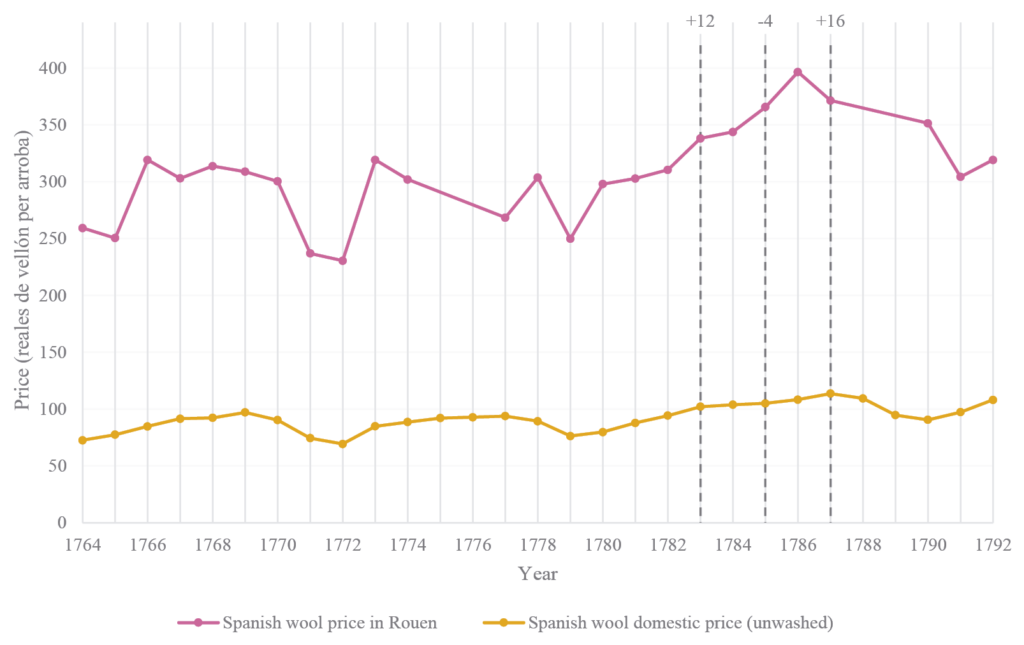
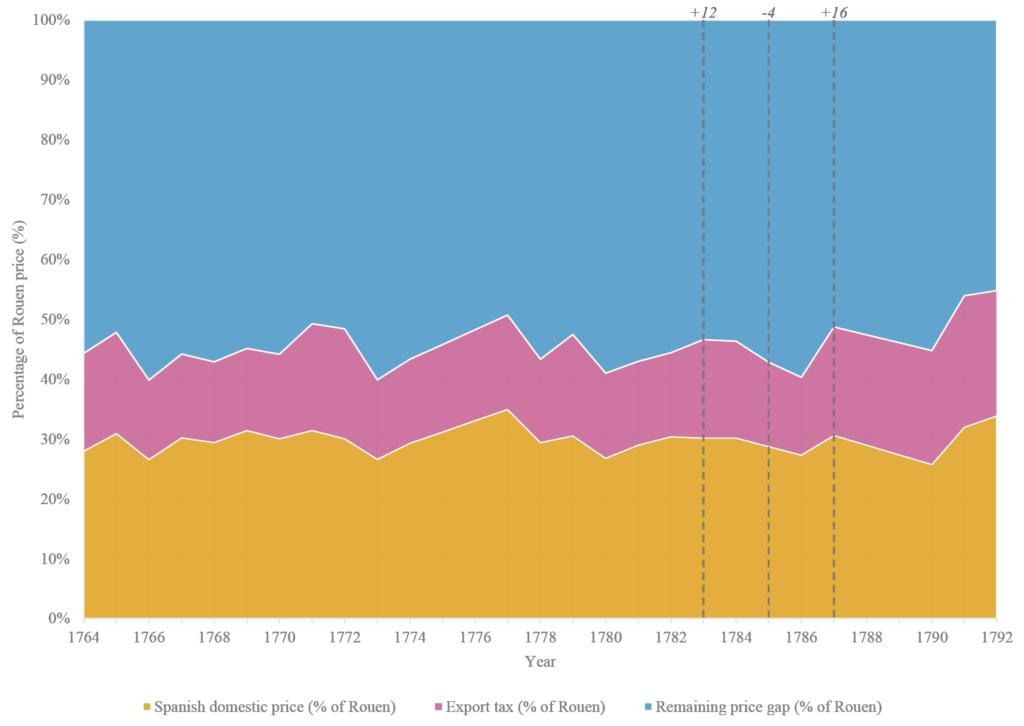
France might have been in fact the only market capable of partially absorbing the tax. Nevertheless, even within this higher-price French market, the merchant’s ability to capture value was constrained. As shown in Figure 1, domestic Spanish prices for unwashed wool – so the price paid by merchants to wool growers – followed a relatively similar trend as prices in Rouen. The fiscal shocks of the 1780s do not lead to a decrease in prices paid to the wool growers, they even tend to keep rising, suggesting that there was not a backward pass-through.
The ganaderos seem to have successfully resisted bearing the cost of the increasing taxation on wool exports. In fact, rather than accepting lower prices to offset the tax hike, growers maintained a rigid and rising price floor. Between 1782 and 1787, the average purchase price for unwashed Segovian wool rose from 94.25 reales to 113.63 reales per arroba (Phillips and Phillips, 1997, p. 317), an increase of 20.6 percent. The price floor maintained by the ganaderos at this moment in time might have been a response to their own severe domestic cost crisis. Between the 1780s and the early 1790s, the cost of pastures surged by an estimated 188 percent, while the net revenue per sheep for elite flocks like El Paular plummeted by 90 percent (García Martín, 1992, p. 76). Consequently, the growers were themselves caught in a domestic profit squeeze by rising land rents as well as the Crown’s increasing support for agriculture, forcing them to maintain high prices for their wool as their total production costs nearly tripled and profit margins might have been reduced from about 74.6 to 14.9 percent (García Sanz, 1978, p. 431).
The burden was therefore pushed further along the chain when possible, as the dramatic rise in Rouen prices between 1782 and 1786 suggests. The year 1786 marked a critical turning point in this regard: prices in Rouen reached a ceiling, and merchants’ ability to transfer costs to manufacturers vanished. Even as the Spanish Crown established its highest levels of fiscal extraction after 1787, the price of wool in Rouen began a significant decline. The decline in prices paid by manufacturers there, along with the high prices to the growers, implied that the profits of wool merchants as intermediary actors were being squeezed. The structural consequences of this convergence can be seen in the value-added decomposition (Figure 2).
This decomposition treats the Rouen price as a ‘fixed pie’ (100%) where the commercial gap – allocated to processing, transport and merchant profit – acts as a residual variable. Because the variables must sum to 100 percent, the merchant’s share is dictated by the expansion of the other two nodes. Across most of the period, the commercial gap proved remarkably resilient, as merchants managed to defend their share even as fiscal pressure mounted in the early 1780s. However, the late 1780s mark a clear rupture. Between 1764 and 1792, this gap shrank from 56 to 45 percent while nominal prices in Rouen rose by approximately 45 percent over the long term, suggesting that this inflation was insufficient to offset the even more rapid escalation of domestic costs.
The data suggest this compression was concentrated precisely in the years after 1786. At this juncture, the total ‘pie’ of the Rouen price peaked and began to decline, while the combined weight of domestic costs – driven by both the escalating export tax and the rising price of unwashed wool – continued to expand. Crucially, the export tax’s share grew from 16 to 21 percent, while growers expanded their share from 28 to 34 percent. This finding is consistent with García Sanz’s analysis of a Real Sociedad Económica de Segovia report, which shows the export duty accounting for approximately 20.8 percent of the total cost of delivering Spanish wool to a manufacture in northern France in 1791 (García Sanz, 1994, p. 410; 1996, p. 105). Because these two nodes successfully claimed a larger portion of a declining total price, the burden fell almost entirely on the merchant’s residual share.
This squeeze was both relative and absolute. In the final years of the series, the devaluation of the livre tournois in the wake of the French Revolution meant that even though nominal prices in Rouen stopped falling and even moved up, the returns to wool merchants plummeted in Spanish currency. Caught between a rigid price floor in Castile, stagnant international prices in London and Amsterdam, falling wool prices in Rouen and a collapsing French currency, the Spanish merchant node could no longer offset the mounting fiscal and monetary pressures – effectively internalising a crisis that fiscality had initiated, but which the Revolution rendered untenable. To uncover the mechanisms behind both this resilience and its eventual breakdown, the analysis must now turn to the micro-historical records of the firms themselves. By utilising archival records from Madrid and Rouen, the following section reconstructs the specific cost structures and revenues of wool shipments to see the squeeze not as an abstract trend, but as a tangible struggle between different participants in the wool chain.
In this section, we move from aggregate market prices to the granular evidence contained in the ledgers and correspondences of Dutari Hermanos and the Grandin manufacture to offer a micro-historical verification of the macroeconomic trends established in the previous section. In addition, the micro-historical evidence allows us to go further than the previous section to highlight the specific commercial mechanisms that drove the relationships among different prices, which suggest new insights on the reasons for the merchant profit squeeze.
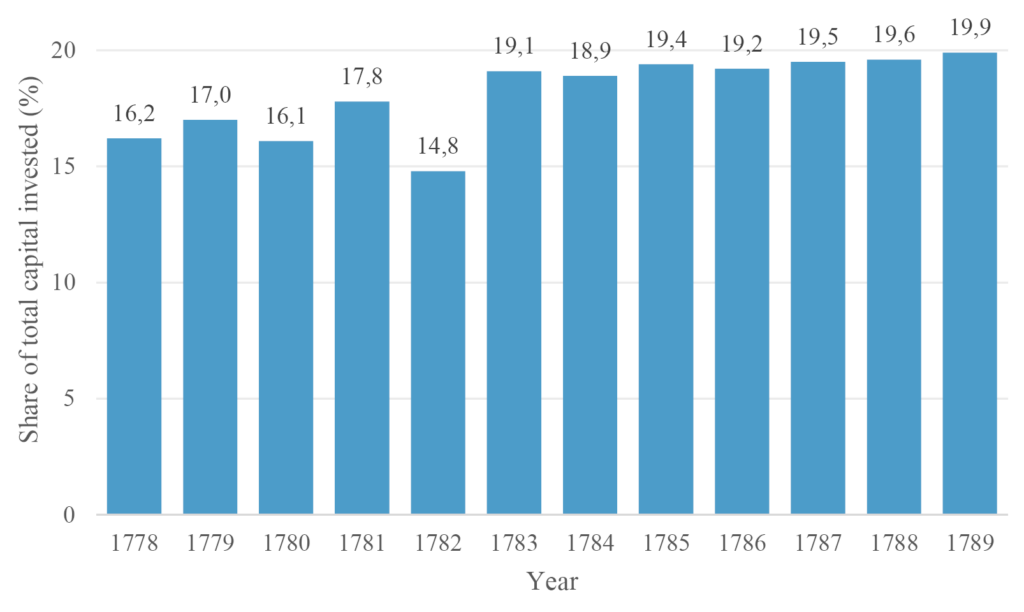
Before the dramatic increase in export taxes of the mid-1780s, the Spanish-French wool chain operated within a relatively stable distributional framework. In 1782, despite the larger transportation expenses that the American War implied, the Dutari firm maintained an average profit rate of 27 percent across four different pilas sold in Rouen (‘Lanas’, 1782-1827, fols. 2-5; ‘Lanas’, 1771-1788). During this baseline period, the export duties – the “Burgos step” – represented on average approximately 16.4 percent of the capital mobilised by the Spanish wool merchants as shown in Figure 3.
However, even in this era of high profitability, signs of pressure were visible at the manufacturing node. The upward trend in wool prices in the Rouen market during the late stages of the American War (Figure 1) eventually exerted sufficient pressure on manufacturing margins to force Grandin to abandon a long period of price stability for his cloth customers. Having maintained a fixed price of 16 livres tournois per aune for his couleur ordinaire cloth since 1777 (‘Registres de copies de lettres’, 15 Feb. 1778), he was forced to increase the price by nearly 10 percent to 17.5 livres in 1782 (‘Registres de copies de lettres’, 9 Apr. 1782).
This upward adjustment suggests that the woollen manufacturer had some commercial room to pass through escalating raw material costs to the consumer – a strategy justified by Grandin’s own expectations of a post-war surge in demand. Still, it was already clear in August 1782 that Grandin expected wool prices to rise faster than other inputs after the return of peace. He observed that while staples such as “oils, soaps, and dyeing ingredients will undoubtedly decrease in price, wool, on the other hand, will be even more expensive”; noting that “the consumption of cloth is such that Spanish wools will no longer suffice; consumption will increase with peace because market outlets will be freer.” (‘Registres de copies de lettres’, 17 Aug. 1782) This suggests that even before the state intervened with new taxes, the Spanish side of the chain was already pushing the price floor higher, leaving the merchant node increasingly exposed between a rising raw material cost and a manufacturer who, despite some ability to raise prices, was constrained by demand for finished cloth.
In fact, Spanish merchants were uniquely vulnerable in this French trade, due to the extended immobilization of capital that it required. The accounting records of Dutari reveal that while transactions in Amsterdam or London typically settled within three to twelve months, the Rouen market operated on an average total capital lock of nearly three years: roughly a year from shipping to the actual sale agreement in Rouen, followed by a stated payment maturity of eighteen to twenty months before funds were received (‘Lanas’, 1782-1827, fols. 2-57). This immobilization acted as a massive multiplier for risk: once a merchant committed wool to the French market, they were exposed to its fluctuations for years.
The year 1783 marks the first substantial increase in export taxes. The effects of this rise can be seen in the average weight of the “Burgos step” as a share of total capital invested (Figure 3), jumping from about 15 percent in 1782 to 19 percent in 1783. To understand the cost implications for Dutari Hermanos in greater detail, we study a specific pila constituted of the wool from the flocks “Topete” and “Nieto”. This pila was consistently sold in Rouen by the merchant house Planter, Quesnel & Cie between 1782 and 1791, except in the year 1789 when it was sold by Michel frères from Orléans. The rise in taxes can be seen right away, as the average cost of the “Burgos step” went from an average of 41.3 reales de vellón per washed arroba between 1778 and 1782 to 52.3 in 1783, a rise of 27 percent. Nevertheless, this pila gave a high profit rate of 37.8 percent for Dutari, even after absorbing all of the “Burgos step”, which can be explained by both an exceptionally high yield in the washing process (45 percent) and high sale prices.
In October 1783, Grandin noted the Spanish attempt to exploit their monopoly on fine raw wool, observing that “the Spaniard spies every favourable moment to make new increases on a material of which he is the sole possessor” (‘Registres de copies de lettres’, 8 Oct. 1783). However, he predicted that this attempt would fail because the manufacturers in Rouen had shown “very little eagerness to buy”, making it “very likely” that they could avoid absorbing the fiscal increase in a price hike. Having once again increased the price of his own couleur ordinaire cloth to 20 livres tournois – 25 percent more than he was charging until 1782 – Grandin’s comments suggest that he had reached a limit for his own costs (‘Registres de copies de lettres’, 8 Apr. 1783). By pointing to a collective lack of demand in Rouen, he suggested that the manufacturers’ hesitation about buying would have been a decisive factor in limiting Spanish wool merchants’ ability to pass the tax hike forward.
As the 1780s progressed, it became clear that the merchant’s room for manoeuvre was shrinking. A systematic analysis of the Dutari cost structure reveals a striking trend: while the prices paid to growers increased – from 92.5 reales de vellón per unwashed arroba in 1778 to 106.4 in 1785 for the Topete y Nieto – and the taxes paid to the state remained high, the costs for labour and materials remained flat. Merchants seem to have partly responded to the fiscal pressure by squeezing the only domestic Spanish nodes they could directly control – the wages of labourers. The Dutaris seem to have been aware of the limits of this strategy. In a letter to Defontenay, they expressed doubt that the “5 [sous] increase” offered in Rouen would be sufficient to cover the “increase in price and derechos reales” they were experiencing in Spain (‘Copiadores de cartas’, 23 June 1785). Nevertheless, the Madrilian firm managed to sustain high levels of profit rate until 1786, coinciding with a peak in Rouen market prices (Figure 1).
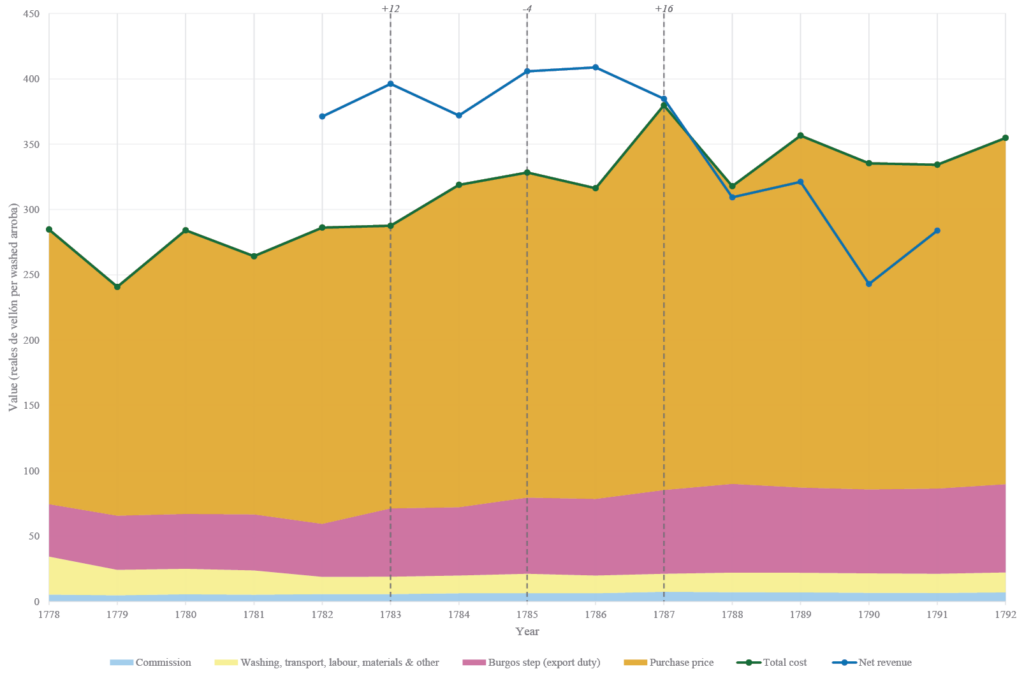
In 1787, export taxes rose by nearly 16 reales over the 1754 baseline, triggering a collapse in the chain’s profitability. The same year, the profitability rate of the Topete y Nieto collapsed to only 1.32 percent, followed by a loss of -2.70 percent in 1788 (Figure 4). To identify the cause of this collapse, I conducted a counterfactual analysis calculating what the profit would have been had the total costs at Burgos remained fixed at their average 1778-1782 level, rather than rising with the new fiscal regime (Table 2).
In 1788, the counterfactual profit rate without the tax increases would have been 6.2 percent. This discrepancy confirms that the fiscal hike was a proximate cause of the profit collapse. However, the tax increase alone does not fully explain the crisis: had merchants possessed the leverage to pass it forward to manufacturers or backward to growers, the trade would have remained commercially viable despite the higher duties. The profit collapse was therefore the product of two converging forces: the state’s fiscal extraction and the structural position of the merchant node, caught between a grower price floor it could not depress and a manufacturer ceiling it could not raise anymore. Though relatively modest as a share of the total costs (Figure 3), this fiscal increase proved decisive when merchants’ residual share for profit got squeezed with no room left to absorb it after 1786.
| Year | Profit rate (actual) | Profit rate (counterfactual) | Difference |
|---|---|---|---|
| 1783 | 37.8 | 43.2 | 5.4 |
| 1784 | 16.7 | 20.8 | 4.1 |
| 1785 | 23.7 | 30.3 | 6.7 |
| 1786 | 29.2 | 36.7 | 7.5 |
| 1787 | 1.3 | 7.8 | 6.5 |
| 1788 | -2.7 | 6.2 | 8.9 |
| 1789 | -9.9 | -3.5 | 6.4 |
| 1790 | -27.6 | -22.3 | 5.3 |
| 1791 | -15.1 | -8.6 | 6.5 |
Note: Profit rates are reconstructed ex-post based on two types of accounting books (libro de cortes and libro de lana) of the Dutari Hermanos company. The “Profit rate (actual)” represents the net return (utilidad) expressed as a percentage of the total capital advanced (coste total). The counterfactual simulates the merchants’ return if the expenses at the “Burgos step” of the chain had remained fixed at the 1778-1782 baseline. The “Difference” column isolates the “tax impact”, quantifying the portion of the profit margin captured by the Spanish State.
Source: AHBE, Libros de contabilidad de otras sociedades, Dutari Hermanos, L. 18564, L. 18566 and L. 18567.
As prices in Rouen stopped increasing, the merchant node lost its ability to pass the tax burden forward to the industry. This manufacturer resistance was clearly articulated by Grandin, who by 1787 was already warning Rouen’s wool merchants of his refusal to accept further inflation. Writing to Defontenay, he explicitly stated: “I find the prices you are sticking to your lots too high” (‘Registres de copies de lettres’, 16 Jan. 1787), using his bargaining power to force prices down. The fact that French manufacturers were unwilling to pay higher prices was communicated to the exporters in Spain, who received increasingly grim reports from their French brokers. In September 1788, the Dutaris lamented to Quesnel that manufacturers and commissioners in France were acting in concert “to strike us down” (‘Copiadores de cartas’, 18 Sept. 1788). A month later they complained directly to Midy frères, who by selling at low prices had “set a precedent that obliged all other commissioners to accept the law you have fixed”, accusing their house of acting in the interest of manufacturers and betraying that of the Spanish merchants who had consigned their wool to them (‘Copiadores de cartas’, 6 Oct. 1788).
When Quesnel successfully resisted manufacturer pressure and sold the Topete pila at 122 sous that October, the Dutaris expressed relief, confessing they had feared they too were “inclined to cater to the manufacturers in their claims [to lower prices]” (‘Copiadores de cartas’, 6 Oct. 1788) – which did not prevent a negative return on the pila. With the “manufacturer ceiling” firmly established by such resistance, and the “grower floor” remaining high, the merchants were left to bear the full weight of fiscal pressure. The Dutaris were under no illusion about their broader situation. Facing mounting losses, they wrote simply that “there is no remedy but to endure: lose the money and secure what part one can” (‘Copiadores de cartas’, 20 Sept. 1788). The capacity to endure was itself a privilege of capital – but one with finite limits.
From 1789, the French wool market was hit by the Revolutionary shock, which converted the pre-existing merchant squeeze into a systemic breakdown. By 1790, the Dutaris’ profit rate on the Topete y Nieto wool dropped to a catastrophic -27.5 percent. This collapse was not isolated. For other pilas traditionally consigned to Rouen, the Dutaris had already begun redirecting wool to northern markets following successive years of losses. The pila from Martin Blanco de la Torre, which had yielded negative returns for both the 1787 and 1788 cortes – losses even more severe than those recorded for the Topete y Nieto – had already been diverted away from France for the corte of 1789. While the export taxes and high grower prices remained the main threats to merchant profits, the devaluation of the livre tournois and the worsening credit conditions in Rouen added a final layer of pressure that even lower Spanish taxes could not have offset.
Despite this deepening meltdown in France and escalating costs in Spain, the Dutari firm’s attachment to the Rouen market remained remarkably persistent. France continued to absorb the majority of the firm’s wool through 1791, typically accounting for 63 to 75 percent of total export volume (‘Lanas’, 1782-1827, fols. 2-57). This persistence – although actual profit rates collapsed – reveals that merchants were not making a choice between equal outlets but were structurally tied to the French chain of the trade. The English market, while a documented destination for wool since at least 1769 (‘Copiadores de cartas’, 5 September 1769), was still incapable of serving as a systemic alternative for Dutari Hermanos.
This is consistent with the national picture drawn by Bilbao Bilbao, who observes that British demand primarily “served to contain a fall in exports that, without its help, would have been vertiginous” (Bilbao Bilbao, 1998, p. 322) – a stabilizing role at the aggregate level that did not, at this point, translate into a viable substitute outlet for individual merchant houses. The reasons for this limitation are clearly documented in the firm’s correspondence. For instance, writing to their commissioner Pedro Miguel de Ligues about their Bristol consignments, the Dutaris admitted that whatever “short profit” the premium Leonese wools still yielded, it was “not enough to compensate for the loss on the inferior grades” of the same pila, which had performed poorly for two years running (‘Copiadores de cartas’, 9 Feb. 1789).
Grandin’s correspondence reveals an industrial node at its breaking point. In March 1790, he complained to Lecouteulx & Cie of Rouen that while he previously bought wool at high prices in hopes of passing the cost on in the price of his cloth, “all our efforts to achieve this have been useless”; noting that merchants in the current crisis preferred “not to buy rather than pay an increased price” (‘Registres de copies de lettres’, 9 March 1790). By August, the scarcity of Spanish wool in Rouen was total – “there does not remain in Rouen a single bale, not a single bale of wool” (‘Registres de copies de lettres’, 28 Aug. 1790) – yet even this “total dearth” could not force a hike in prices there (‘Registres de copies de lettres’, 7 Sept. 1790). The few bales that reached the market were offered at high prices by merchants who anticipated that scarcity would finally give them leverage, but manufacturers proved unwilling to pay, preferring to absorb the shortage rather than accept terms they considered unsustainable.
The explanation for this paradox – that total scarcity failed to produce higher prices – lay in the collapse of the livre tournois coupled to the extended credits to manufacturers. As shown in Appendix 1, the exchange rate for French currency plummeted from roughly 4.0 reales per livre in 1789 to 2.41 by 1792. This created a dual loss for the Spanish merchants: nominal wool prices in Rouen, even when stable, converted back into far fewer reales de vellón. Furthermore, the long credit windows of the French market – which by 1788 had expanded from the standard 18 months to extraordinary maturities of 24 or 26 months – meant that capital was locked in a depreciating currency for years at a time. In a letter to a trading house in Amsterdam, they observed that although some sales had been completed in Rouen, the credit was excessively long, adding that the discounts they had to pay for cash payments to recover their capital were at punitive rates of 5 to 6 percent against 4 percent in Amsterdam, which would further erode their profits (‘Copiadores de cartas’, 10 March 1788).
Because Dutari Hermanos retained legal ownership of the wool until the final sale, its capital remained “locked in the fleece” for as much as two years following its arrival in Normandy. To protect themselves, the Dutaris began denominating some sales directly in reales de vellón in 1791 – an unusual and desperate measure to bypass the French currency risk. The French manufacturer Grandin was acutely aware of this dynamic. In October 1791, he noted to a Madrid correspondent that a high purchase price in France was “compensated by the exchange rate which is very favourable to you [the foreign buyer]” (‘Registres de copies de lettres’, 27 Oct. 1791). However, for the Spanish merchant selling wool in France, that same rate meant a drastically reduced return upon the eventual repatriation of their capital.
Amid rising Spanish taxes and high grower prices, this lag in Dutari’s capital turnover must have been a burden. As late as 1792, the Dutaris noted that they had “never seen higher prices for unwashed wool, without knowing the cause” – a remark that captures their inability to compress costs at the Spanish end of the chain (‘Copiadores de cartas’, 19 Sept. 1792). Furthermore, the revolutionary volatility meant that as exchange rates became increasingly unfavourable to Spanish sellers, they faced a growing risk that their capital might never be fully recovered. At this juncture, the merchant squeeze shifted from a primarily fiscal phenomenon to a systemic breakdown. As the counterfactual in Table 2 demonstrates, from 1789 onward, the trade would have remained unprofitable even if the Spanish state had not increased export duties, confirming that the shattering of the French monetary and credit systems had superseded Bourbon fiscality as the terminal cause of the chain’s collapse.
By 1791, the divergence between the French market and the rest of the European wool hubs became a chasm. While British and Dutch buyers offered rapid liquidity, the Rouen node continued to demand two-year credit windows at the exact moment the livre tournois was losing its value (Denzel, 2010, p. 286). It is not surprising, therefore, that the firm’s records show the total disappearance of the Rouen node in 1792, a strategic shift confirmed in a letter sent on November 12, 1792, to the firm Duvergier & Cie in Rouen: “In this year we have sent no wool on consignment to this Kingdom [France], but we trust that for the next [year], circumstances will permit it, which is what we desire for the common benefit” (‘Copiadores de cartas’, 12 Nov. 1792).
Facing mounting losses, the Dutaris attempted to transmit the pressure backward through the chain. In October 1792, with more than a million livres frozen in France at ruinous exchange rates, they informed Ligues that they would not pursue the wool of growers Taranco and Prieto Barrio unless they agreed to a price of 110-112 reales, anticipating that northern markets would soon see a considerable price fall as French manufacturing collapsed. They acknowledged, however, that this pressure would carry little weight if the growers found other willing buyers – “much good may it do those who throw themselves into buying at any price” (‘Copiadores de cartas’, 13 Oct. 1792). Indeed, in November 1792, Prieto Barrio refused to negotiate until he knew the price obtained by a rival flock owner, demanded advance payments as a condition of sale, and made clear he had competing buyers in Burgos and Madrid (‘Copiadores de cartas’, 3 Nov. 1792). The grower price floor held firm to the very end of the period.
Beyond unit costs and profit rates, the total volume of wool handled by the Dutari firm serves as a metric for its commercial resilience. While the firm proved remarkably resilient to the fiscal pressures of the 1780s – maintaining a stable average of 27,586 arrobas exported per year between 1783 and 1789 (‘Lanas’, 1788-1827, fol. 47) – the political and monetary shocks of the early 1790s eventually broke this momentum. Despite initial efforts to navigate the Revolutionary crisis by redirecting wool to northern markets, which sustained volumes at a relatively high average of 21,969 arrobas between 1790 and 1792 (‘Lanas’, 1788-1827, fol. 47), the escalation of the French Revolutionary Wars eventually collapsed the credit and trade infrastructures. By 1795, the firm’s trade volume plummeted to a mere 5,667 arrobas (‘Lanas’, 1788-1827, fol. 47).
This longitudinal trend in total volume confirms that while the fiscal weight of the renta de lanas successfully squeezed the intermediaries’ margins, it was the political and monetary upheavals of the 1790s that ultimately strangled the flow of the commodity itself and destroyed any opportunity of safe profit. The firm’s capacity to act as a shock absorber against the tax squeeze – predicated on its capacity to mobilise substantial capital – proved insufficient against the total breakdown of the credit and currency circuits that had hitherto linked Castile to Normandy.
The micro-historical analysis of the Dutari ledgers and Grandin correspondence validates the macroeconomic “merchant squeeze” identified in the previous section. By tracing specific wool consignments across the Bay of Biscay, this section has demonstrated that the merchant sphere functioned as the primary buffer within the chain, absorbing the cumulative friction between the state’s fiscal extraction in the face of increasingly resistant buyers of wool in France. While the firm’s ability to mobilise capital provided the resilience necessary to maintain high trade volumes and endure the initial “Burgos squeeze” of the 1780s, this resilience was finite. The “breaking of the chain” in 1792 was thus the logical conclusion of a distributional logic that had steadily compressed the commercial node of the wool trade.
This paper began with a fundamental question regarding early modern capitalism: when states impose substantial taxes on internationally traded goods, who ultimately bears the cost? Tracing the tax wedge created by the export duties on Spanish wool within the Spanish-French wool chain, this study shows that fiscal burdens are not passed through neutrally but determined by the power asymmetries between each node. Between 1778 and 1792, the merchant node – usually characterised as the trade’s dominant beneficiary – functioned as the structural shock absorber of the chain.
At the Spanish end of the chain, wool growers successfully defended a high price floor, resisting any backward pass-through of the tax. At the French end, Rouen manufacturers imposed a price ceiling as demand for finished cloth weakened in the late 1780s. Squeezed between these two rigid nodes, merchants absorbed a tax that was, in isolation, a comparatively modest fiscal escalation – but one that became decisive because it coincided with a rising domestic price floor against a Rouen ceiling that had stopped growing. This initial fiscal squeeze left the merchant node structurally exposed, but it was the subsequent collapse of the French currency and the length of credit terms that account for the trade’s terminal unprofitability after 1789.
These findings suggest three broader contributions to the historiography. First, they provide an empirical corrective to the assumption that merchants inevitably earned the “lion’s share” of early modern Spanish wool trade. By looking beyond aggregate price differentials to internal cost structures, this study shows that merchant profitability was not guaranteed but contingent upon external factors that fluctuated. Although this study focuses on the wool chain, it has broader implications for the economic history of merchant capital and profits. Second, this analysis shows that the Bourbon reforms had profound distributional consequences, both within and outside of Spain. The question of how much fiscal authorities understood about these consequences, before and after the tax changes, is an interesting one that would be worth exploring from the perspective of political economy.
Finally, this paper offers a methodological contribution to commodity chain analysis. It demonstrates that non-material dimensions of circulation – such as taxation regimes, credit, and currency volatility – are as decisive in shaping value distribution among actors as the physical transformation of the commodity, particularly in chains where the raw material accounts for the bulk of the final value. While capital possession provided firms like Dutari Hermanos with the resilience to endure a decade of compressed margins, it did not grant them full power to dictate the terms of the trade – and that resilience proved finite as the collapse of the Spanish-French wool chain in the early 1790s revealed its limits in the face of an unprecedented political upheaval.
Archival sources
DUTARI HERMANOS, Libros de contabilidad de otras sociedades:
L. 18564, Lanas, 1771-1788.
L. 18566, Lanas, 1788-1827.
L. 18567, Lanas, 1782-1827.
L. 18583, Copiadores de cartas, 1785-1786.
L. 18584, Copiadores de cartas, 1788-1789.
L. 18585, Copiadores de cartas, 1792-1794.
L. 18594, Copiadores de cartas, 5 September 1769.
Fonds Grandin:
15J5, Grands livres de comptes, 1761-1767.
15J7, Grands livres de comptes, 1766-1771.
15J8, Grands livres de comptes, 1771-1774.
15J10, Grands livres de comptes, 1777-1782.
15J11, Grands livres de comptes, 1783-1787.
15J12, Grands livres de comptes, 1790-an VI.
15J49, Registres de copies de lettres, 1778-1779.
15J51, Registres de copies de lettres, 1782-1784.
15J53, Registres de copies de lettres, 1786-1790.
15J54, Registres de copies de lettres, 1790-1792.
BIBLIOTHÈQUE PATRIMONIALE VILLON, Rouen:
Collection Coquebert de Montbret:
Traité sur les Laines & Observations sur les Troupeaux d’Espagne. Manière de laver les Laines. Plan d’un lavoir. Tableau des Piles. Observations sur les Laines de Berry. 1791. Ms Montbret-391.
MÉDIATHÈQUE GEORGES-DELAW, Sedan:
DESAUNOIS, Delo. 1769. Traité sur les draperies fines, contenant le détail des opérations de fabrique, des différentes manières de les exécuter, le fort ou le faible de chacune, la description des machines et des outils, le prix de la main-d’œuvre, des observations sur les règlements, et plusieurs tableaux concernant les manufactures de Sedan et d’Elbœuf. Ms 4.
Departamento del Fomento General del Reyno y de la Balanza de Comercio. 1803. Balanza del comercio de España con las potencias extrangeras en el año de 1792. Madrid: Imprenta Real. URL: http://archive.org/details/A009129 (Accessed: 6 February 2026).
ALCORTA ORTIZ DE ZÁRATE, Elena. 2001. Negocios familiares y circuitos laneros en Bilbao en la segunda mitad del siglo xviii. In Agustín GONZÁLEZ ENCISO (ed.), El negocio de la lana en España (1650-1830). Pamplona: Ediciones Universidad de Navarra, 175–200.
BARBIER, Jacques; KLEIN, Herbert. 1981. Revolutionary Wars and Public Finances: The Madrid Treasury, 1784-1807. The Journal of Economic History 41(2): 315–339.
BARTOLOMEI, Arnaud. 2017. Les marchands français de Cadix et la crise de la Carrera de Indias (1778-1828). Madrid: Casa de Velázquez.
BASKES, Jeremy. 2013. Staying Afloat: Risk and Uncertainty in Spanish Atlantic World Trade, 1760-1820. Stanford: Stanford University Press.
BASURTO LARRAÑAGA, Román. 1983. Comercio y burguesía mercantil de Bilbao en la segunda mitad del siglo xviii. Bilbao: Servicio Editorial de la Universidad del País Vasco/Euskal Herriko Unibertsitatearen Argitalpen Zerbitzua.
BECCHIA, Alain (ed.). 2018. La draperie en Normandie du XIIIe siècle au XXe siècle. Mont-Saint-Aignan: Presses universitaires de Rouen et du Havre. DOI: https://doi.org/10.4000/books.purh.7218
BECKERT, Sven. 2025. Capitalism: A Global History. New York: Penguin Press.
BILBAO BILBAO, Luis María. 1998. Exportación de lana española y demanda británica en el siglo xviii. In Felipe RUIZ MARTÍN; Ángel GARCÍA SANZ (eds.), Mesta, trashumancia y lana en la España moderna. Barcelona: Crítica, 303–331.
BILBAO BILBAO, Luis María. 2001. Exportación de lanas y finanzas públicas. La política arancelaria en el comercio lanero español, 1750-1827. In Agustín GONZÁLEZ ENCISO (ed.), El negocio de la lana en España (1650-1830). Pamplona: Ediciones Universidad de Navarra, 347–386.
BRAUDEL, Fernand. 1979. Les jeux de l’échange. Paris: Librairie Armand Colin.
CARTER, Harold Burnell. 1964. His Majesty’s Spanish Flock: Sir Joseph Banks and the Merinos of George III of England. Sydney: Angus & Robertson.
CHARLES, Loïc; DAUDIN, Guillaume; GIRARD, Paul; PLIQUE, Guillaume. 2026. toflit18_data. GitHub repository. URL: https://github.com/medialab/toflit18_data (Accessed: 5 August 2026)
CORNU, Pierre; PINOTEAU, Henri. 2021. La guerre des moutons, le mérinos à la conquête du monde 1786-2021. Montreuil: Gourcuff Gradenigo.
DARDEL, Pierre. 1963. Navires et marchandises dans les ports de Rouen et du Havre au XVIIIe siècle. Paris: SEVPEN.
DELGADO RIBAS, Josep Maria. 2007. Dinámicas imperiales (1650-1796): España, América y Europa en el cambio institucional del sistema colonial español. Barcelona: Bellaterra.
DELOBETTE, Édouard. 2005. Ces Messieurs du Havre. Négociants, commissionnaires et armateurs de 1680 à 1830. PhD thesis, Université de Caen. URL: https://theses.hal.science/tel-00219751
DENZEL, Markus. 2010. Handbook of World Exchange Rates, 1590-1914. Farnham: Ashgate Publishing, Ltd.
FINDLAY, Ronald; O’ROURKE, Kevin. 2007. Power and Plenty: Trade, War, and the World Economy in the Second Millennium. Princeton: Princeton University Press.
GARCÍA BAQUERO, Antonio. 2003. El comercio colonial en la época del absolutismo ilustrado: problemas y debates. Granada: Universidad de Granada.
GARCÍA MARTÍN, Pedro. 1992. La ganadería mesteña en la España borbónica (1700-1836). Madrid: Ministerio de Agricultura, Pesca y Alimentación.
GARCÍA SANZ, Ángel. 1978. La agonía de la Mesta y el hundimiento de las exportaciones laneras: un capítulo de la crisis económica del Antiguo Régimen en España. Agricultura y Sociedad 6: 283–356.
GARCÍA SANZ, Ángel. 1994. Competitivos en lanas, pero no en paños: lana para la exportación y lana para los telares nacionales en la España del Antiguo Régimen. Revista de Historia Económica 12(2): 397–434. DOI: https://doi.org/10.1017/S0212610900004572
GARCÍA SANZ, Ángel. 1996. Empresarios de la España del Antiguo Régimen: ganaderos trashumantes, exportadores de lana y fabricantes de paños. In Francisco COMÍN; Pablo MARTÍN ACEÑA (eds.), La empresa en la historia de España. Madrid: Civitas, 93–114.
GONZÁLEZ ENCISO, Agustín (ed.). 2001. El negocio de la lana en España (1650-1830). Pamplona: Ediciones Universidad de Navarra.
GRAFE, Regina. 2005. Entre el mundo ibérico y el atlántico: comercio y especialización regional, 1550-1650. Bilbao: Diputación Foral de Bizkaia = Bizkaiako Foru Aldundia.
GRAFE, Regina. 2017. Distant Tyranny: Polycentric State-Building and Fiscal Systems in Spain 1650–1800. In Katia BÉGUIN; Anne L. MURPHY (eds.), State Cash Resources and State Building in Europe 13th-18th century. Vincennes: Institut de la gestion publique et du développement économique. DOI: https://doi.org/10.4000/books.igpde.3978
GUTIÉRREZ ALONSO, Adriano. 2001. Los miembros del Consulado de Burgos en el siglo xviii: aproximación a sus comportamientos económicos. In Agustín GONZÁLEZ ENCISO (ed.), El negocio de la lana en España (1650-1830). Pamplona: Ediciones Universidad de Navarra, 135–174.
HOPKINS, Terence; WALLERSTEIN, Immanuel. 1986. Commodity Chains in the World-Economy Prior to 1800. Review (Fernand Braudel Center) 10(1): 157–170.
LAMIKIZ, Xabier. 2010. Trade and trust in the eighteenth-century Atlantic world: Spanish merchants and their overseas networks. Woodbridge: The Boydell Press.
LE GOUIC, Olivier. 2011. Lyon et la mer au XVIIIe siècle: connexions atlantiques et commerce colonial. Rennes: Presses universitaires de Rennes. URL: https://books.openedition.org/pur/111165
MANN, Julia de Lacy. 1971. The Cloth Industry in the West of England from 1640 to 1880. Oxford: Clarendon Press.
MARICHAL, Carlos. 2006. Mexican Cochineal and the European Demand for American Dyes, 1550-1850. In Steven TOPIK; Carlos MARICHAL; Zephyr FRANK (eds.), From Silver to Cocaine: Latin American Commodity Chains and the Building of the World Economy, 1500-2000. Durham: Duke University Press, 76–92.
MITCHELL, Brian; DEANE, Phyllis. 1962. Abstract of British historical statistics. Cambridge: Cambridge University Press.
MOORE, Jason. 2000. Sugar and the Expansion of the Early Modern World-Economy: Commodity Frontiers, Ecological Transformation, and Industrialization. Review (Fernand Braudel Center) 23(3): 409–433.
MOORE, Jason. 2009. Madeira, Sugar, and the Conquest of Nature in the “First” Sixteenth Century: Part I: From “Island of Timber” to Sugar Revolution, 1420–1506. Review (Fernand Braudel Center) 32(4): 345–390.
O’BRIEN, Patrick Karl. 1988. The Political Economy of British Taxation, 1660-1815. The Economic History Review 41(1): 1–32. DOI: https://doi.org/10.1111/j.1468-0289.1988.tb00453.x
PALACIO ATARD, Vicente. 1960. El comercio de Castilla y el puerto de Santander en el siglo xviii: notas para su estudio. Madrid: Consejo Superior de Investigaciones Científicas, Escuela de Historia Moderna.
PHILLIPS, Carla Rahn; PHILLIPS, William. 1997. Spain’s golden fleece: wool production and the wool trade from the Middle Ages to the nineteenth century. Baltimore: Johns Hopkins University Press.
POSTHUMUS, Nicolaas. 1943. Nederlandsche prijsgeschiedenis, I. Leiden: Brill. Digitised data consulted in Rudolph M. Bell; Martha Howell (eds.), Medieval and Early Modern Data Bank, Rutgers University Libraries. URL: https://memdb.libraries.rutgers.edu/posthumus-prices (Accessed: 5 August 2026)
RÖNNBÄCK, Klas. 2014. Sweet Business: Quantifying the Value Added in the British Colonial Sugar Trade in the 18th Century. Revista de Historia Económica – Journal of Iberian and Latin American Economic History 32(2): 223–245. DOI: https://doi.org/10.1017/S0212610914000081
TOOKE, Thomas. 1823. Thoughts and Details on the High and Low Prices of the Last Thirty Years. London: John Murray.
TORRES SÁNCHEZ, Rafael. 2001. Lana y banca: los servicios financieros al negocio lanero en el siglo xviii. In Agustín GONZÁLEZ ENCISO (ed.), El negocio de la lana en España (1650-1830). Pamplona: Ediciones Universidad de Navarra, 235–268.
TORRES SÁNCHEZ, Rafael. 2015. Constructing a Fiscal-Military State in Eighteenth-Century Spain. London: Palgrave Macmillan. DOI: https://doi.org/10.1057/9781137478665
WILDBOLZ-GALLEGO, Raul. 2026. The Decline in the Profitability of the “Carrera De Indias” at the End of the 18th Century: The Case of a Foreign Company (1765-1789). Investigaciones de Historia Económica – Economic History Research 22(2): 59–84.
| Year | Average price of an arroba in livres tournois | Average price of an arroba in reales de vellón | Reales de vellón per 1 livre tournois |
|---|---|---|---|
| 1764 | 65.80 | 259.27 | 3.94 |
| 1765 | 63.07 | 250.40 | 3.97 |
| 1766 | 80.37 | 319.07 | 3.97 |
| 1767 | 76.30 | 302.91 | 3.97 |
| 1768 | 78.81 | 313.65 | 3.98 |
| 1769 | 76.80 | 308.75 | 4.02 |
| 1770 | 75.27 | 300.33 | 3.99 |
| 1771 | 59.66 | 236.85 | 3.97 |
| 1772 | 57.91 | 230.47 | 3.98 |
| 1773 | 81.00 | 319.14 | 3.94 |
| 1774 | 75.49 | 301.97 | 4 |
| 1775 | – | – | 3.98 |
| 1776 | – | – | 3.97 |
| 1777 | 67.42 | 268.32 | 3.98 |
| 1778 | 76.48 | 303.62 | 3.97 |
| 1779 | 62.44 | 249.78 | 4 |
| 1780 | 74.65 | 297.87 | 3.99 |
| 1781 | 71.08 | 302.82 | 4.26 |
| 1782 | 73.04 | 310.41 | 4.25 |
| 1783 | 76.85 | 338.12 | 4.4 |
| 1784 | 82.05 | 343.77 | 4.19 |
| 1785 | 88.32 | 365.66 | 4.14 |
| 1786 | 95.76 | 396.43 | 4.14 |
| 1787 | 91.48 | 371.40 | 4.06 |
| 1788 | – | – | 4.05 |
| 1789 | – | – | 4 |
| 1790 | 92.47 | 351.39 | 3.8 |
| 1791 | 92.47 | 304.23 | 3.29 |
| 1792 | 132.43 | 319.16 | 2.41 |
Note: The price series was reconstructed by assuming a standardized bale weight of 10 arrobas. This conversion factor is consistent with contemporary mémoires and is further corroborated by the libros de cortes of the Dutari Hermanos firm, which records granular data on the specific weights of individual wool batches.
Source: Archives départementales de la Seine-Maritime, 15J5 to 15J12; exchange rates based on Denzel (2010).
1. Based on the TOFLIT18 database, this only takes into account imports of Spanish wool from Spain, but imports of Spanish wool from the Netherlands and Hanseatic cities were massive, sometimes reaching up to 2 million lbs in some years.
2. As per the above footnote, the French figure represents only imports of wool from Spain and excludes wool re-exported via the Netherlands and Hanseatic cities, unlike the British estimates; the true gap between the two markets in 1787 may therefore be narrower than these figures suggest, or may not exist at all.
3. English higher prices for Spanish Leonese wool rose from 44d. in 1782 to 46d. in 1787 based on Tooke (1823). Dutch prices for Fine Segovian wool rose from 2.4 guilders per lb in 1782 to 2.63 guilders in 1787 based on Posthumus (1943). 1782-1787 is used as the primary window because it covers the critical period of Bourbon fiscal reform, offers continuous data across all three markets, avoids the 1788-1789 gaps in the Rouen series, and coincides with the start of the Tooke series.
4. Rouen prices for Segovian washed wool rose from 73.04 l.t. per arroba in 1782 to 91.48 l.t. in 1787 (Appendix 1); Burgos export duties rose from 42.32 to 67.33 reales de vellón over the same period (Bilbao Bilbao, 2001). Indexed to 1782=100, the 1787 Rouen price reaches 125.2 (l.t.) / 119.6 (reales), against 159.1 for the export tax.